The formula
For x² + px + q = 0 with (p/2)² − q < 0:
- x = −p/2 ± i√(q − (p/2)²)
The expression under the root is turned round, q − (p/2)², so that it is positive. The i carries the minus.
With the general form ax² + bx + c = 0 the same thing reads x = (−b ± i√(4ac − b²))/(2a).
Example
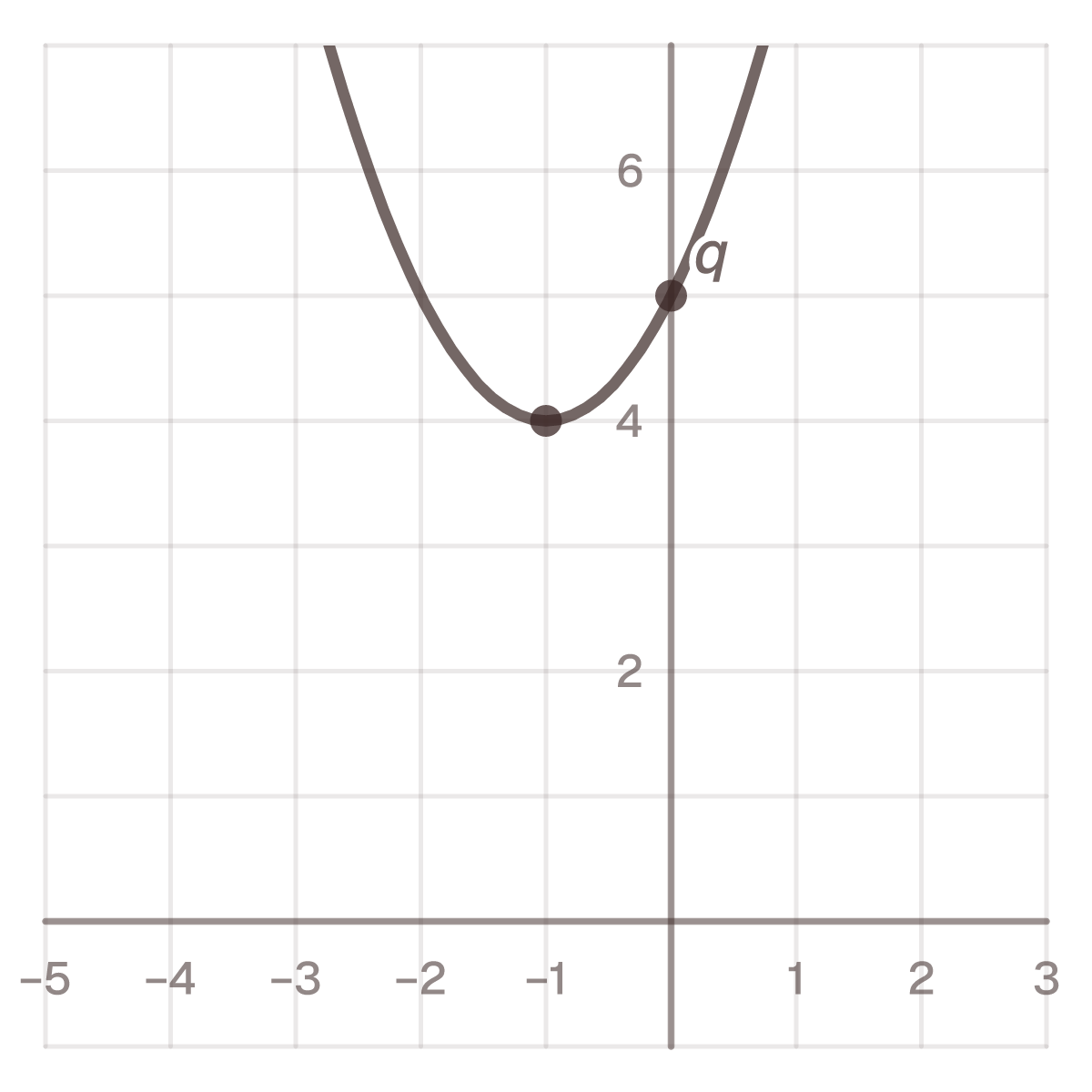
x² + 2x + 5 = 0: p = 2 and q = 5. (p/2)² − q = 1 − 5 = −4, so the roots are complex:
x = −1 ± i√(5 − 1) = −1 ± i√4 = −1 ± 2i
Check: (−1 + 2i)² + 2(−1 + 2i) + 5 = (−3 − 4i) + (−2 + 4i) + 5 = 0.
A second example: the general form
2x² − 4x + 10 = 0. Divide by 2 first: x² − 2x + 5 = 0, p = −2 and q = 5. (p/2)² − q = 1 − 5 = −4, so x = 1 ± i√4 = 1 ± 2i. The discriminant says the same before anything is worked out: b² − 4ac = 16 − 80 < 0.
Where next
- The real case: the pq formula and the quadratic formula.
- The sign that decides: the discriminant.
- The roots in polar form, and why they mirror each other: complex numbers in rectangular and polar form.
Common mistakes
- Taking the root of a negative twice: −1 ± i√(−4) is wrong. Either √(−4) = 2i or i√4 = 2i, not both.
- Answering “no solution”. There is no real solution; in the complex numbers there are two.
- Giving only one root. They come in pairs: a + bi and a − bi.
Common questions
Why do the roots come in pairs?
Because the ± stands in front of the i. If a + bi is a root of an equation with real coefficients, so is
a − bi, and the two are each other’s conjugate.
Can the equation be factorised?
Yes, with complex factors: x² + 2x + 5 = (x + 1 − 2i)(x + 1 + 2i). Multiply out and the i disappears.