What the theorem says
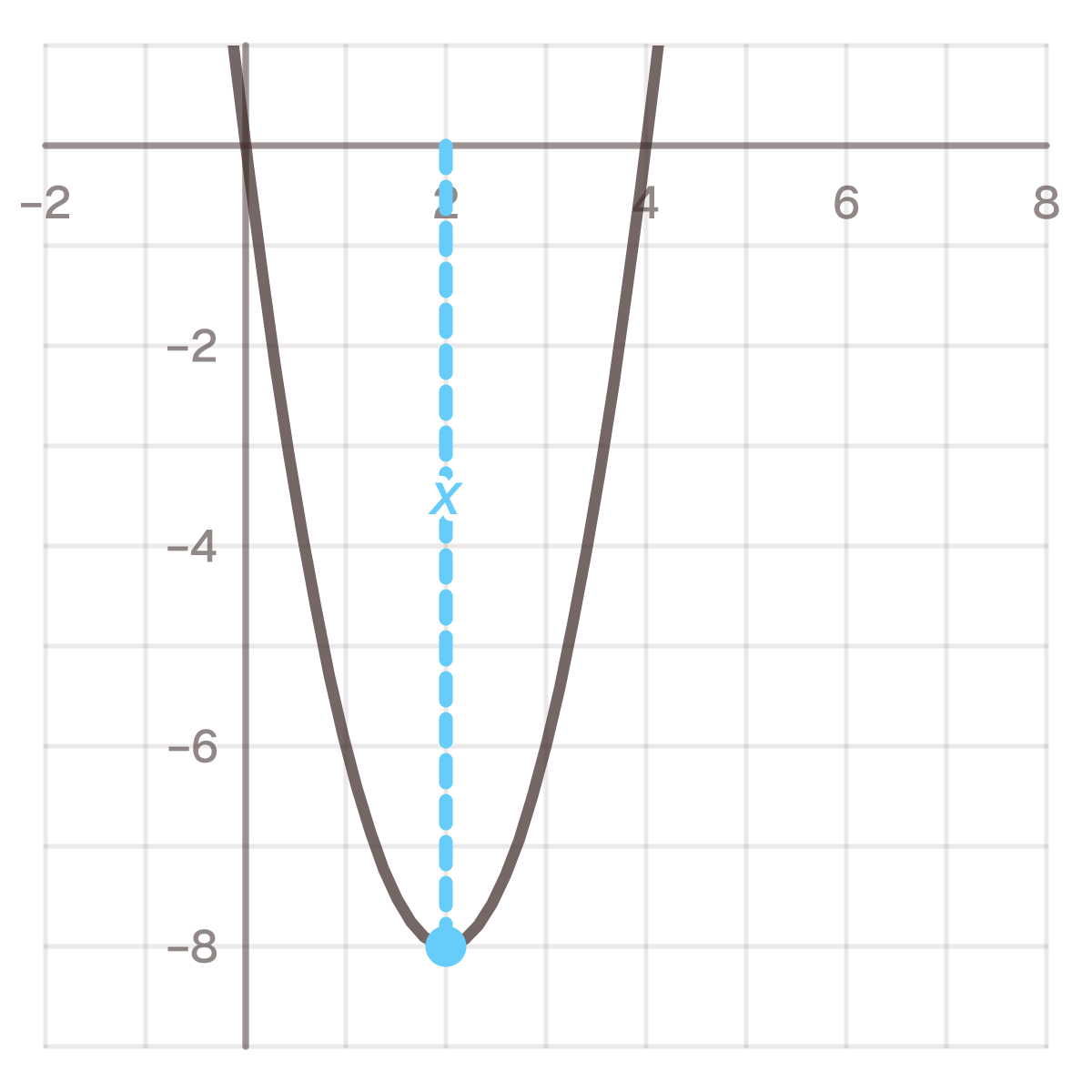
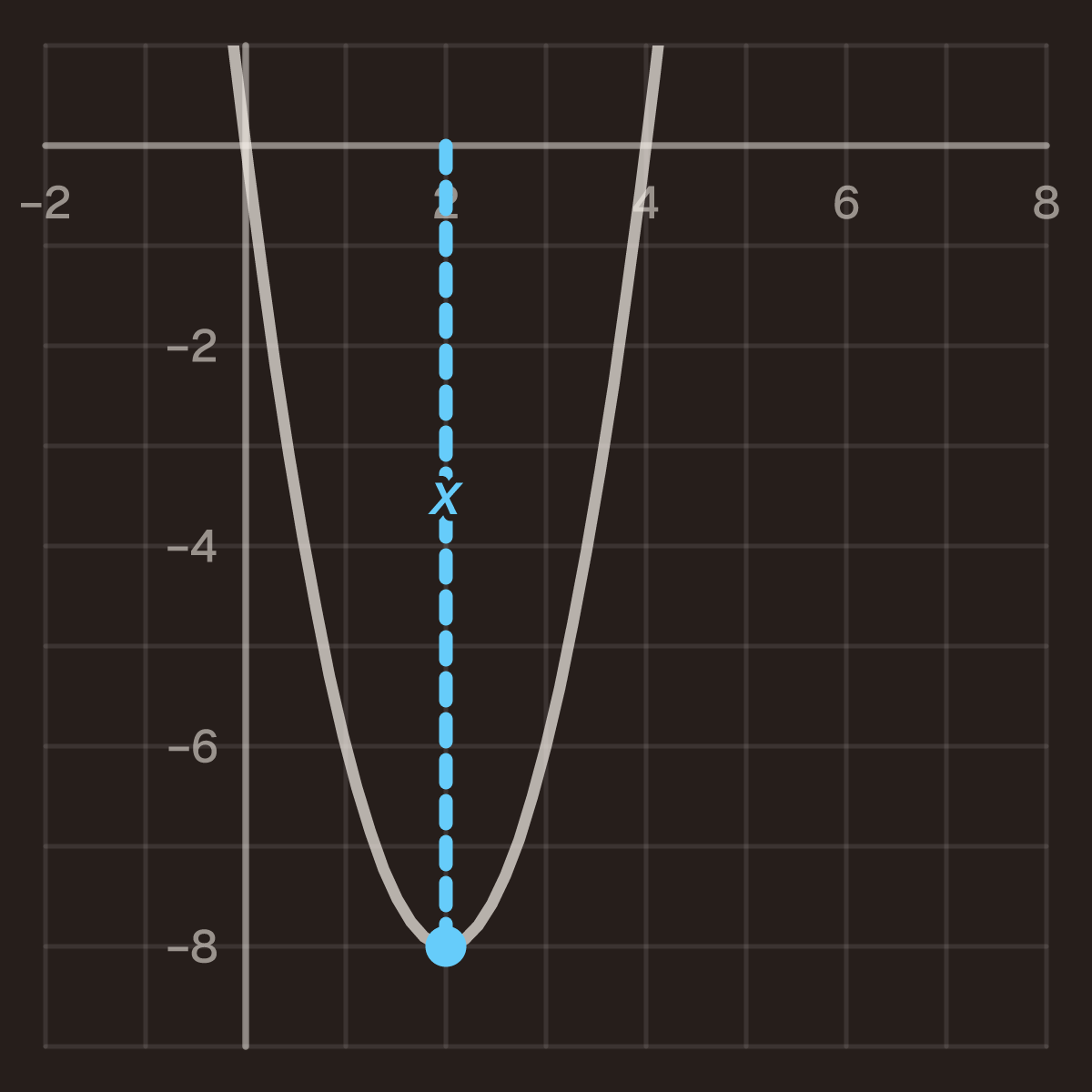
For the parabola y = ax² + bx + c with a ≠ 0, the graph of a quadratic function. The line x = −b/(2a) cuts the parabola into two mirror
images, and it is also where it turns — the x-coordinate of the vertex.
To get the height of the vertex, put that value back into the equation. The axis gives you the x part;
one substitution gives you the y part.
Why −b/(2a)
It is the quadratic formula with the root
struck out.
The formula gives x = (−b ± √D) / (2a). The two roots sit the same distance either side of −b/(2a) — the
root is the distance and the plus and minus are the directions. The midpoint of two points equally far
from the same number is that number.
It also means the axis exists even when the roots do not. If the discriminant is negative the parabola
has no zeros, but it still turns, and it turns there.
The roots sit symmetrically
If you already have the roots you need no formula: the axis is their average.
x = (x₁ + x₂) / 2
That this holds follows from Vieta’s formulas,
which say the sum of the roots is −b/a. Half of that sum is −b/(2a).
Worked examples
Example 1. Where is the axis of symmetry of y = 2x² − 8x + 5?
x = −(−8) / (2 · 2) = 8 / 4 = 2
The height of the vertex: y = 2 · 4 − 16 + 5 = −3. The vertex is (2, −3).
Example 2. A parabola has axis x = 3 and a = 1. What is b?
b = −2 · 1 · 3 = −6. The equation is y = x² − 6x + c for any c at all — c moves the parabola up and
down without touching the axis.
Example 3. What is the smallest value of y = 3x² + 12x + 7?
x = −12 / 6 = −2, and y = 3 · 4 − 24 + 7 = −5. Since a is positive the parabola opens upwards, so −5
is the minimum.
Common mistakes
- Losing the minus sign. When a and b have the same sign the axis is to the left of the y-axis.
- Dividing by a instead of 2a. The 2 comes from completing the square and belongs to the formula.
- Answering with the y-value. The axis is an x-value. The vertex is a pair.
- Thinking c matters. c moves the whole parabola vertically and never changes where it turns.
- Looking for an axis on a straight line. If a = 0 there is none.
Common questions
How is this different from vertex form?
Mathematically it is not. The h in
vertex form is −b/(2a). The
difference is where the number sits: here you work it out, there you read it off.
Is there an axis when there are no real roots?
Yes. The parabola turns whether or not it reaches the x-axis, and the formula never touches the
discriminant.
What does an axis at zero mean?
That b = 0. The parabola y = ax² + c is symmetric about the y-axis, which is what a missing x
term amounts to.