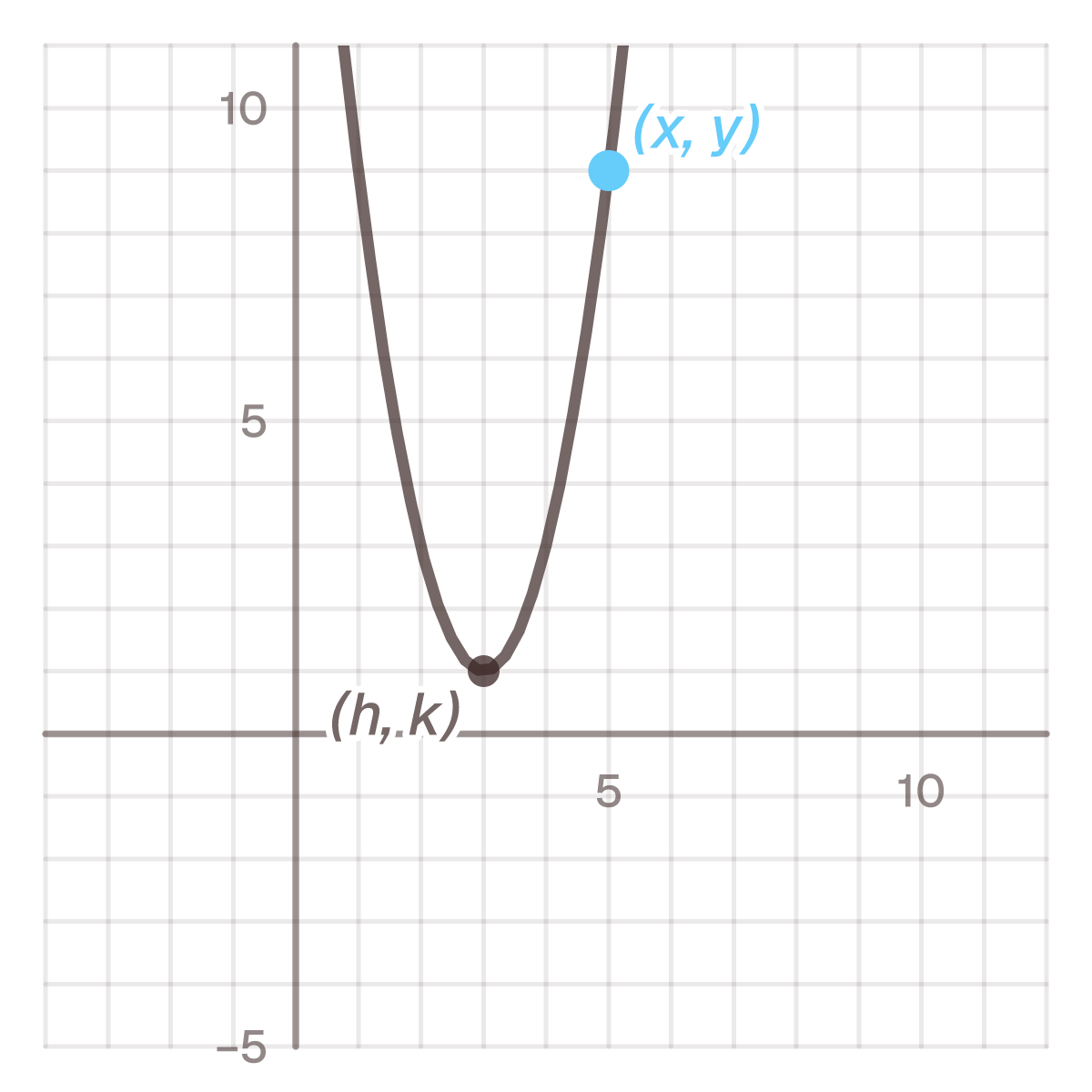
Written like this, a quadratic function shows its vertex directly: it is at (h, k). No working is needed — the numbers are right there, in the bracket and at
the end of the line.
Watch the minus sign in the bracket. y = a(x − 3)² + 1 has its vertex at (3, 1), and y = a(x + 3)² + 1
has its vertex at (−3, 1). The form is written with a minus, so a plus in your equation means a negative
h.
What a, h and k do
|
Means |
Changes |
| a |
Opening and width |
a > 0 opens upwards, a < 0 downwards; a large |a| gives a narrow parabola |
| h |
x-coordinate of the vertex |
Moves the parabola sideways |
| k |
y-coordinate of the vertex |
Moves the parabola up or down |
a is the same a as in y = ax² + bx + c. Only h and k are new, and they are a translation of b and c into
something you can see.
When a is positive, k is the parabola’s smallest value. When a is negative, it is its largest.
From vertex form to standard form, multiply out: y = 2(x − 3)² + 1 becomes
y = 2(x² − 6x + 9) + 1 = 2x² − 12x + 19.
From standard form to vertex form, complete the square, or take the shortcut: h is the
axis of symmetry −b/(2a), and k is the y-value
there. For y = 2x² − 12x + 19 that gives h = 12/4 = 3 and k = 2 · 9 − 36 + 19 = 1. Back to
y = 2(x − 3)² + 1.
Worked examples
Example 1. Where is the point on y = 2(x − 3)² + 1 when x = 5?
y = 2(5 − 3)² + 1 = 2 · 4 + 1 = 9
Example 2. A parabola has its vertex at (3, 1) and passes through (5, 9). What is a?
9 = a(5 − 3)² + 1 gives 8 = 4a, so a = 2.
Example 3. Where else does the height y = 9 occur on that parabola?
Points are mirrored in the axis x = 3. (5, 9) is two steps to the right, so (1, 9) is two steps to the
left. When a > 0, every height above the vertex is reached twice.
Common mistakes
- Reading h with the wrong sign. (x + 4)² has h = −4, not 4.
- Thinking k moves when the parabola narrows. a changes the width, not where the vertex sits.
- Forgetting to multiply a in when expanding. a(x − h)² means the whole square is multiplied.
- Looking for the vertex in standard form. c is the y-intercept, not the height of the vertex.
- Stopping at one point. If the question asks for x given y there are normally two answers, one on
each side of the axis.
Common questions
What is the quickest way to get vertex form?
Work out h = −b/(2a), put it back into the equation to get k, and write y = a(x − h)² + k. It is faster
than completing the square, though it
rests on the same thing.
What happens when a = 0?
Then it is not a parabola but the horizontal line y = k, which has no vertex. The card says so if you
try.
Can the roots be read off as easily?
Almost. Set y = 0 and you get (x − h)² = −k/a, then take the square root. There are two roots when −k/a is
positive, which is when the vertex lies on the opposite side of the x-axis from the way the parabola
opens.