It is the expression under the root in the
quadratic formula, lifted out and given a
name of its own. The name means “the one that distinguishes”, and what it distinguishes between is three
cases.
What the sign means
For real a, b and c with a ≠ 0:
| Discriminant |
Roots |
The parabola |
| D > 0 |
Two distinct real roots |
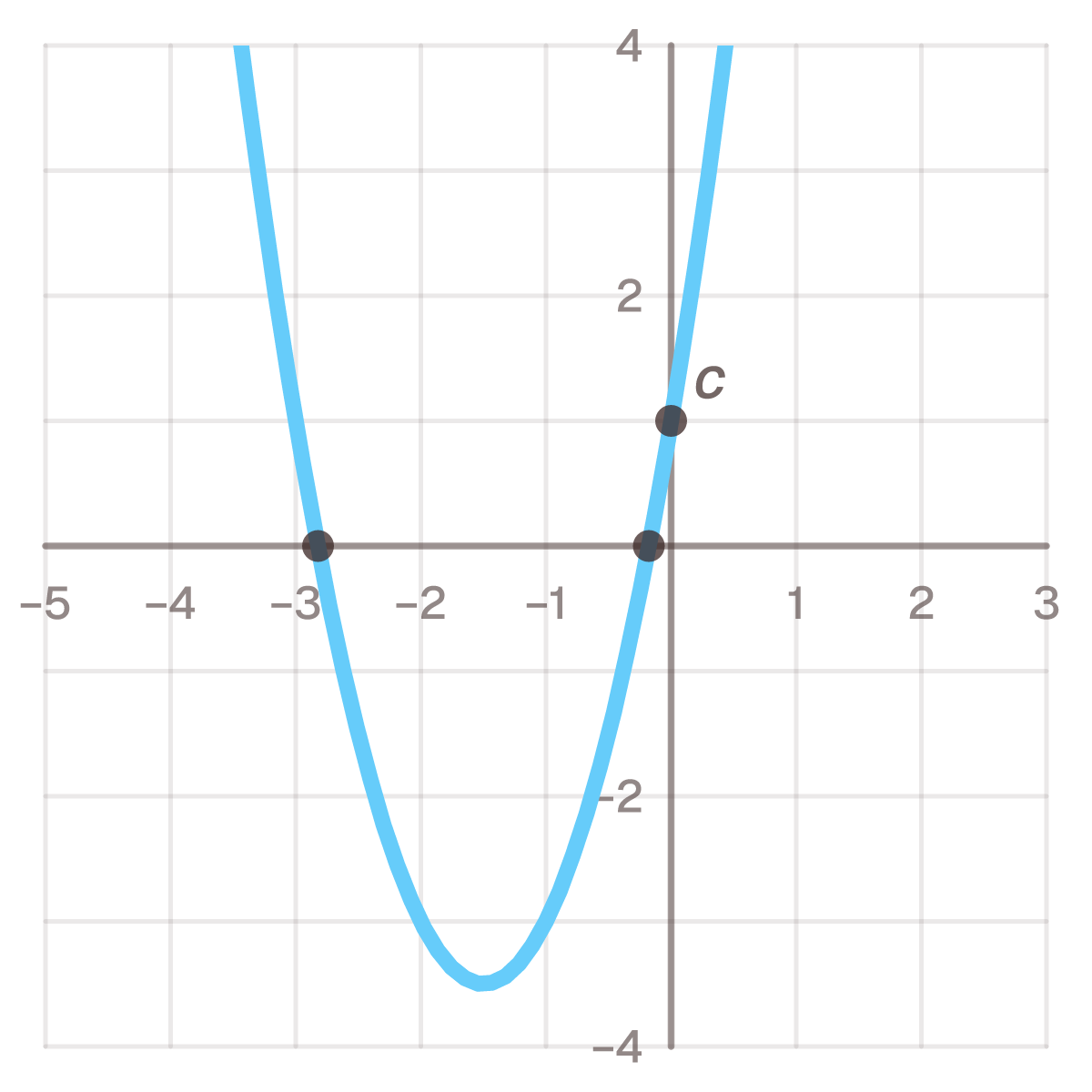
Crosses the x-axis twice |
| D = 0 |
One double root |
Touches the x-axis at its vertex |
| D < 0 |
No real root |
Lies entirely above or entirely below the x-axis |
The third case is not a mistake. A parabola need not reach the x-axis, and an equation with no real
solution is a perfectly good answer to the question.
One reason to work out the discriminant on its own is that the question sometimes is the number:
“for which c does this equation have two solutions?” is answered by an inequality, not by two roots.
When the equation is written x² + px + q = 0, the discriminant is (p/2)² − q. It is the same number —
put a = 1, b = p and c = q into b² − 4ac, divide by 4, and you get (p/2)² − q. The sign is unchanged, and
the sign is all that matters here.
Worked examples
Example 1. How many roots does 2x² + 6x + 1 = 0 have?
D = 6² − 4 · 2 · 1 = 36 − 8 = 28
Positive, so two distinct roots.
Example 2. How many roots does x² − 6x + 9 = 0 have?
D = 36 − 36 = 0
A double root. The equation is (x − 3)² = 0 and the root is x = 3, counted twice.
Example 3. For which c does x² + 4x + c = 0 have two solutions?
D = 16 − 4c > 0 gives c < 4. At c = 4 there is a double root, and above 4 no real root at all.
Common mistakes
- Forgetting the sign of c. When c is negative and a positive, −4ac is positive and the discriminant grows.
- Writing b² as −b². The square of a negative number is positive.
- Treating D as a root. The discriminant is a step on the way, not an answer to the equation.
- Mixing up the forms. b² − 4ac assumes ax² + bx + c = 0. If you have already divided a away, the
expression is (p/2)² − q.
- Reading D = 0 as “no solution”. Zero means one solution, not none.
Common questions
Why four times ac?
Because completing the square halves b and then squares it, which gives b²/4. Multiply the whole
expression by 4 to be rid of the fraction, and the price is a factor of 4 in front of ac.
What happens when a = 0?
Then it is not a quadratic any more but a linear equation, and the discriminant says nothing. The
formula returns b², but bx + c = 0 has one root as long as b ≠ 0.
Is the discriminant good for anything else?
Yes — it also tells you whether a quadratic with integer coefficients factorises over the integers. When
D is a perfect square the roots are rational, the quadratic splits into factors with integer
coefficients, and the factor theorem can find
the roots.