- x = (−b ± √(b² − 4ac)) / (2a)
Holds when a ≠ 0.
a is the number in front of x², b the number in front of x, and c the term on its own. The equation has
to be gathered on the left with a zero on the right, but unlike the
pq formula you do not divide a away first.
The whole numerator is divided by 2a, not just the root. That is a common copying mistake with
this formula, and a fraction bar drawn under both terms is the fix.
Divide ax² + bx + c = 0 by a and you get x² + (b/a)x + c/a = 0, so p = b/a and q = c/a. Put that into the
pq formula, multiply top and bottom by 2a, and this formula falls out. The two are one thing written for
two starting points:
|
pq formula |
Quadratic formula |
| The equation |
x² + px + q = 0 |
ax² + bx + c = 0 |
| Under the root |
(p/2)² − q |
b² − 4ac |
| Requires |
dividing by a first |
a ≠ 0 |
Swedish textbooks teach both and mostly use pq. English-language textbooks teach this one.
Worked examples
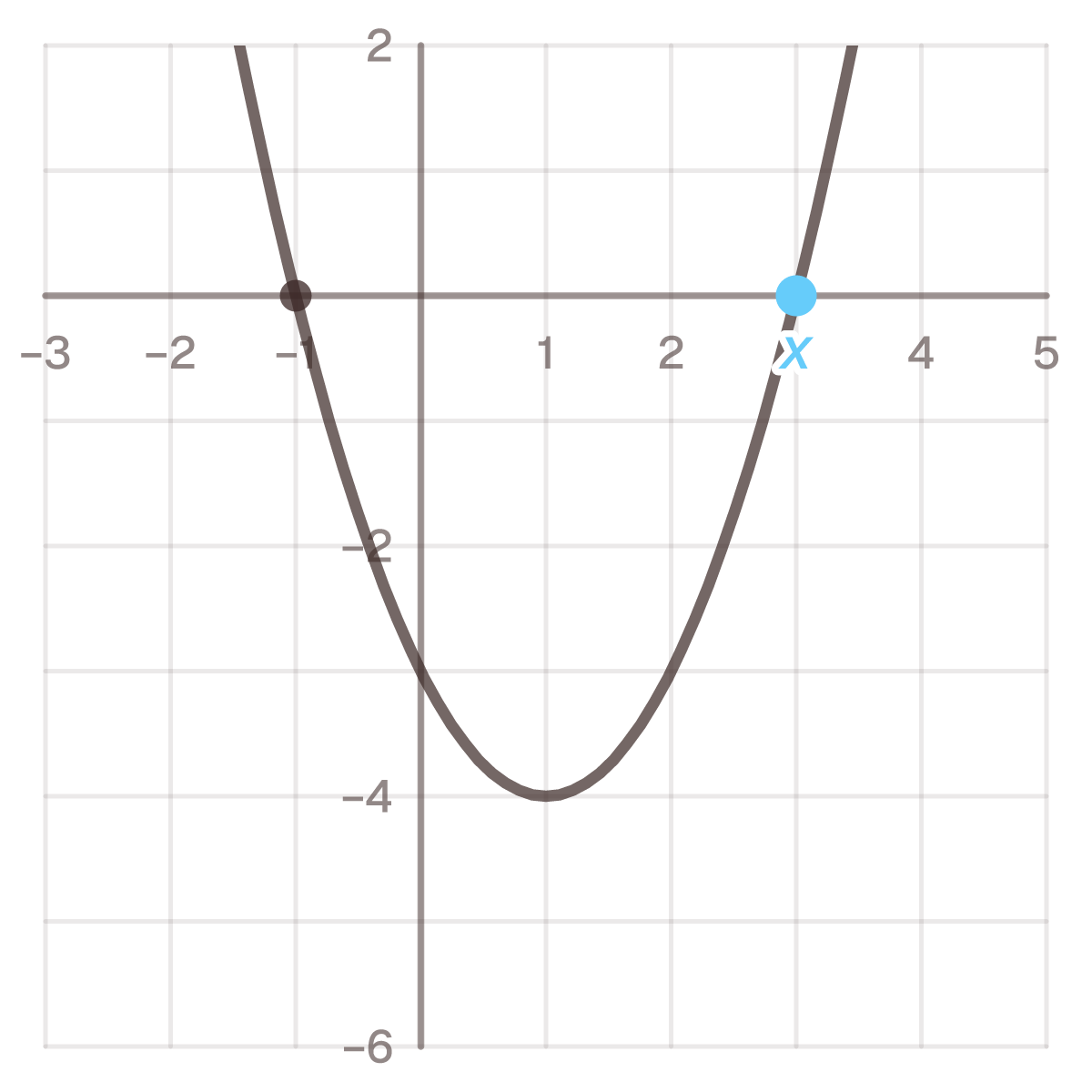
Example 1. Solve x² − 2x − 3 = 0.
a = 1, b = −2, c = −3.
x = (2 ± √((−2)² − 4 · 1 · (−3))) / 2 = (2 ± √(4 + 12)) / 2 = (2 ± 4) / 2
The roots are x = 3 and x = −1.
Example 2. Solve 2x² + 2x − 12 = 0.
a = 2, b = 2, c = −12.
x = (−2 ± √(4 + 96)) / 4 = (−2 ± 10) / 4
The roots are x = 2 and x = −3. Dividing by 2 first would have given the same answer — it is the
same equation.
Watch the signs. With c negative and a positive, −4ac turns into a plus, which makes the number under
the root larger rather than smaller.
Common mistakes
- Dropping the bracket around −b. (−b ± √…) / 2a means minus b is divided by 2a as well.
- Dividing only the root by 2a. The denominator belongs to the whole numerator.
- Squaring a negative b wrongly. (−5)² is 25, not −25.
- Writing a = 0. Then there is no x² term, the equation is linear, and the formula divides by zero.
- Forgetting that −4ac can be positive. When a and c have opposite signs the expression under the
root grows.
Common questions
Which of the two formulas should I use?
Whichever means less arithmetic. If the number in front of x² is already 1, or divides everything
cleanly, the pq formula is shorter. If it is 3 and nothing else divides by 3, this one saves you the
fractions.
What does b² − 4ac mean?
It is the discriminant, and it decides how
many roots there are: positive gives two, zero gives one, negative gives no real root.
Can I get a, b or c back from a known root?
One root gives you one of them if you know the other two — that is what the card does when you pick a,
b or c as the unknown. A single root never fixes the whole equation, though: infinitely many parabolas
pass through the same zero.