What the theorem says
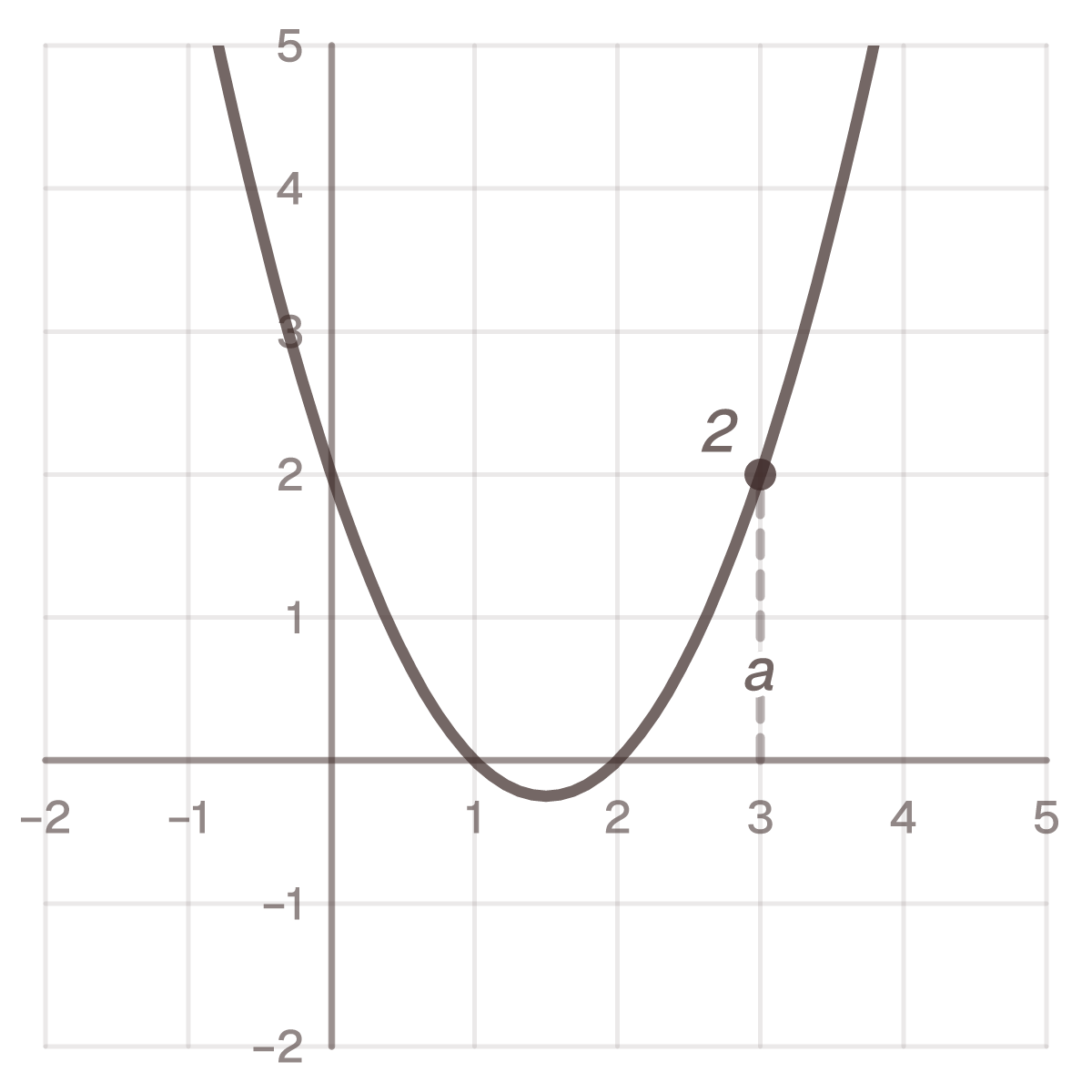
When a polynomial p(x) is divided by (x − a), the remainder is p(a).
It is also called the polynomial remainder theorem, or the little Bézout theorem.
So: put a into the polynomial, and the number you get is the remainder. No polynomial division, no long division at all.
The division written as an equality, with q(x) for the quotient and r for the remainder:
p(x) = (x − a) · q(x) + r
Put x = a into that line and the theorem falls straight out: the first term is zero, because a − a = 0, and what is left is p(a) = r. That is the entire proof.
What a remainder is here
In whole-number division the remainder is smaller than the divisor: 17 divided by 5 is 3 remainder 2, and the remainder has to be under 5. Polynomials behave the same way, but with degree in place of size.
Dividing by (x − a), which has degree one, the remainder must have degree zero — that is, be a number. That is why the remainder here is always a single number and never an expression in x.
Worked examples
Example 1. What is the remainder when x³ − 2x² + 5x − 1 is divided by (x − 2)?
Put in x = 2: 8 − 8 + 10 − 1 = 9.
Check by long division: the quotient is x² + 5 and the remainder 9. The same answer, without the working.
Example 2. What is the remainder on division by (x + 3)?
(x + 3) is (x − (−3)), so a = −3. For p(x) = x³ + 4x² − x + 2 that gives −27 + 36 + 3 + 2 = 14.
Example 3. For which k is (x − 1) a factor of x³ + kx − 4?
The remainder has to be zero: 1 + k − 4 = 0 gives k = 3. That is the factor theorem used backwards.
Common mistakes
- The wrong sign for a. Dividing by (x + 3) means substituting −3, not 3.
- Taking the remainder for a root. The remainder is what is left over; a root is where the polynomial is zero.
- Slipping on powers of negative numbers. (−3)³ is −27, while (−3)² is 9.
- Using the theorem with a quadratic divisor. Dividing by x² − 1, the remainder can be an expression in x, and the theorem in this form no longer applies.
Common questions
Can I work out the remainder on this page?
Not with a card: p stands for any polynomial, so there are no fields to fill in. Type your polynomial into
the polynomial division calculator instead. It sets out the division
step by step and shows the quotient and remainder, so you can check the remainder against p(a).
How is it different from the factor theorem?
The factor theorem is this theorem with the remainder set to zero. The remainder theorem is the more
general statement.
Is it faster than long division?
Much faster, if the remainder is all you want. If you need the quotient as well, the division has to be
done anyway — or done by synthetic division, which is the same arithmetic in shorthand.