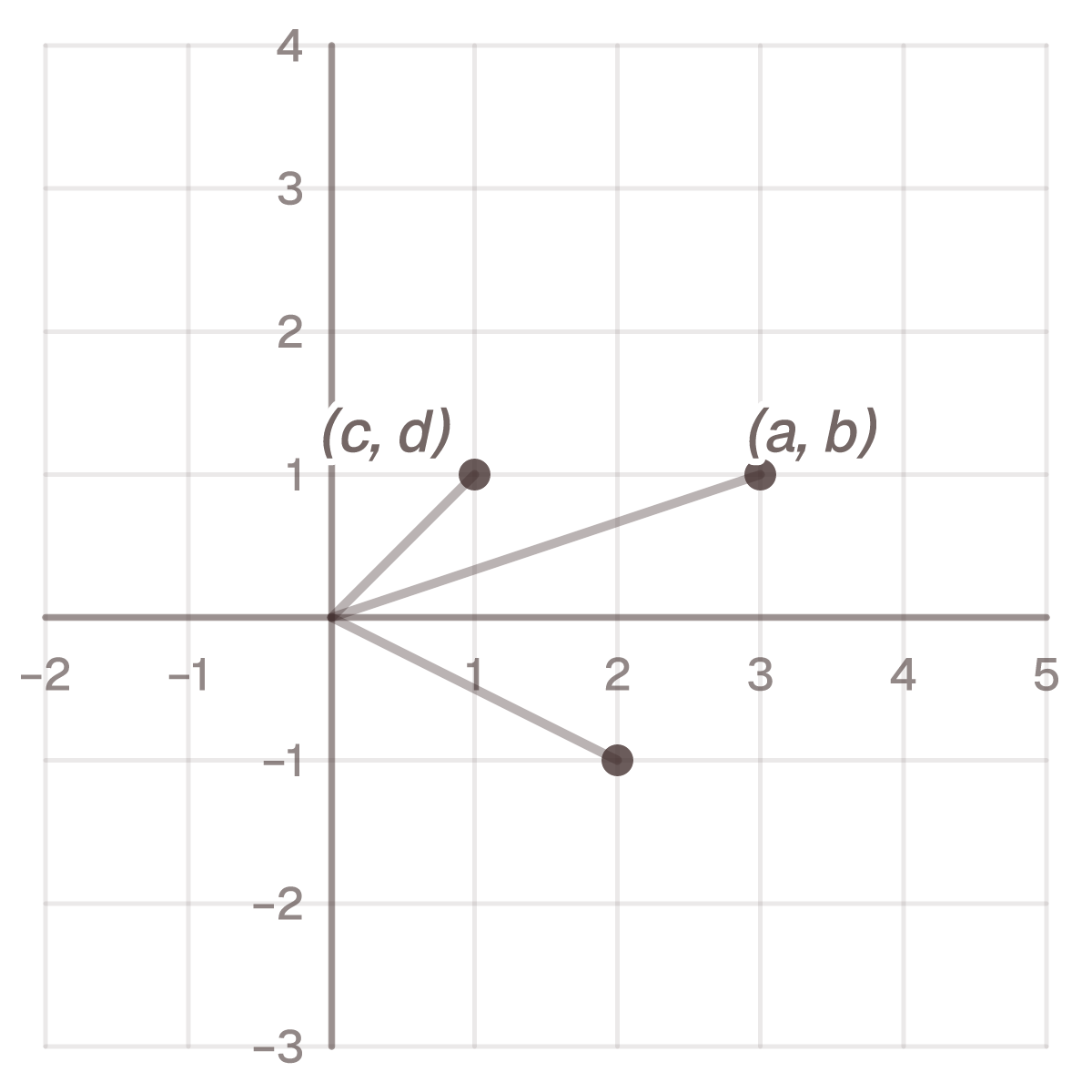
The formula
- (a + bi)/(c + di) = ((ac + bd) + (bc − ad)i) / (c² + d²)
Holds when c + di ≠ 0, that is, when c and d are not both 0.
It comes from multiplying by (c − di)/(c − di), which is 1. The new bottom is (c + di)(c − di) = c² + d², a real number (see a complex number times its conjugate). The new top is the product (a + bi)(c − di) = (ac + bd) + (bc − ad)i.
Example
(3 + 4i)/(2 − 5i). The conjugate of the bottom is 2 + 5i.
- Bottom: (2 − 5i)(2 + 5i) = 4 + 25 = 29
- Top: (3 + 4i)(2 + 5i) = 6 + 15i + 8i + 20i² = −14 + 23i
So the quotient is (−14 + 23i)/29, which is about −0.483 + 0.793i.
Check by multiplying back: (−14 + 23i)(2 − 5i)/29 = (−28 + 70i + 46i − 115i²)/29 = (87 + 116i)/29 = 3 + 4i. ✓
Practical advice
Do the two steps separately rather than inserting numbers into the long formula: write the conjugate, find the real denominator c² + d², multiply out the top. The three small calculations are easier to check than one large one.
Common mistakes
- Using the divisor itself instead of its conjugate. (c + di)² is not real.
- Multiplying only the top. The bottom must be multiplied by the same number.
- A sign error in the imaginary part. It is bc − ad, not ad − bc.
Where next
- Multiplying complex numbers is the step used on top.
- In polar form division is a quotient of moduli and a difference of arguments: polar form.