The formula
re^(iθ) = r(cos θ + i sin θ)
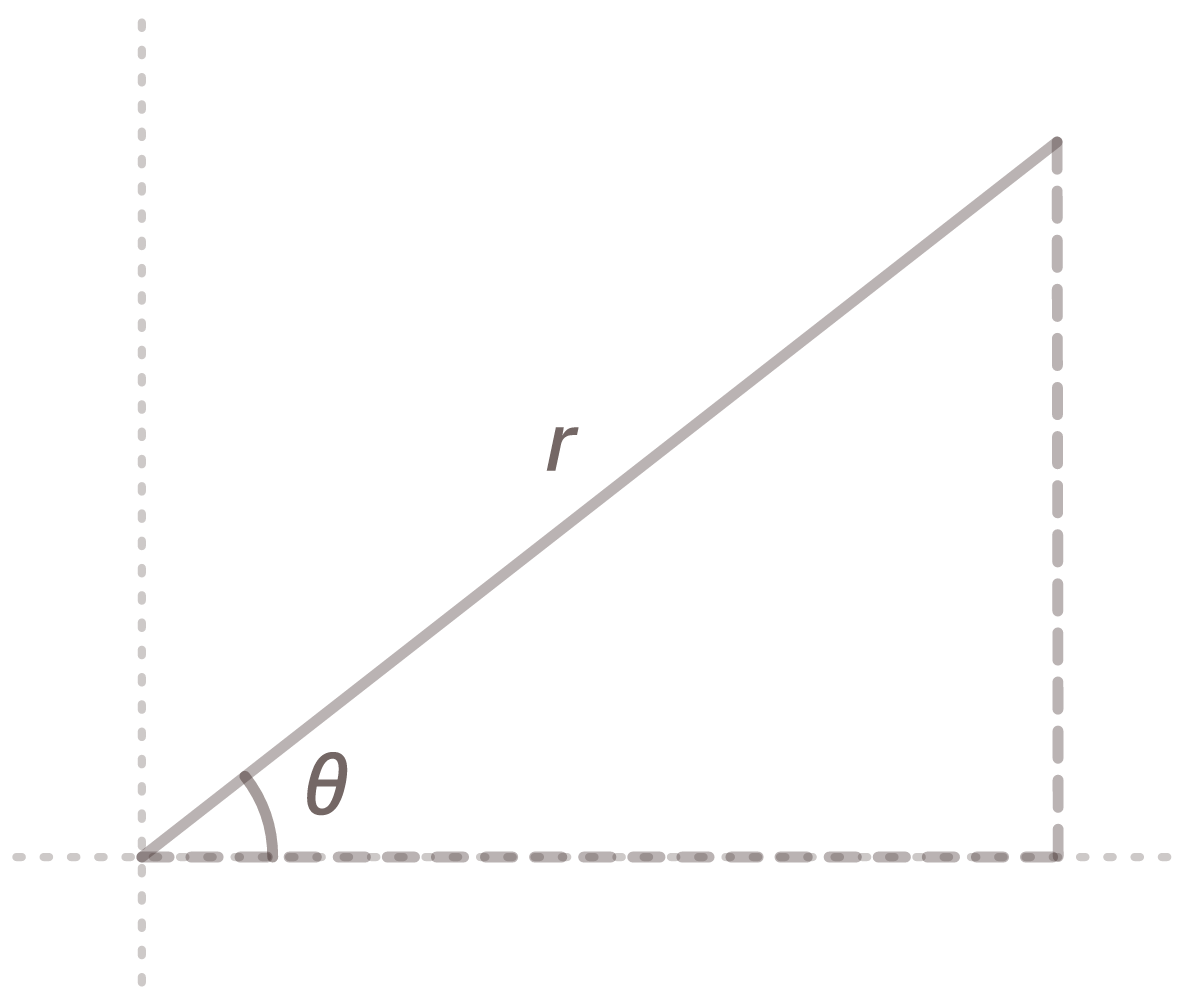
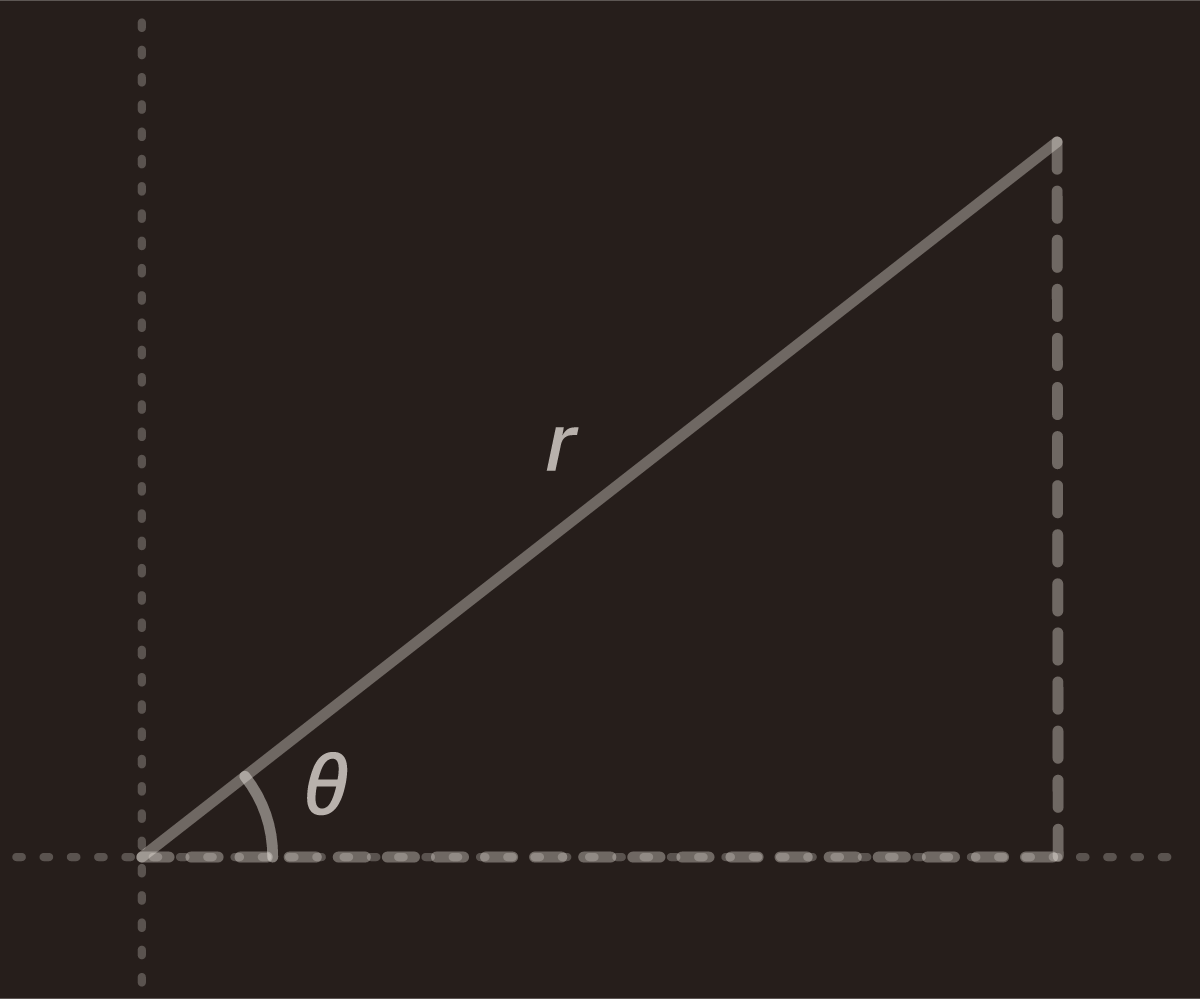
r is the modulus, the distance from the origin, and θ is the argument, the angle from the positive real axis measured in radians. The left side is the short way to write the right side, and with r = 1 it is Euler’s formula, e^(iθ) = cos θ + i sin θ.
Worked examples
From exponential to rectangular form. 2e^(iπ/3) = 2(cos π/3 + i sin π/3) = 2(1/2 + i·√3/2) = 1 + i√3.
Special angles. e^(iπ) = cos π + i sin π = −1, and 3e^(iπ/2) = 3(0 + i·1) = 3i.
From rectangular to exponential form. For 1 + i the modulus is √(1² + 1²) = √2 and the argument is π/4, since the point lies on the line a = b in the first quadrant. So 1 + i = √2·e^(iπ/4).
Why the angle is in radians
The notation puts θ in an exponent, where it is a plain number. A degree value would need a conversion first: 90° is π/2, and e^(i·90) is not e^(iπ/2). The polar form page shows how to find r and θ.
What it is used for
Products and quotients become the power laws that are already known, see product in exponential form and quotient in exponential form, and de Moivre’s formula is the power law for e^(iθ).
Common mistakes
- Degrees in the exponent. The argument has to be in radians.
- Dropping the i. e^θ is a real number, and e^(iθ) is a point on a circle of radius 1.
- Reading the rule as ordinary growth. For a real θ the number e^(iθ) has modulus 1, so it turns and does not grow.
Common questions
Is e^(iθ) a proven equality or a definition?
In a course at this level it is taken as the meaning of e^(iθ). That it fits the power laws and the power series
of e^x, sin x and cos x is what makes the choice natural, and it is shown at university level
(Maclaurin series of eˣ).