The rule
- (a + bi) + (c + di) = (a + c) + (b + d)i
The real part of the sum is a + c and the imaginary part is b + d. Nothing is multiplied, so i is carried along like the x in 3x + 5x: terms with i are collected with terms with i.
Examples
Two numbers. (3 + 4i) + (2 − 5i) = (3 + 2) + (4 − 5)i = 5 − i.
With a negative real part. (−1 + 6i) + (4 + 2i) = (−1 + 4) + (6 + 2)i = 3 + 8i.
A real number added to a complex one. 7 + (2 + 3i) = 9 + 3i. A real number is a complex number whose imaginary part is 0, so only the real part changes.
On the plane
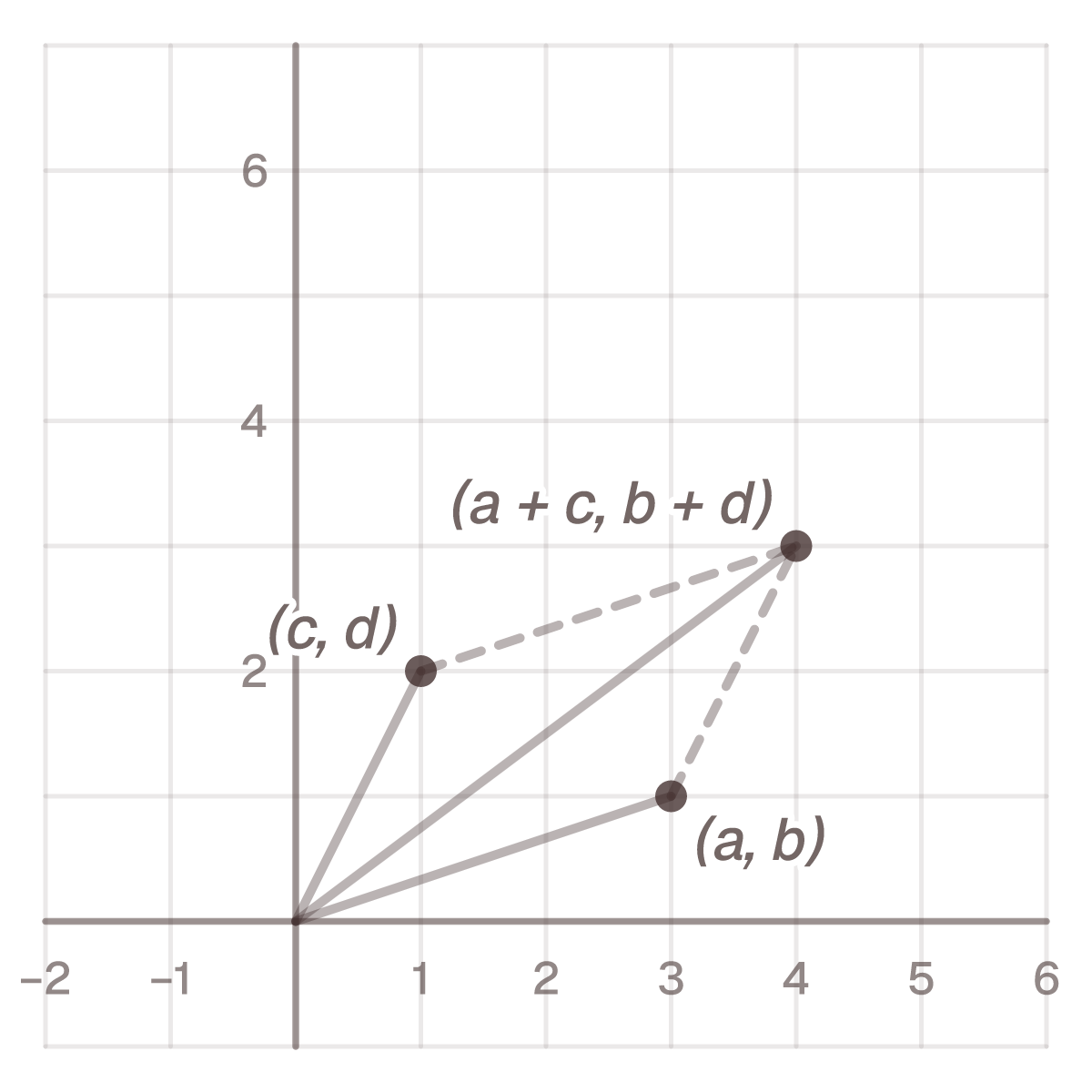
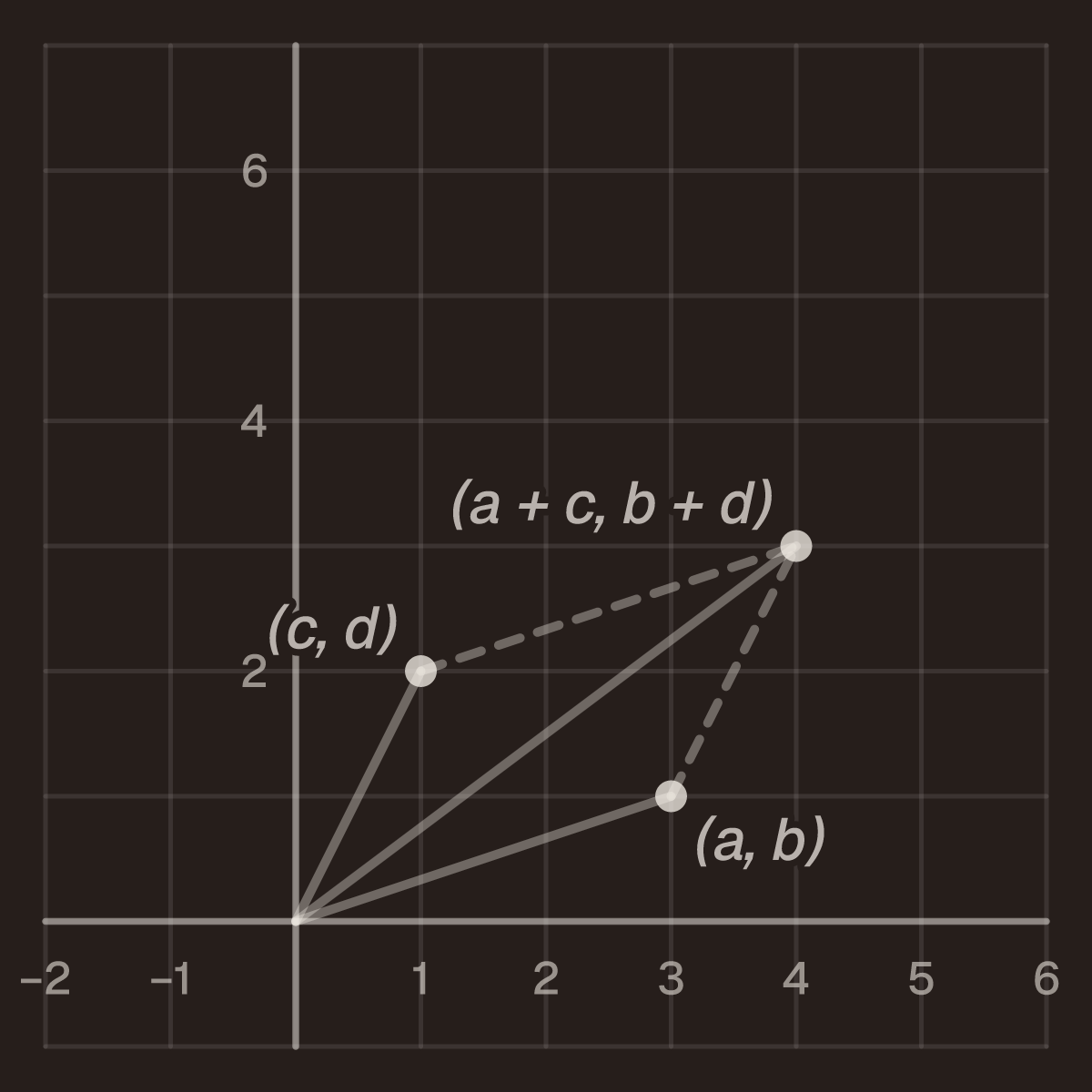
In the complex plane a + bi is the point a across and b up, and adding two numbers is adding the two arrows from the origin, tip to tail. It is the same rule as adding two vectors, and the parallelogram picture works the same way.
Common mistakes
- Adding a real part to an imaginary part. 3 + 4i cannot be simplified to 7i, and (3 + 4i) + (2 − 5i) is not 5 − 1. The result keeps its i.
- Losing a sign in the second number. Bracket it: the imaginary part of 2 − 5i is −5, so 4 + (−5) = −1.
Where next
- The opposite operation: subtracting complex numbers.
- Multiplying is more than partwise: multiplying complex numbers.
- The numbers themselves: rectangular and polar form.