What the formula says
- P(X = k) = C(K, k) · C(N − K, n − k) / C(N, n)
N is the size of the whole population, K how many of those are successes, n how many you draw and k
how many successes you want among them. C(n, k) is the number of
combinations, n! / (k! · (n − k)!).
Why it holds
Every set of n drawn from N is equally likely, and there are C(N, n) of them. The favourable ones pick k of the K successes and the remaining n − k from the N − K others: C(K, k) · C(N − K, n − k) ways. The probability is favourable over all.
Worked examples
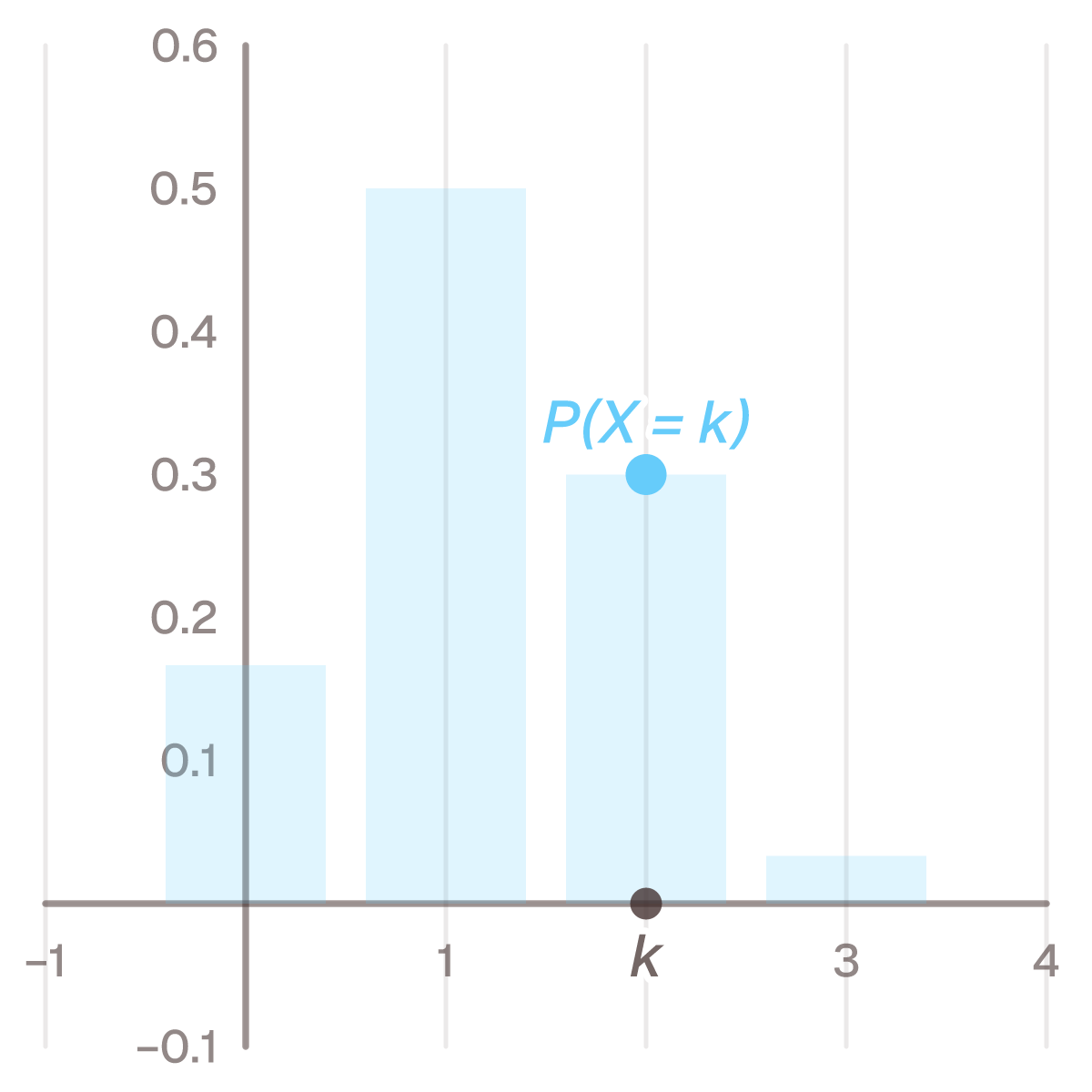
A small batch. Ten parts, four of them faulty. Draw three. The chance of exactly two faulty ones:
- P = C(4, 2) · C(6, 1) / C(10, 3) = 6 · 6 / 120 = 0.3
Two aces. Five cards from a deck of 52, which holds four aces:
- P = C(4, 2) · C(48, 3) / C(52, 5) = 6 · 17,296 / 2,598,960 ≈ 0.040
A lottery. Seven numbers are drawn from 35 and you have picked seven. The chance of exactly four right:
- P = C(7, 4) · C(28, 3) / C(35, 7) = 35 · 3,276 / 6,724,520 ≈ 0.017
All seven right is 1 / 6,724,520.
Hypergeometric or binomial?
The binomial distribution assumes each draw has the same probability, which is true when you put back what you drew. Without replacement the probability shifts with every draw. When the population is large and the sample small, the shift is tiny and the binomial is a good approximation. The mean is the same in both, n · K / N; the hypergeometric’s variance is smaller when more than one item is drawn.
Frequently asked questions
Why does the order of the draws not matter?
Combinations count sets, not sequences. Counting ordered draws would multiply both the favourable and the
total by the same n!, which cancels.