What the formula says
P(X = k) = n! / (k!(n − k)!) · pᵏ · (1 − p)ⁿ⁻ᵏ
The probability of exactly k successes in n tries, when each try succeeds with probability p and
the tries are independent of each other. The formula is a definition of the distribution.
It has three parts. pᵏ · (1 − p)ⁿ⁻ᵏ is the probability of one particular order, such as heads, heads, tails, tails. But the k successes can sit anywhere among the n, and there are n! / (k!(n − k)!) combinations of places for them. The formula writes that number as the binomial coefficient (n k), read “n choose k”, which is the nCr button on a calculator.
Worked examples
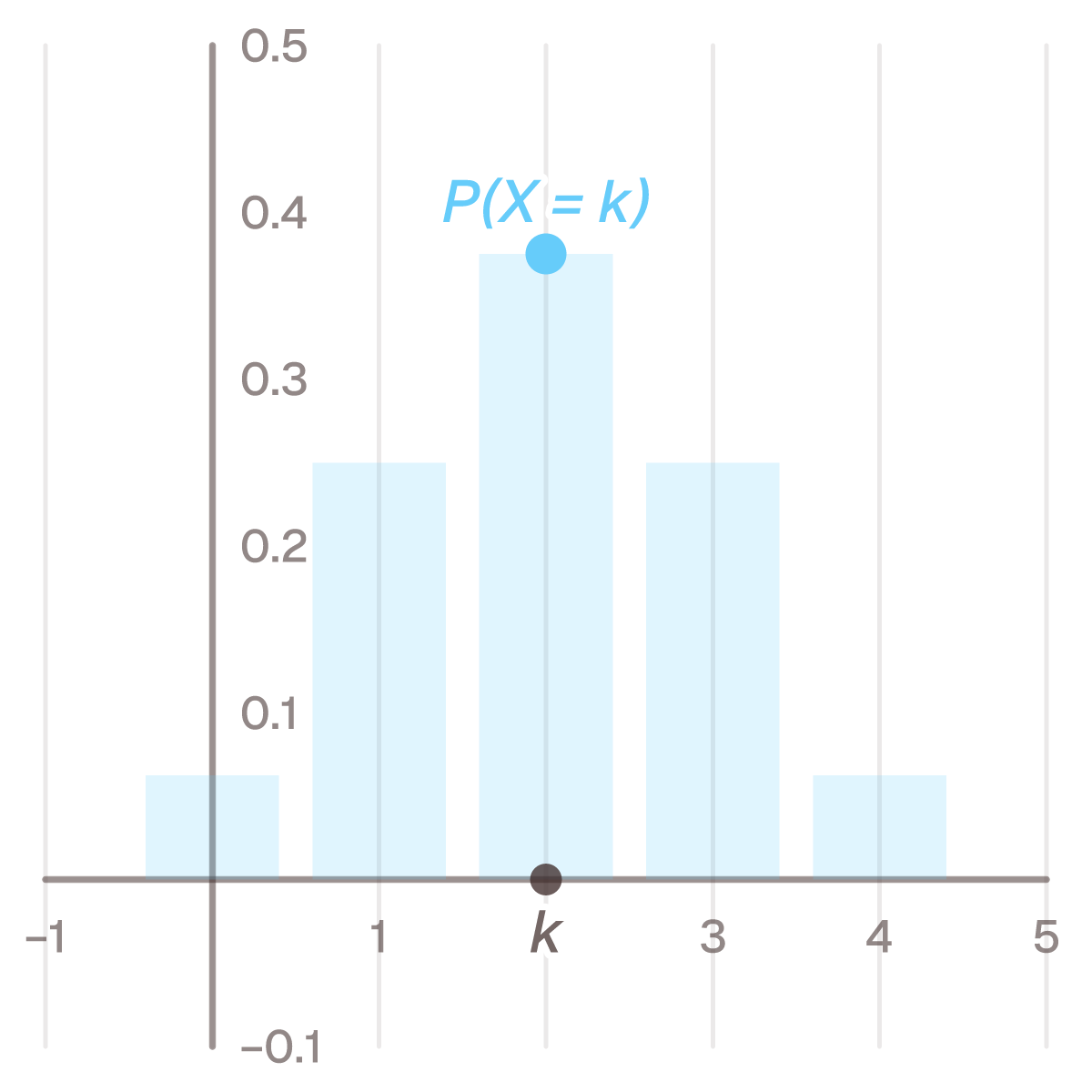
Two heads in four tosses. n = 4, k = 2, p = 0.5. The combinations are 4! / (2! · 2!) = 6, and each order has probability 0.5² · 0.5² = 0.0625. The answer is 6 · 0.0625 = 0.375.
Three sixes on five dice. n = 5, k = 3, p = 1/6. C(5, 3) = 10, so 10 · (1/6)³ · (5/6)² = 10 · 1/216 · 25/36 = 250/7776 ≈ 0.032, about 3%.
Common mistakes
- Leaving out the combinations factor. Without it the answer is 0.0625, the probability of one particular order, not of two heads in any order.
- Answering “at least k” with the formula for “exactly k”. At least two heads in four tosses is the sum for k = 2, 3 and 4: 6/16 + 4/16 + 1/16 = 11/16 ≈ 0.69.
- Using it when the tries are not independent. Drawing without replacement changes the probability with every draw.
Common questions
What is the difference between exactly and at least?
Exactly k is one term of the formula. At least k is the sum of the terms for k, k + 1 and so on up to n.
It is often quicker to work out the opposite: at least one is 1 minus the probability of none.
What is the expected value?
n · p. Four coin tosses have an expected value of 4 · 0.5 = 2 heads. The variance is n · p · (1 − p),
which is 1 for the coin tosses. See expected value for what the number means.
When does the binomial distribution not apply?
When the tries affect each other, or when p changes from try to try. Drawing cards from a deck without
putting them back is a common example. The number of tries must also be fixed in advance: “roll until
you get a six” is a different distribution.