What the rule says
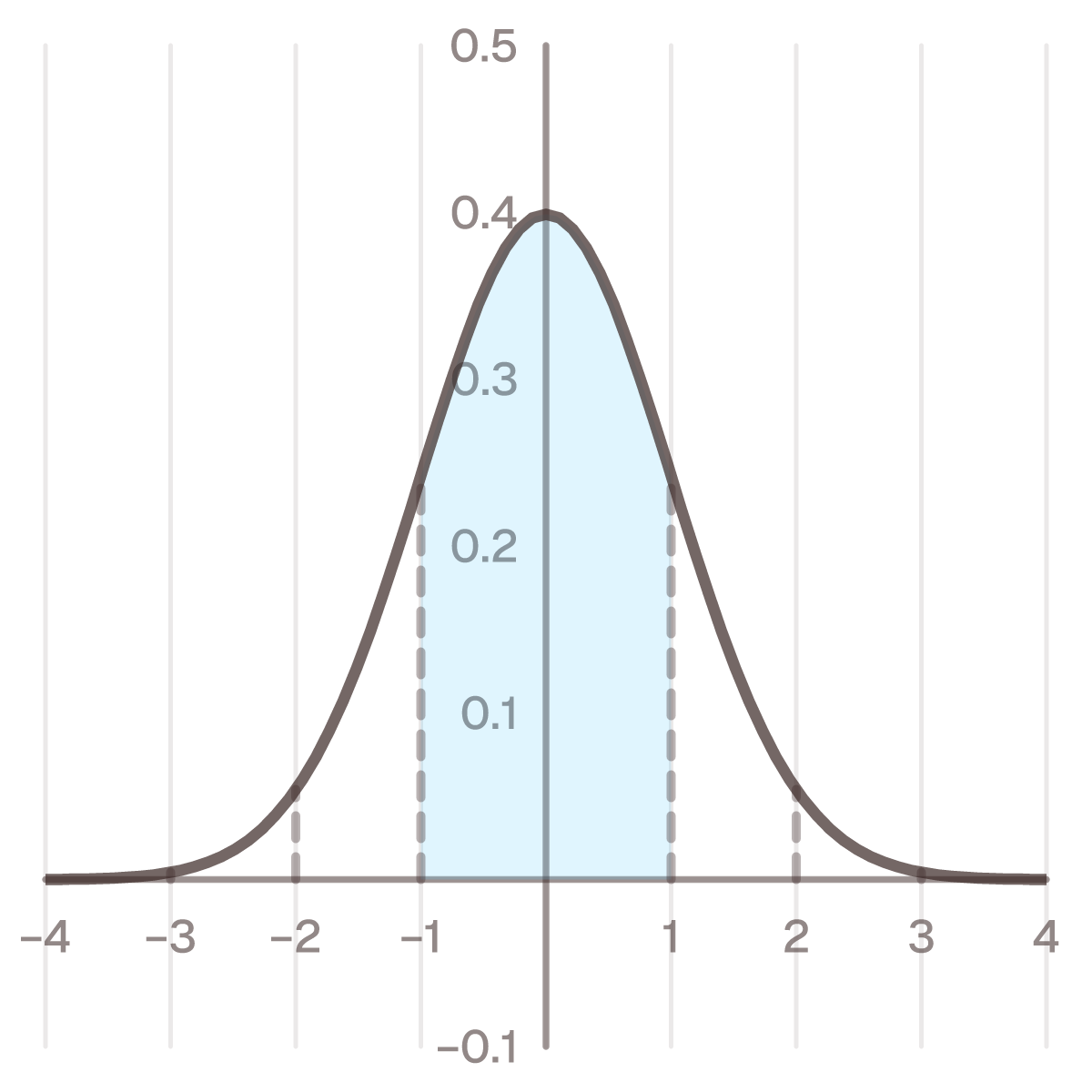
For data that follow a normal distribution with mean μ and standard deviation σ:
| Interval | Share inside | Share in each tail |
|---|---|---|
| μ ± σ | about 68% | about 16% |
| μ ± 2σ | about 95% | about 2.5% |
| μ ± 3σ | about 99.7% | about 0.15% |
The shares are rounded. To two decimals they are 68.27%, 95.45% and 99.73%.
Worked example
Heights with mean 170 cm and standard deviation 8 cm. About 68% lie between 170 − 8 and 170 + 8, that is between 162 and 178 cm. About 95% lie between 154 and 186 cm, and about 99.7% between 146 and 194 cm.
The tail is half of what is left
What share are taller than 186 cm? 95% lie inside 154–186, so 5% lie outside — but that 5% is split between the short end and the tall end. Above 186 cm there are about 2.5%, not 5%.
The same reasoning gives the in-between shares: between 170 and 186 cm there is half of 95%, about 47.5%.
A second example: an uneven interval
Test scores with mean 60 and standard deviation 10. What share scored between 50 and 80? 50 is one standard deviation below the mean and 80 is two above. From 50 to 60 is half of 68%, 34%. From 60 to 80 is half of 95%, 47.5%. Together about 81.5%.
For a value that is not a whole number of standard deviations from the mean, work out its z-score and use a table or a calculator instead.
Common mistakes
- Forgetting that there are two tails. 95% inside leaves 2.5% on each side, not 5%.
- Using it on data that are not normal. Incomes, waiting times and other skewed data do not follow the rule, and the numbers it gives for them look plausible and are wrong.
- Treating the shares as exact. 68% is 68.27% rounded; a question that asks for more precision wants a table.
- Mixing up σ and σ². The intervals are built from the standard deviation, not the variance.
Common questions
Why is it called the empirical rule?
Because it is used as a rule of thumb for measured data. It follows exactly from the normal
distribution, so for normal data it is not a rough observation but a rounding of exact values.
What share lies more than 3 standard deviations from the mean?
About 0.3%, split between the two tails: roughly 0.15% on each side. That is why a value beyond 3σ
is often treated as unusual.