Relative frequency
The relation
f
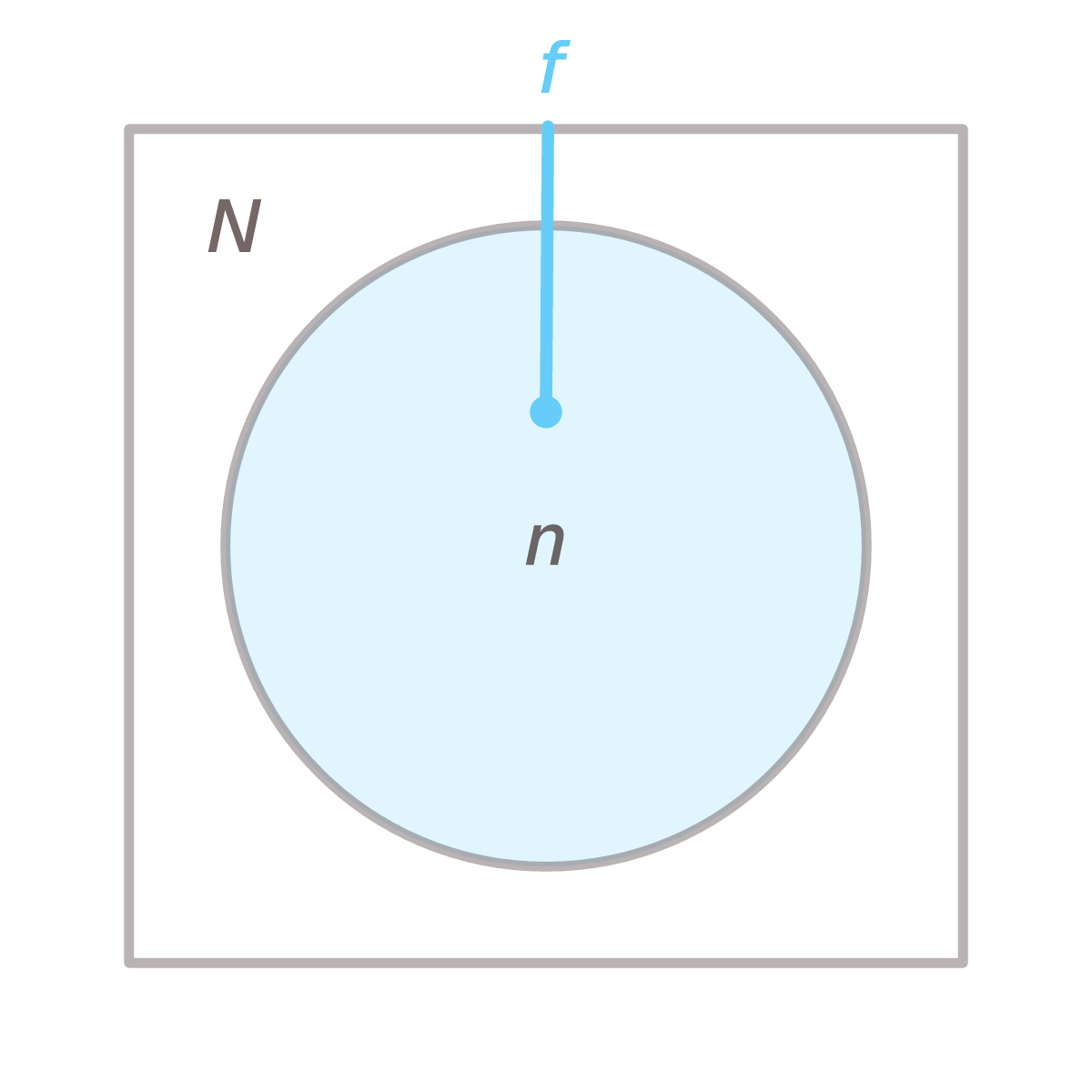
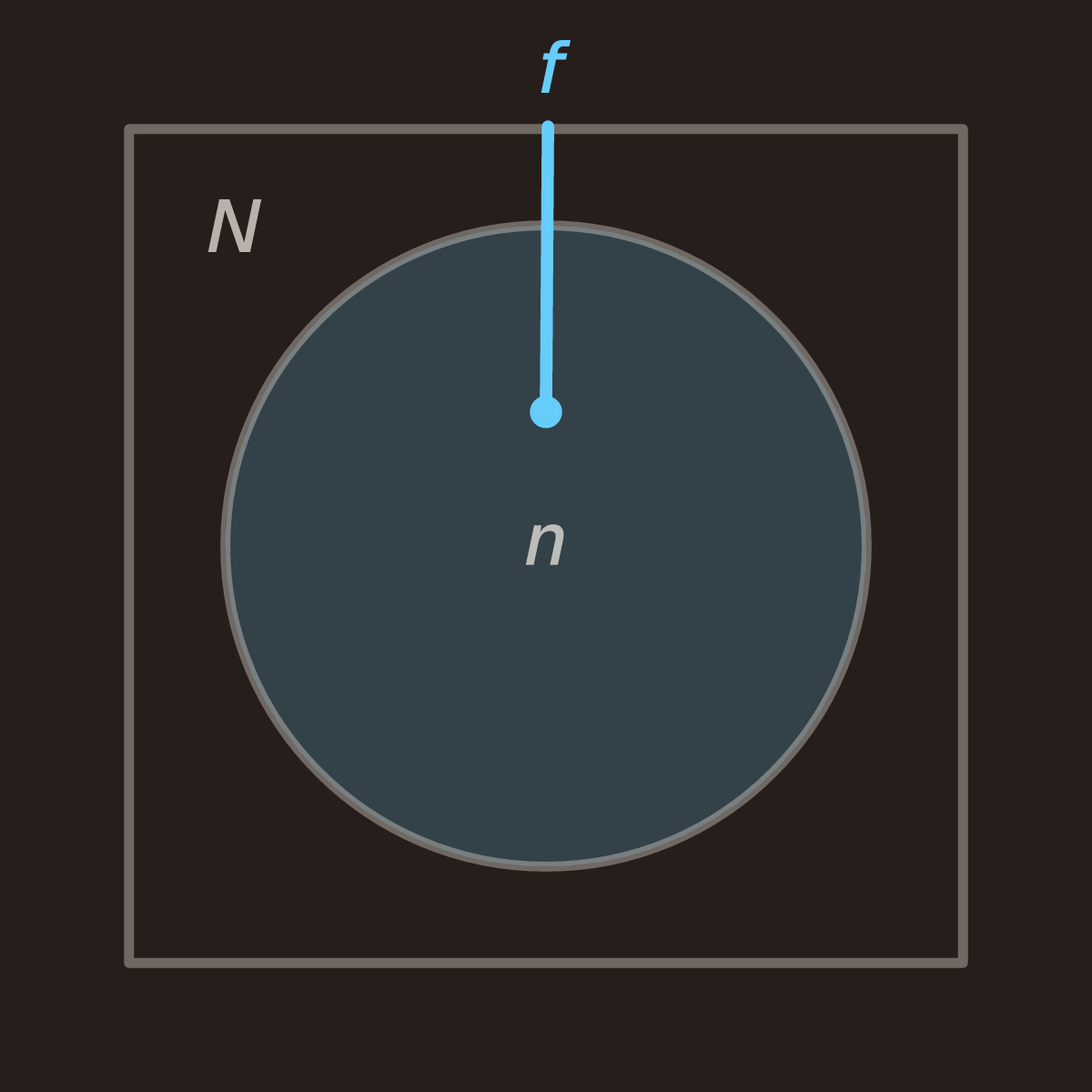
How often something actually happened, as a share of the number of times it was tried. Unlike a probability it is measured, not counted in advance.
Solve for
f=0.34
f equals 17 divided by 50, equals 0.34
Den här sidan finns på svenska. Byt till svenska
Definition — what does that mean?
How often something actually happened, divided by how many times you tried.
In Swedish: Relativ frekvens
f
How often something actually happened, as a share of the number of times it was tried. Unlike a probability it is measured, not counted in advance.
f=0.34
f equals 17 divided by 50, equals 0.34
You are given
Round to 3 decimals.
Relative frequency is a proportion computed from data you already have:
f = n / N
n is the number of times the event happened, N the number of trials or observations. Toss a coin 16 times and get heads on 9 of them, and the relative frequency is 9/16 = 0.5625.
The answer always lies between 0 and 1, because n can never exceed N. Multiplied by 100 it is a percentage, and in a frequency table the relative-frequency column adds up to 1.
The probability of heads is 0.5. It follows from the coin’s two equally likely sides and never changes, however much you toss. The relative frequency of heads in your particular 16 tosses is 0.5625, and another 16 tosses will give something else. One is a property of the experiment, the other a property of an outcome.
What connects them is the law of large numbers: with more trials, the relative frequency tends to come closer to the probability. Over 16 tosses a gap of 0.06 is perfectly ordinary; over 16,000 it would be remarkable.
And in the other direction: when the probability cannot be worked out — the chance a particular component fails, the share of customers who abandon a purchase — the relative frequency from enough data is the best estimate available. Insurers build their prices on estimates of this kind.
Forwards. An event happens 9 times in 16 trials. f = 9/16 = 0.563 (to three decimals).
Frequency table. 200 survey responses, 46 of them “yes”. Relative frequency 46/200 = 0.23, that is 23%.
Backwards. A relative frequency of 0.25 over 80 observations means the event happened 0.25 · 80 = 20 times.
Can a relative frequency exceed 1?
No. If it does, the denominator is wrong, or you have added up categories that overlap.
How many trials are needed to estimate a probability?
It depends on how close you want to get. The uncertainty falls roughly as 1/√N, which means a hundred
times as many trials buy ten times the precision.
Is relative frequency the same as a proportion?
In practice yes. “Relative frequency” is used when the numbers come from repeated trials or a frequency
table; “proportion” is the more general word.
| Solve for | Rearranged | With the numbers | Comes to |
|---|---|---|---|
| f | nN | 1750 | 0.34 |
| n | fN | 0.34·50 | 17 |
| N | nf | 170.34 | 50 |
Last reviewed October 6, 2026 ·How pages are reviewed
Statistics and probabilityAll formulas
Copy the code into your page where the formula card should appear. It loads from lovetocalc.com, so it stays current on its own — all we ask is that the credit line comes with it.