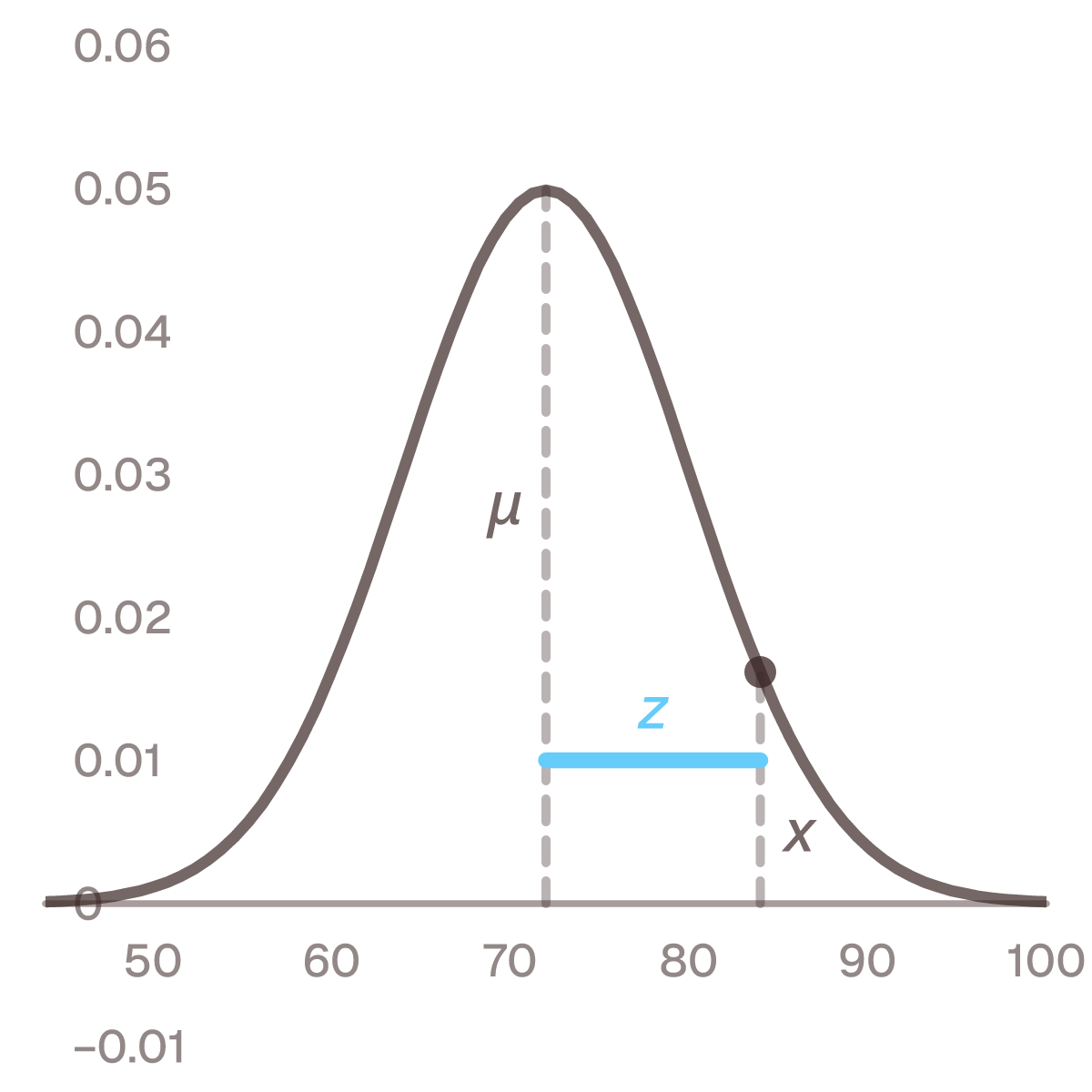
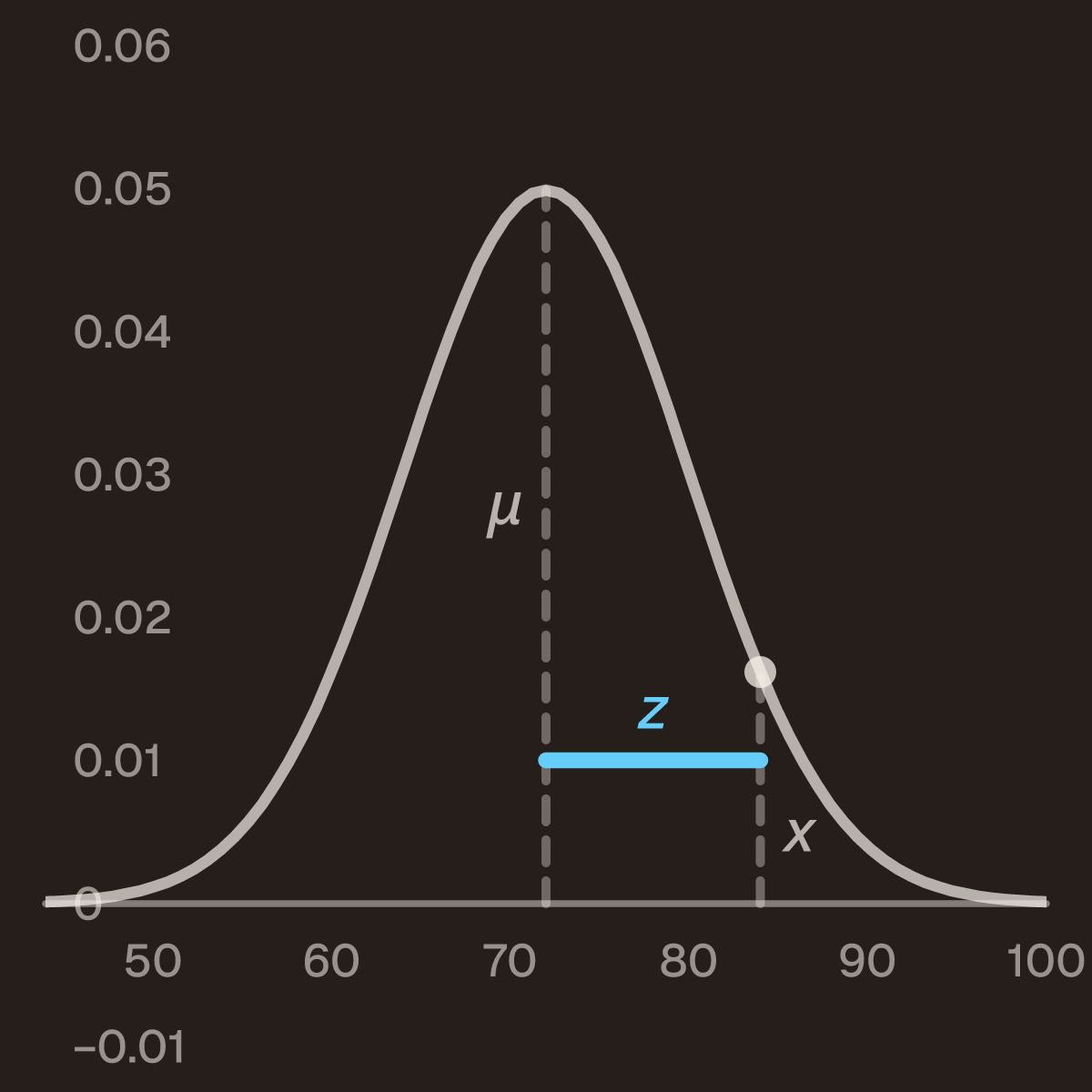
The z-score, also called the standard score, turns a measurement into a distance:
z = (x − μ) / σ
The numerator is how far the value lies from the mean. The denominator is the standard deviation — how big
a deviation is normal in this particular data. The quotient is the distance measured in standard
deviations.
A z-score of 1.5 means “one and a half standard deviations above the mean”. Negative z-scores lie below the
mean, and z = 0 is exactly on it.
Why the unit disappears
Numerator and denominator are measured in the same unit — centimetres, marks, dollars — so the unit cancels.
So a z-score is a pure number, and pure numbers can be compared.
Two exams of different difficulty: 84 marks on a paper with mean 72 and standard deviation 8 gives z = 1.5.
Sixty marks on a paper with mean 50 and standard deviation 5 gives z = 2. The second result is the stronger
one even though the raw mark is lower — relative to the group it sits further ahead. Raw marks cannot be
compared across the two papers; z-scores can.
The same holds across entirely different quantities: a z-score of 2 means two standard deviations above
the mean, whatever is measured. How unusual that is depends on the distribution. For heights, which are
roughly normal, a little over 2% lie higher; for incomes, which are skewed, that figure does not hold.
The rules of thumb for a normal distribution
If the data is normally distributed, the z-score has direct interpretations:
- |z| < 1 — about 68% of all values.
- |z| < 2 — about 95%.
- |z| < 3 — about 99.7%.
So a z-score of 1.5 is high but not remarkable; roughly 7% of values lie above it. A z above 3 is rare,
and is often used as the cut-off for flagging a value as an outlier.
The rules of thumb require normality. The z-score itself does not — it can be computed on any data — but
the translation into percentages does.
Worked examples
Forwards. x = 84, μ = 72, σ = 8. Then z = (84 − 72) / 8 = 12/8 = 1.5.
Below the mean. x = 48, μ = 60, σ = 15 gives z = (48 − 60) / 15 = −0.8.
Backwards, the value. A z-score of 1.5 in data with μ = 72 and σ = 8 corresponds to
x = 72 + 1.5 · 8 = 84. That rearrangement is what you need when a threshold is set in z and has to be
turned back into marks.
Common mistakes
- Reversing the numerator. It is x − μ, not μ − x. The wrong order gives the right size with the wrong
sign, and the sign says whether the value lies above or below the mean.
- Dividing by the variance. The denominator is the standard deviation σ, not σ². The units give it
away.
- Reading z as a percentage. 1.5 is not 1.5%. Getting to a percentage goes through the normal
distribution table.
- Using the rules of thumb on skewed data. 68–95–99.7 assumes normality. For incomes, which are heavily
skewed, they do not hold.
Common questions
Can a z-score be negative?
Yes, and it should be for every value below the mean. The sign carries the direction, the magnitude
carries the distance.
What counts as a “high” z-score?
In roughly normal data, above 2 is unusual and above 3 rare. Where the line falls depends on the
context — in industrial quality control 3 is a common alarm threshold.
How does it differ from a percentile?
A z-score measures distance in standard deviations; a percentile says what share lies below. They can be
converted if the distribution is known: in a normal distribution, z = 1.5 is roughly the 93rd
percentile.
Is it called a z-score or a standard score?
Both. In Swedish, z-värde. Same formula.