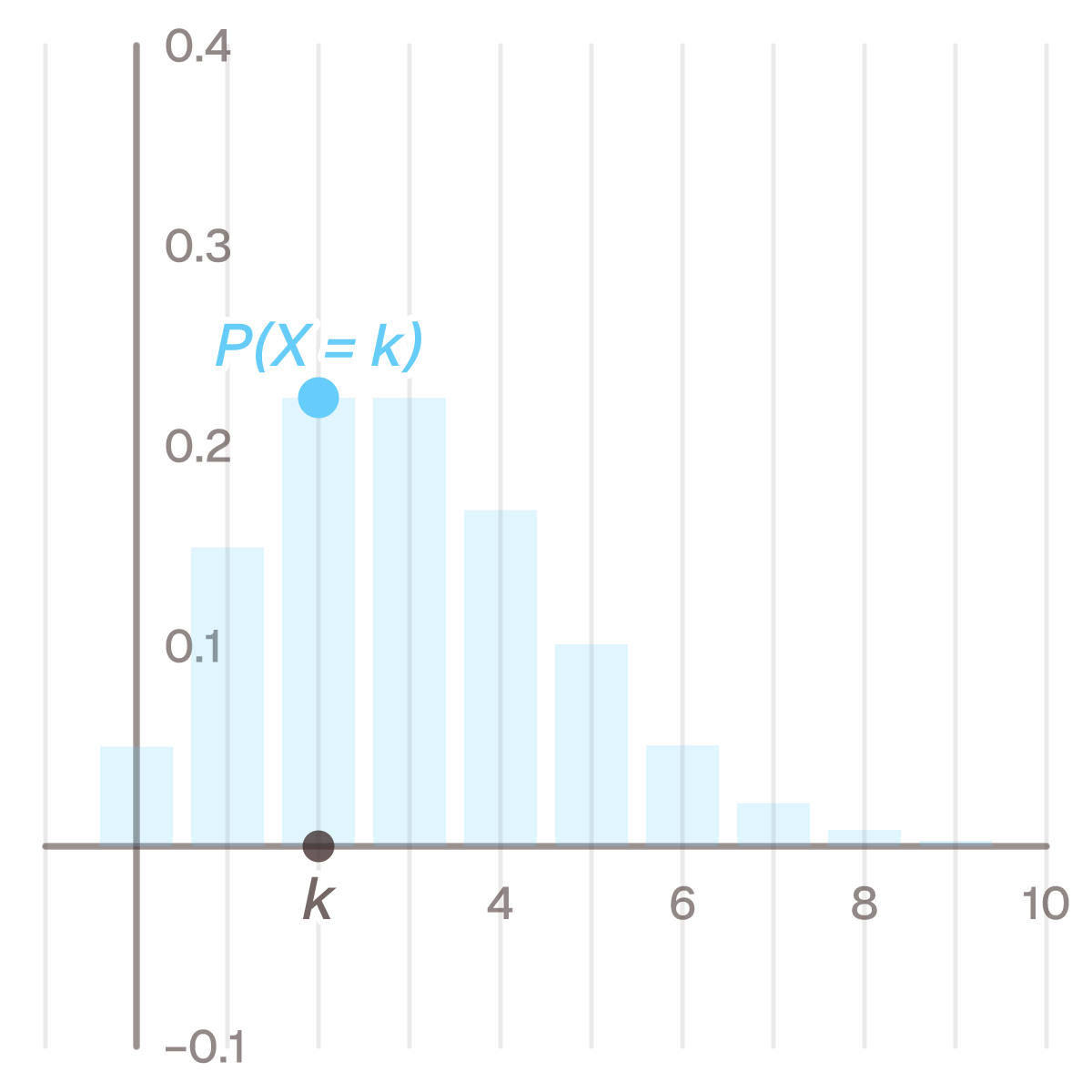
The formula
P(X = k) = λᵏ · e^(−λ) / k!
λ (lambda) is the expected number of events, k the number you ask about (0, 1, 2, …) and k! its
factorial.
A shop gets 3 customers an hour on average. The chance of exactly 2 in the next hour: P = 3² · e⁻³ / 2! = 9 · 0.0498 / 2 ≈ 0.2240.
The whole distribution
| k | P(X = k), λ = 3 |
|---|---|
| 0 | 0.0498 |
| 1 | 0.1494 |
| 2 | 0.2240 |
| 3 | 0.2240 |
The chance of at most two is the sum of the first three rows: 0.4232. Questions with “at least” are easiest through the complement: at least one customer is 1 − 0.0498 = 0.9502.
Two more to check against: λ = 5 and k = 5 gives 0.1755; λ = 1 and k = 0 gives e⁻¹ ≈ 0.3679.
When it applies
Events that happen one at a time, independently, at a steady average rate: calls to a switchboard, typos per page, radioactive decays per second, goals in a football match. The expected value and the variance are both λ, which is a quick way to test whether real data fit — if the variance of the counts is far larger than their mean, something is probably clumping them.
It is also the binomial distribution in the limit of many trials and a small probability: 1,000 trials with p = 0.003 behave almost exactly like Poisson with λ = n · p = 3.
Common mistakes
- λ for the wrong interval. 3 an hour is 6 per two hours; scale λ before using it.
- Forgetting k! for k = 0. 0! = 1, so P(X = 0) = e^(−λ).
- Using it for clumped events. Customers arriving in groups break the independence the formula relies on.
Questions people ask
What is the time between events?
The exponential distribution with the same λ: the Poisson counts the events,
the exponential measures the gaps.
Can λ be a decimal?
Yes — 2.4 goals a match is fine. k must be a whole number.