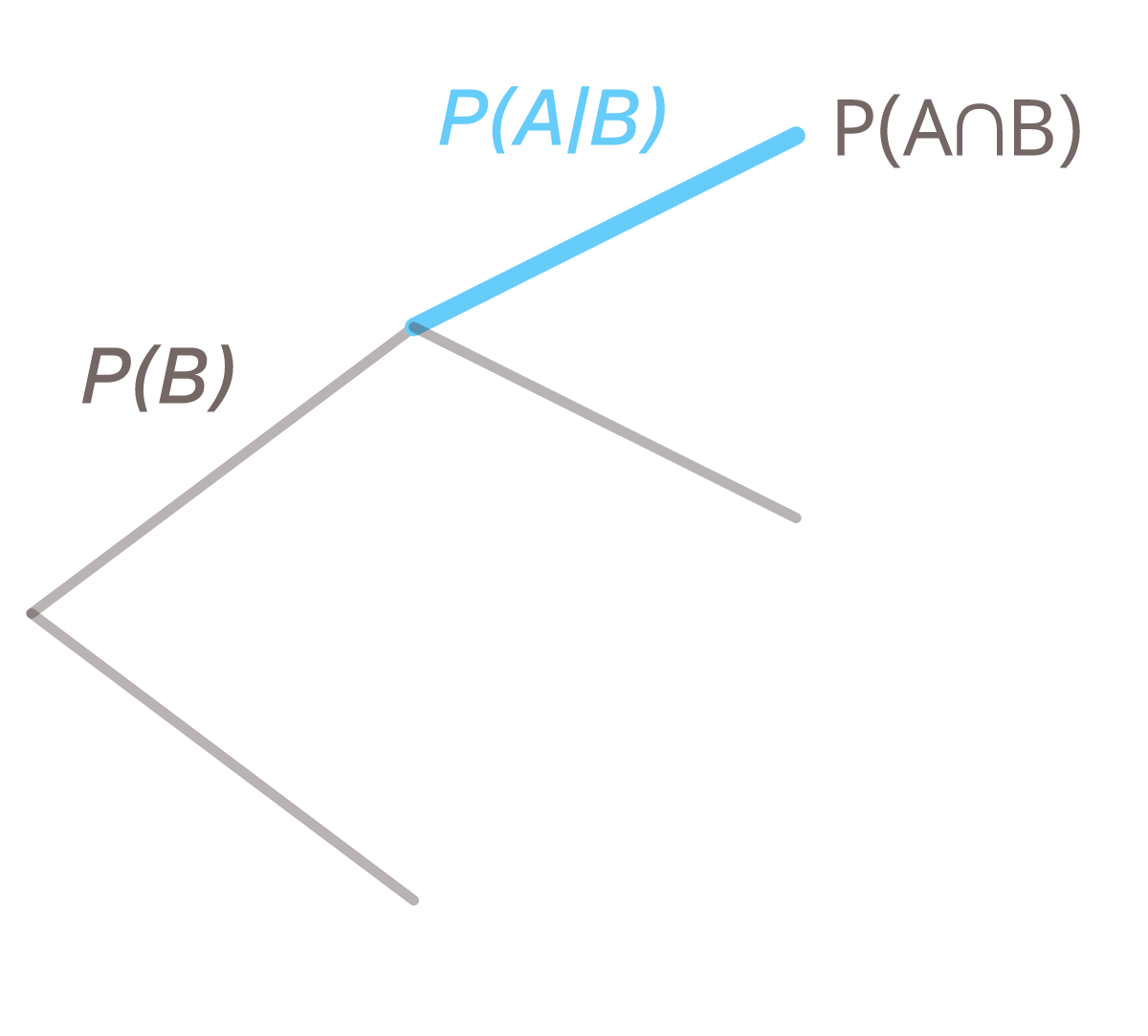
A conditional probability is the probability of one event given that another has already happened. It
is written P(A|B) and read “the probability of A given B”.
P(A|B) = P(A∩B) / P(B)
The numerator is the probability that both happen. The denominator is the probability of what you have
been told.
The condition shrinks the sample space
It is easier to see with counts than with decimals. A class of 30 students:
18 girls, and 12 of the students play football, 8 of them girls. The probability that a randomly chosen
student is a football-playing girl is 8/30. The sample space is the set of all outcomes, here the
30 students.
But the question “how likely is it that the student plays football, given that it is a girl?” is no longer
about all 30. Being told “it is a girl” strikes out 12 of the students. Eighteen remain, and 8 of them play
football: 8/18.
Dividing by P(B) is exactly that: a rescaling from the whole sample space to the part of it the condition
leaves behind. Numerator and denominator are both over the same 30, which therefore cancels —
(8/30) / (18/30) = 8/18.
Worked examples
Forwards. P(A∩B) = 0.12 and P(B) = 0.4. Then P(A|B) = 0.12 / 0.4 = 0.3.
Independent events. If A and B are independent then P(A∩B) = P(A)·P(B), so P(A|B) = P(A)·P(B)/P(B) =
P(A). The condition changes nothing, which is what
independence means.
Backwards, the intersection. If you know P(A|B) = 0.3 and P(B) = 0.4, then P(A∩B) = 0.3 · 0.4 =
0.12. That rearrangement is the multiplication rule in its general form: P(A∩B) = P(A|B) · P(B), true
whether or not the events are independent.
Common mistakes
- Turning the condition around. P(A|B) and P(B|A) are rarely equal. That 90% of the sick test positive
does not mean 90% of the positives are sick — see
Bayes’ theorem.
- Dividing by the wrong probability. The denominator is always what you were told, the thing after the
bar.
- Setting P(A∩B) = P(A)·P(B) without checking. That shortcut requires independence, and many exercises
are built so that it does not hold.
- Using the original total. 8/30 answers a different question from 8/18.
Common questions
What does the bar in P(A|B) mean?
“Given that”. What stands to the right of the bar is what you already know; what stands to the left is
what you are asking about. The order matters.
Can a conditional probability be larger than the unconditional one?
Yes. If what you learn is evidence for A, then P(A|B) is larger than P(A). The probability that it is
raining is small; the probability that it is raining given that the sky is dark is larger.
What if P(B) = 0?
The formula is undefined. In discrete examples such as dice and marbles, P(B) = 0 means B cannot happen,
and then there is nothing to condition on. For continuous variables, where every single value has
probability 0, conditioning is done with density functions instead, which is beyond this formula.
Is this the same as drawing without replacement?
Yes. The probability for the second marble is a conditional probability, conditioned on what the first
one was. That is why the denominator shrinks from 10 to 9.