P(X ≤ x) = 1 − e^(−λx)
λ is the rate — events per unit of time — and x the time waited, in the same unit.
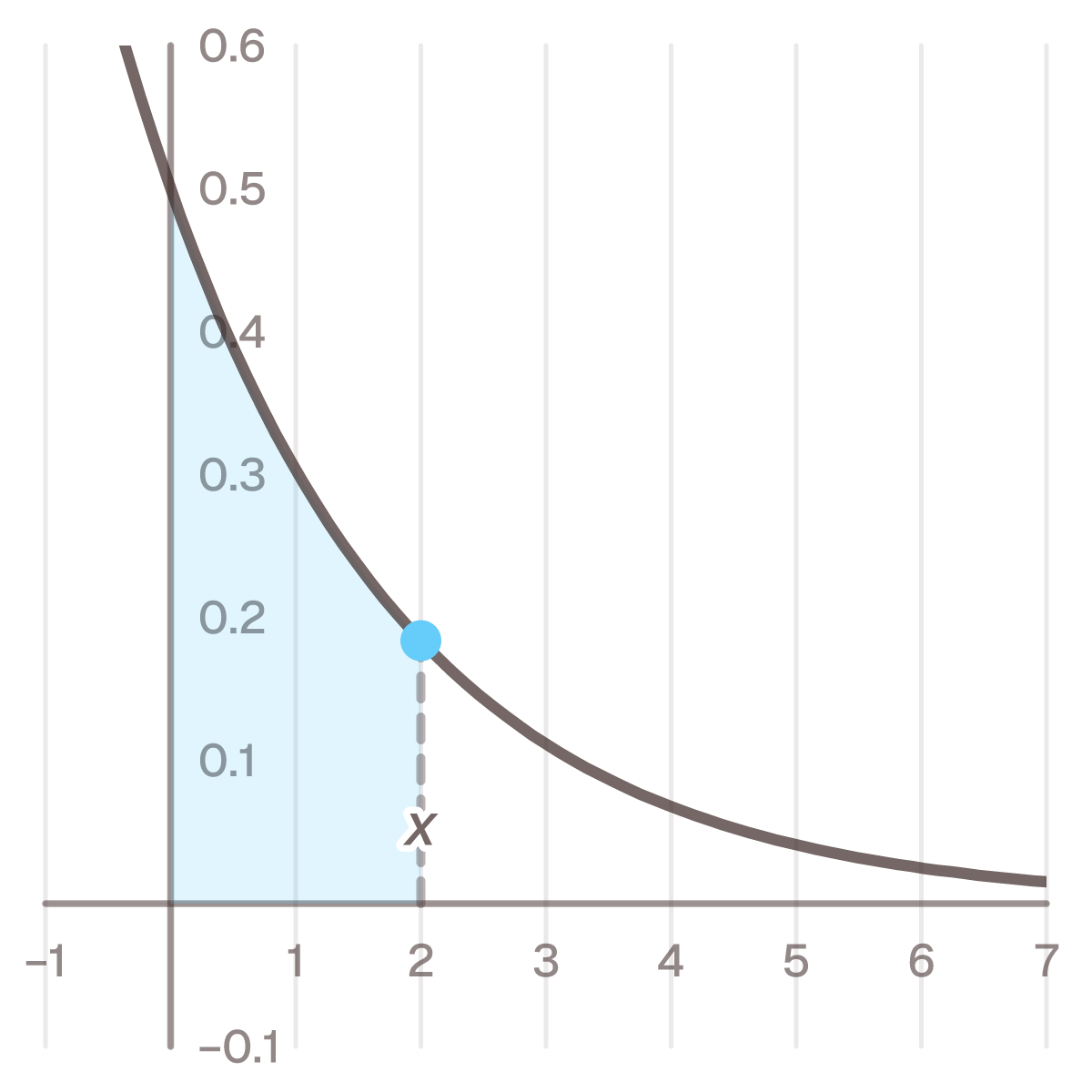
Buses come at random, on average one every two minutes (λ = 0.5 per minute). The chance one arrives within
2 minutes: P = 1 − e^(−0.5 · 2) = 1 − e⁻¹ ≈ 0.6321.
λ = 1 per hour, x = 0.5 hours: P = 1 − e^(−0.5) ≈ 0.3935.
The average wait is 1 / λ — two minutes in the bus example. The median is shorter: half the waits are over
by ln 2 / λ, which at λ = ln 2 is exactly 1. The long tail of occasional long waits pulls the mean above it.
The chance the wait is longer than x is the other side, e^(−λx). For the buses, waiting more than 4 minutes
has probability e⁻² ≈ 0.135.
It has no memory
If you have already waited 5 minutes, the chance of a bus in the next 2 is still 0.6321. The time you
have already waited does not change the probability. That is exactly right for radioactive decay — an
atom does not age — and wrong for anything that wears out, like a car tyre.
It is the waiting-time side of the Poisson distribution: if events per hour are
Poisson with rate λ, the gaps between them are exponential with the same λ.
Common mistakes
- Mixing up rate and mean. One bus every 2 minutes is λ = 0.5, not λ = 2.
- Answering the wrong side. 1 − e^(−λx) is “within x”; “longer than x” is e^(−λx).
- Using it for things that age. A light bulb near the end of its life is more likely to fail, not equally likely.
Questions people ask
How is it related to half-life?
A radioactive half-life is the median of an exponential distribution: ln 2 / λ, with λ the decay constant.
What is the probability of an exact time?
Zero — the time is continuous, so only intervals have probabilities.