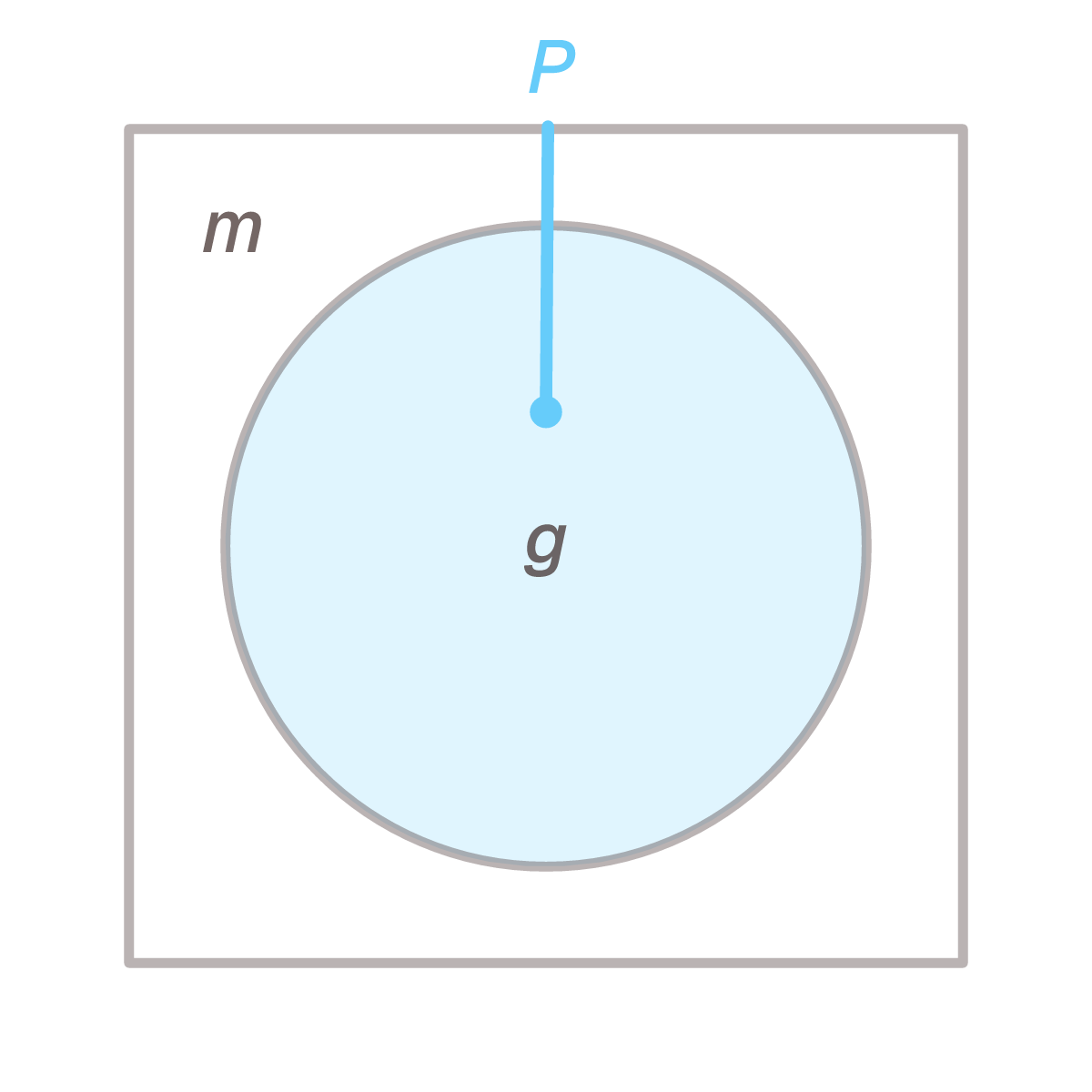
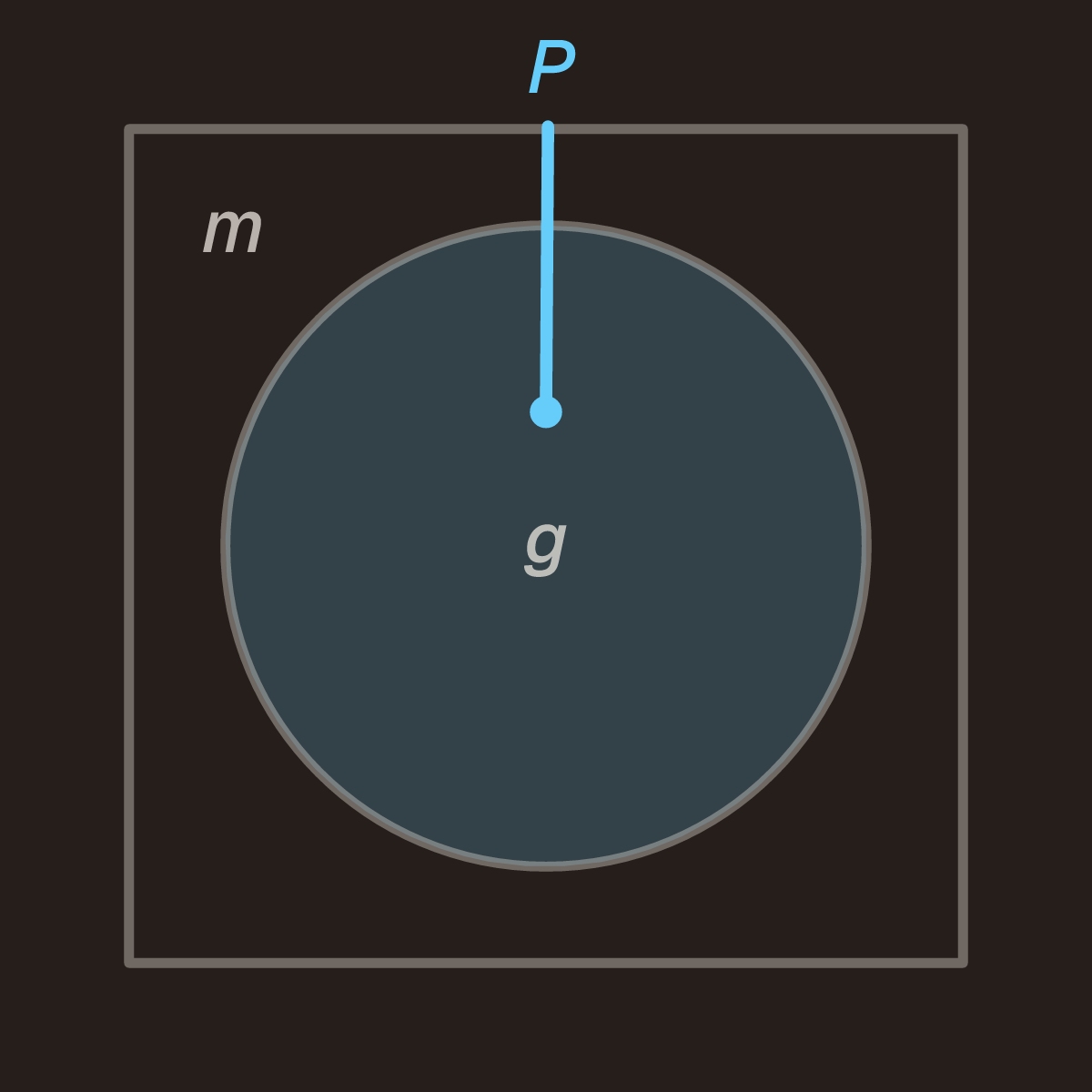
An experiment has a number of possible outcomes, and together they make up the sample space. Some of them count as the event you are interested
in — those are the favourable ones. The probability is one divided by the other:
P = g / m
A die has six possible outcomes. “A six” is one of them, so P = 1/6. “An even number” is three of them,
so P = 3/6 = 0.5. The answer is always between 0 and 1: no favourable outcomes gives 0, and every
outcome being favourable gives 1.
It is the classical definition of probability.
The requirement of equally likely outcomes
The formula holds only when every outcome is equally likely. That is not a condition you can work
out from the numbers — it is a claim about the experiment, and you are the one who decides whether it is
true.
A bag of marbles qualifies. A die qualifies. A coin toss qualifies. But “it rains or it does not” is two
outcomes and the probability is not 0.5, because the two are not equally likely. The same goes for “the
team wins, draws or loses”: three outcomes, but not 1/3 each.
This is a common way to use the formula wrongly, and it never shows up in the arithmetic.
Worked examples
A bag. Eight marbles, three of them red. The probability of drawing a red one is 3/8 = 0.375.
Backwards, the favourable count. A bag holds 20 marbles and the probability of drawing a blue one is
0.35. The number of blue marbles is 0.35 · 20 = 7.
Backwards, the possible count. Four marbles are green and the probability of drawing a green one is
0.25. The bag holds 4 / 0.25 = 16 marbles.
Two dice. This is where the denominator goes wrong. A total of 7 is not one outcome out of eleven
possible totals — the eleven totals are not equally likely. Count the 36 equally likely pairs instead:
six of them total 7, so 6/36 = 1/6.
Common mistakes
- Using the formula on outcomes that are not equally likely. Two outcomes does not mean 50/50.
- Answering with the count instead of the share. “Three red out of eight” is not the answer; 3/8 is.
- Counting the wrong denominator. It is the number of possible outcomes, not the number of answer
options or the number of different results you can imagine.
- Answering with a number above 1. That means favourable and possible have swapped places.
Common questions
Should the answer be a fraction, a decimal or a percentage?
All three are the same number and all three are correct. The fraction 3/8 is exact, the decimal 0.375
is easiest to compare with other probabilities, and 37.5% is easiest to say out loud.
How is this different from relative frequency?
A probability is worked out in advance by thinking about the experiment.
Relative frequency is measured afterwards by
counting how often it actually happened.
Can a probability be 0 or 1?
Yes. 0 is the event that never happens and 1 is the one that always does. You cannot work backwards
from 0 to the number of possible outcomes, though — a bag with no red marbles gives 0 whether it holds
ten marbles or ten thousand.
How do I find the probability that something does not happen?
Take 1 minus the probability that it does. That is the
complement rule, and it is often far easier to
work with than the event itself.