Two events, and the question is the probability that both happen. When the first does not affect the
second, the probabilities multiply:
P(A∩B) = P(A) · P(B)
The ∩ sign means “and”. Two coin tosses: the probability of heads both times is 0.5 · 0.5 = 0.25.
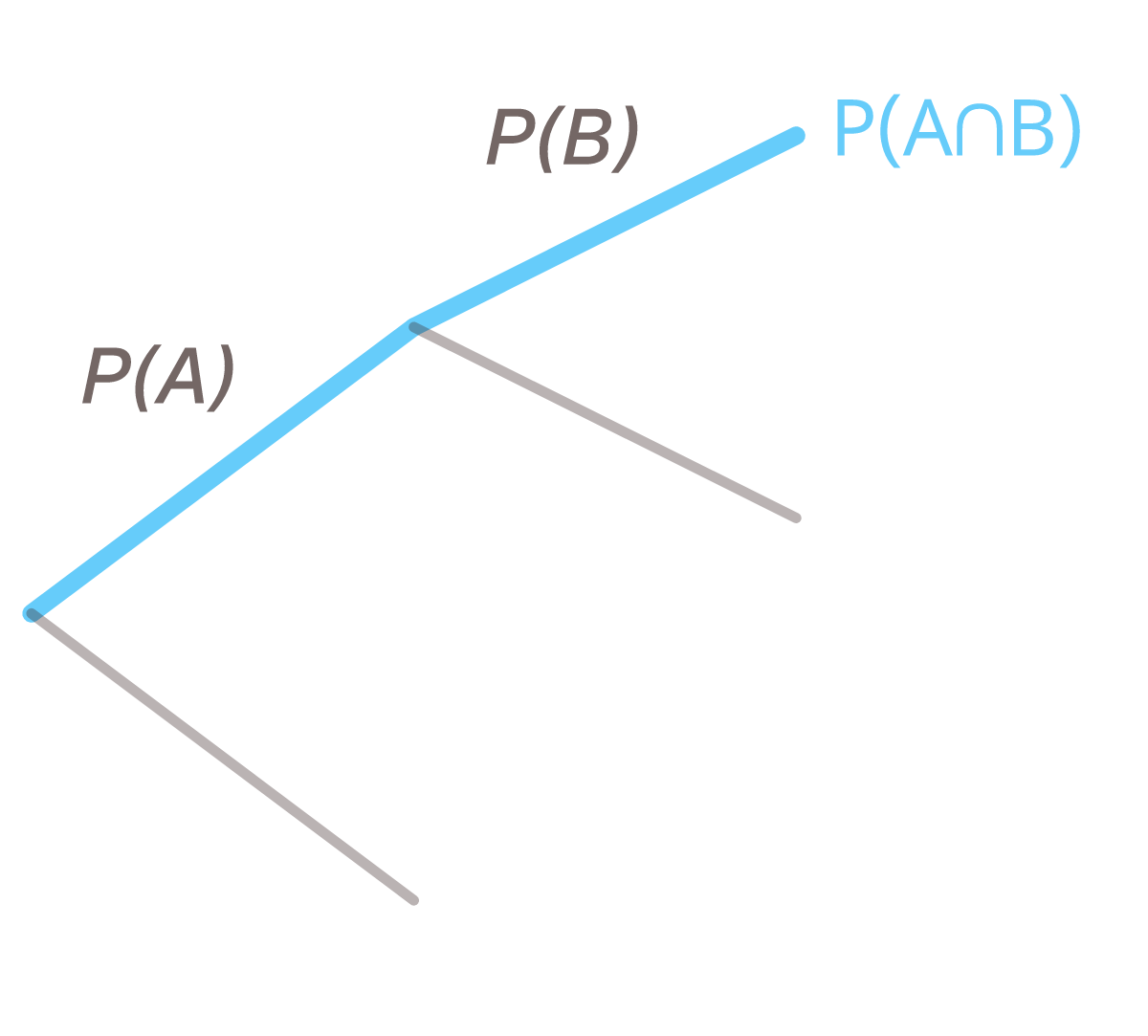
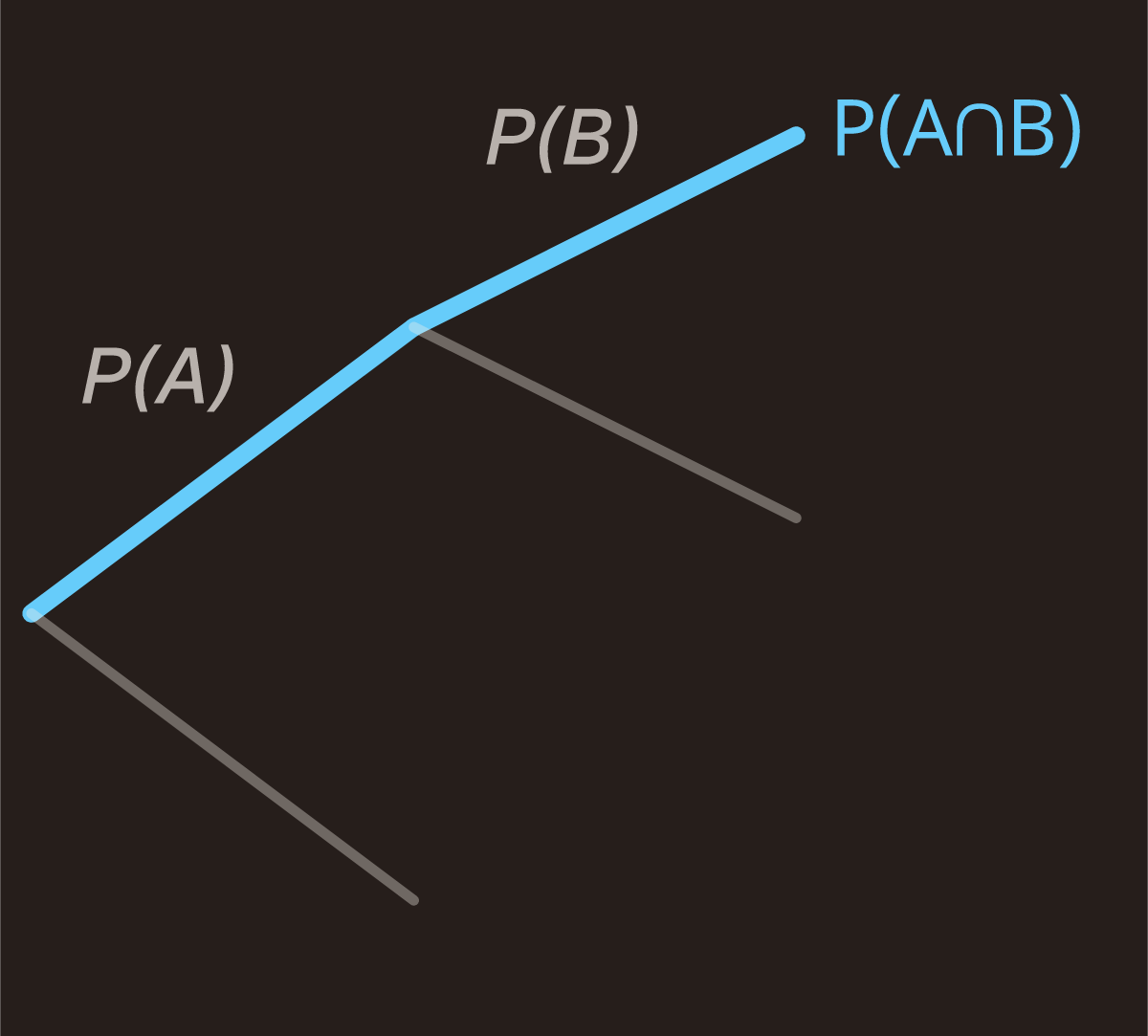
A tree diagram is the picture of the formula. Each branch carries a probability, and the probability of a
path through the tree is the product of the branches along it. Multiplying is following the path.
The answer never comes out larger than either factor, and it is smaller whenever the other factor is
below 1. Both happening is a narrower requirement than one of them happening.
The condition: independence
The formula holds only when the events are independent — when the first does not change the setup for
the second. Two coin tosses are independent. Two throws of a die are independent. Today’s weather and
tomorrow’s are not.
The school example that breaks the condition is the bag of marbles. Ten marbles, three red, and you draw
two without putting the first one back. The probability the first is red is 3/10. The probability the
second is red is now 2/9, not 3/10 — one red marble is gone and nine remain. The answer is
3/10 · 2/9 = 1/15, and that second factor is a
conditional probability.
Put the marble back and the draws are independent again, so the formula on this page applies directly:
3/10 · 3/10 = 9/100.
Worked examples
Forwards. The probability that a bus is late is 0.3 and that a train is late is 0.4, independently of
each other. Both late: 0.3 · 0.4 = 0.12.
Three times. Three dice, the probability of a six on all three: (1/6)³ = 1/216 ≈ 0.0046.
Backwards. Two independent events both happen with probability 0.12, and the second has probability
0.4 on its own. The first then has probability 0.12 / 0.4 = 0.3.
Common mistakes
- Multiplying when the draws are not independent. Without replacement the denominator changes each
draw.
- Multiplying when the question says “or”. “Both” multiplies; “at least one” is the
addition rule.
- Adding instead. 0.3 + 0.4 = 0.7 is larger than either event, which gives the error away at once:
both happening can never be more likely than one of them happening.
- Multiplying percentages as percentages. 30% · 40% is 12%, not 1200%. Work in decimals.
Common questions
How do I know whether two events are independent?
Ask whether the first changes the second. Is the marble put back? Are they two different people, two
different dice, two different days at the same odds? Then they are independent. It is a judgement about
the situation, not something the numbers can tell you.
Does the rule work for more than two events?
Yes. If they are all independent, multiply all the probabilities. Five independent components that each
work with probability 0.99 all work with probability 0.99⁵ ≈ 0.951.
What does ∩ mean?
The intersection of two sets — what belongs to both. Read it as “and”. The probability of “A or B” is
written with ∪ instead.
Can the answer be larger than one of the factors?
Never — and that makes a good check. A larger number means you added, or turned something around.