Complement rule
The relation
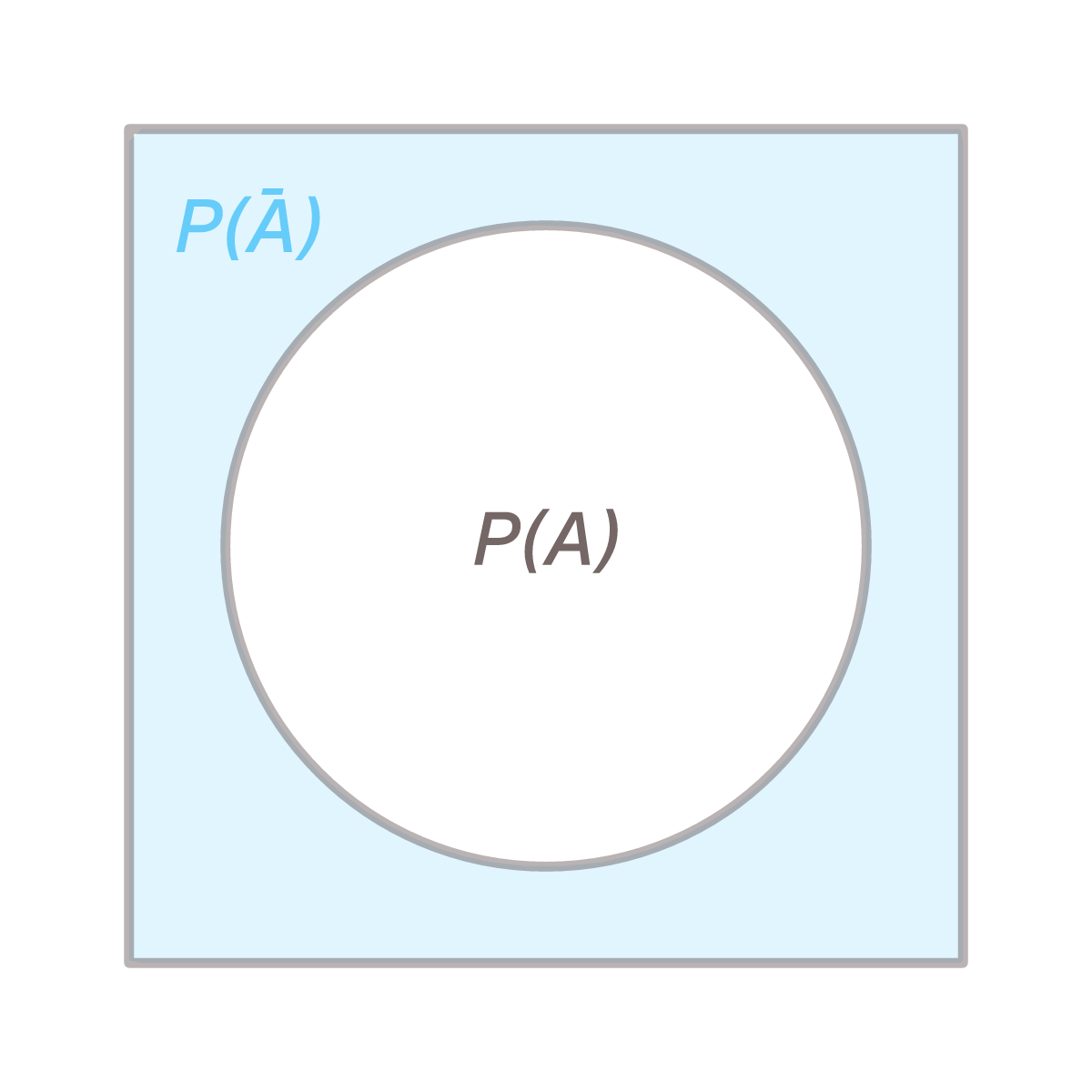
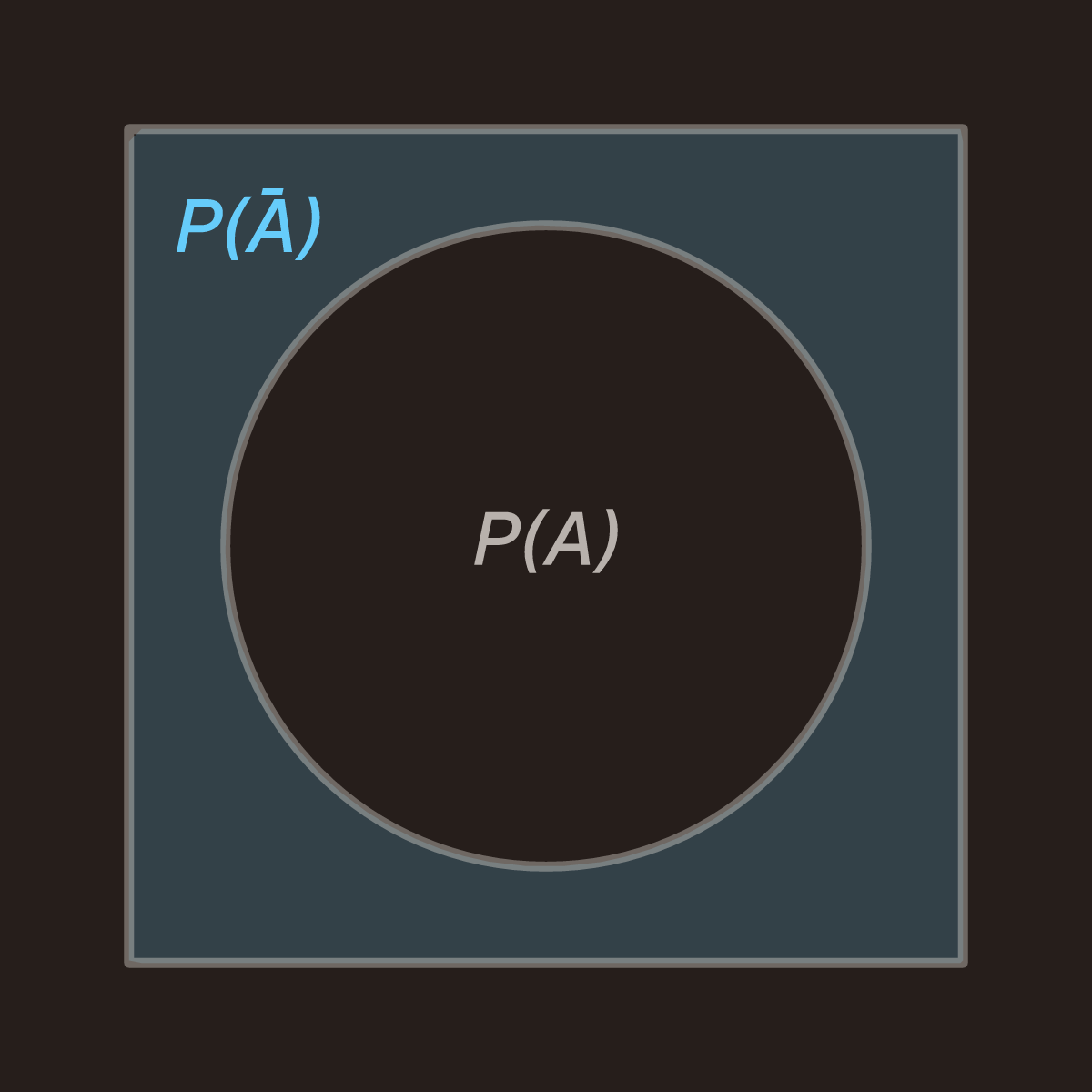
P(Ā)
The probability that an event does not happen is 1 minus the probability that it does. The two always add to 1.
Solve for
P(Ā)=0.75
P(Ā) equals 1 minus 0.25, equals 0.75
Den här sidan finns på svenska. Byt till svenska
Theorem — what does that mean?
The probability that something does not happen is 1 minus the probability that it does.
In Swedish: Komplementhändelse
P(Ā)
The probability that an event does not happen is 1 minus the probability that it does. The two always add to 1.
P(Ā)=0.75
P(Ā) equals 1 minus 0.25, equals 0.75
You are given
Either an event happens or it does not. There is no third possibility, so the two probabilities always add to 1:
P(A) + P(Ā) = 1
Move one across and the formula reads the way it is usually written:
P(Ā) = 1 − P(A)
The bar over the letter is read “not A” or “the complement of A”. If the probability of rain is 0.3, the probability of no rain is 0.7.
The rule is simple, and it is useful because “at least one” is almost always harder to count than “none at all”.
Four throws of a die, and the question is the probability of at least one six. Head-on that is four cases to add up: exactly one six, exactly two, exactly three, exactly four. Through the complement it is one subtraction. The probability that a throw is not a six is 5/6, and four throws in a row without a six is (5/6)⁴ ≈ 0.482. So the probability of at least one six is 1 − 0.482 = 0.518.
If you spot the words “at least one” in a question, the complement is almost always the way through.
Forwards. The probability that a component works is 0.96. The probability that it does not is 1 − 0.96 = 0.04.
Backwards. The probability that a parcel arrives late is 0.12. The probability that it arrives on time is 1 − 0.12 = 0.88. Same formula, other direction — the two are interchangeable.
At least one. Ten coin tosses, the probability of at least one head. No heads at all has probability (1/2)¹⁰ = 1/1024, so the answer is 1 − 1/1024 = 1023/1024 ≈ 0.999.
Why 1 and not 100?
Because a probability is a number between 0 and 1. The percentage form is the same number read out
differently. Working in percentages you subtract from 100%, which is exactly the same operation.
How is the complement written?
P(A’) is common in English textbooks. You will also see P(Ā) and P(Ac). All three
mean the same thing.
Does the rule work for several events?
Yes, but only against everything else. The complement of “a six” is “not a six”, which is 1, 2, 3, 4 or
5 together. To combine two events you want the
addition rule.
Can the complement equal the event?
Yes, when both are 0.5. A coin toss is the usual example.
| Solve for | Rearranged | With the numbers | Comes to |
|---|---|---|---|
| P(Ā) | 1 | 1 | 0.75 |
| P(A) | 1 | 1 | 0.25 |
Last reviewed October 6, 2026 ·How pages are reviewed
Sheets that ask this formula, with their answer keys. Open one to see the questions or print it.
Six questions of each kind: favourable outcomes over possible ones, the chance that something does not happen, and two independent events both happening.
Statistics and probabilityAll formulas
Copy the code into your page where the formula card should appear. It loads from lovetocalc.com, so it stays current on its own — all we ask is that the credit line comes with it.