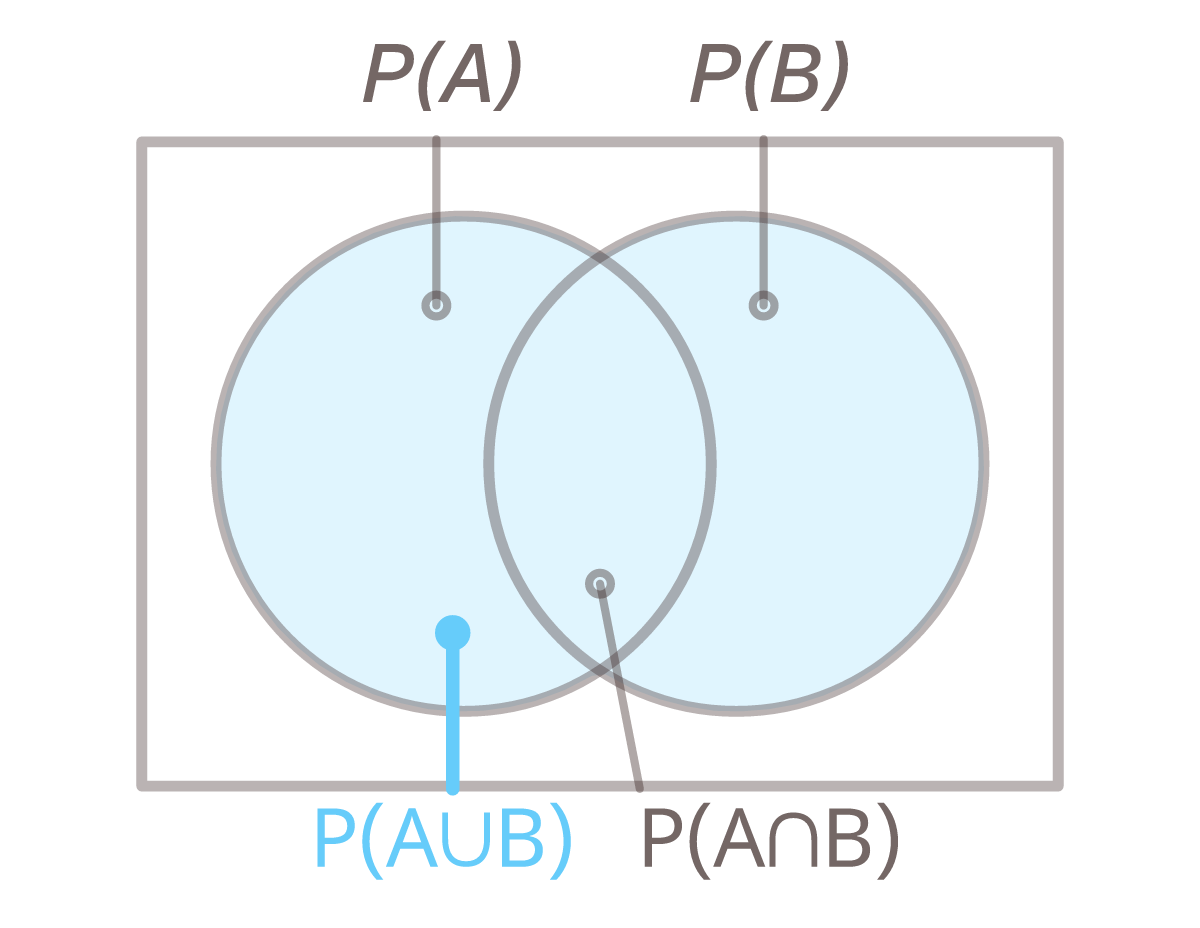
The question is the probability that at least one of two events happens — A or B, or both.
P(A∪B) = P(A) + P(B) − P(A∩B)
The ∪ sign means “or”. The last term, the intersection, is the probability that both happen.
Adding is the natural first step, and the minus sign is the correction. Draw two overlapping circles. Add
the areas of both and you have counted the overlap once too often — once in each circle. Subtracting it
once gives the combined area.
When the overlap is zero
If the events cannot happen at the same time, P(A∩B) = 0 and the formula shortens to a plain addition:
P(A∪B) = P(A) + P(B)
Such events are called mutually exclusive (or disjoint). A die cannot show both 2 and 5, so the
probability of 2 or 5 is 1/6 + 1/6 = 1/3, with nothing to subtract. A card drawn from a deck, on the other
hand, can be both a heart and a king, so the probability of a heart or a king is 13/52 + 4/52 − 1/52 =
16/52.
The choice between the short and the long form comes down to one question: can they happen together?
Worked examples
Forwards. P(A) = 0.5, P(B) = 0.4 and the probability that both happen is 0.2. Then
P(A∪B) = 0.5 + 0.4 − 0.2 = 0.7.
The deck. The probability that a drawn card is a heart (13/52) or a king (4/52), where the king of
hearts is both (1/52): 13/52 + 4/52 − 1/52 = 16/52 = 4/13 ≈ 0.308.
Backwards, the overlap. Two events with probabilities 0.5 and 0.4 give 0.7 together. The overlap is
0.5 + 0.4 − 0.7 = 0.2. That is often how you find out how much two groups share: from the three
numbers you already have.
Common mistakes
- Forgetting the minus term. Without the subtraction the answer comes out too large, and can even
exceed 1 — impossible for a probability, which makes it a good check.
- Subtracting twice. The overlap was counted once too often, not twice. One subtraction is enough.
- Assuming the events are mutually exclusive. “Heart or king” is not. Always ask whether both can
happen at once before shortening the formula.
- Multiplying instead. “Both” is the
multiplication rule; “at
least one” is this page.
Common questions
What is the difference between mutually exclusive and independent?
They are not the same thing, and the words get in the way. Mutually exclusive means they cannot
happen together — P(A∩B) = 0. Independent means one does not affect the other —
P(A∩B) = P(A)·P(B). Two events with positive probability cannot actually be both: if you know one
happened, you know the other did not, which is a clear case of dependence.
Is there another way to work out “at least one”?
Yes, and often an easier one: work out the probability that none of them happens and subtract
from 1. See the complement rule. With many events
that is almost always the route to take.
Does the formula work for three events?
The principle does, but the formula gets longer: add the three, subtract the three pairwise
intersections, add the common intersection back. It is called inclusion–exclusion, and it is the same
count with more circles.
What does ∪ mean?
The union of two sets — everything belonging to at least one of them. Read it as “or”, in the sense of
“one or the other or both”.