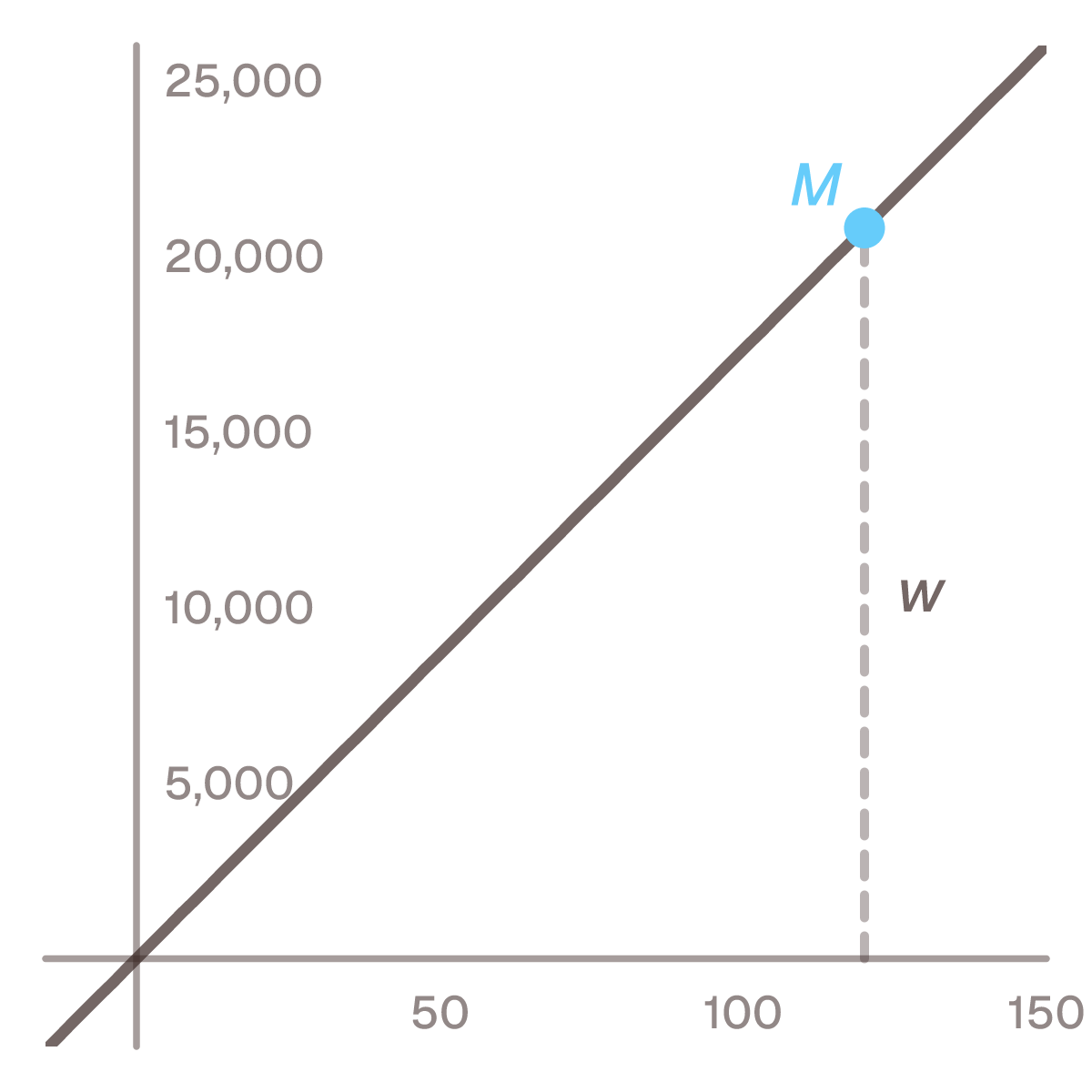
The hourly wage times the hours in a week times the weeks in a year, spread over twelve months — the arithmetic behind turning an hourly rate into a monthly one.
M equals ((120 times 40) times 52) divided by 12, equals (4,800 times 52) divided by 12, equals 249,600 divided by 12, equals 20,800
Working4 steps
M
=
120·40·5212
=
4,800·5212
=
249,60012
=
20,800
Practice questions
You are given
M=16000
h=20
n=48
What the formula says
M = w · h · n / 12
where w is the hourly wage, h the hours a week, n the weeks you work in a year and M the monthly
pay.
Read it in two steps. w · h · n is what you earn in a year. Dividing by 12 spreads that evenly over the
months. It is the same arithmetic as the hourly to monthly calculator,
except that the weeks are a letter of their own here, so you can enter fewer than 52.
Worked example
20 an hour, 40 hours a week, 52 weeks a year:
20 · 40 = 800 a week
800 · 52 = 41,600 a year
41,600 / 12 = 3,466.67 a month
Why not times four?
A month is not four weeks. It is 52 / 12 ≈ 4.33 weeks. Work out 800 · 4 and you get 3,200, about 267 too
little every month. That is why the formula goes through the year.
When it isn’t 52 weeks
52 weeks assumes you are paid every week of the year, paid holiday included. If you have unpaid leave,
seasonal work or a shorter working year, enter the weeks you are actually paid for. 36 weeks at the same
wage and hours averages 2,400 a month.
The formula gives gross pay. Tax, holiday pay and supplements are not included.
Frequently asked questions
Why divide by 12 rather than work per week?
Because a month does not hold a whole number of weeks. Going through the year makes every month the same
size, and twelve of them add up to exactly one year’s pay.
How do I go the other way, from monthly pay to an hourly wage?
Solve for w: w = 12 · M / (h · n). 3,466.67 a month at 40 hours a week and 52 weeks is 20 an hour. The
formula above solves for whichever letter you choose.
Looking for another letter? The formula solved for each one
Copy the code into your page where the formula card should appear. It loads from lovetocalc.com, so it stays current on its own — all we ask is that the credit line comes with it.