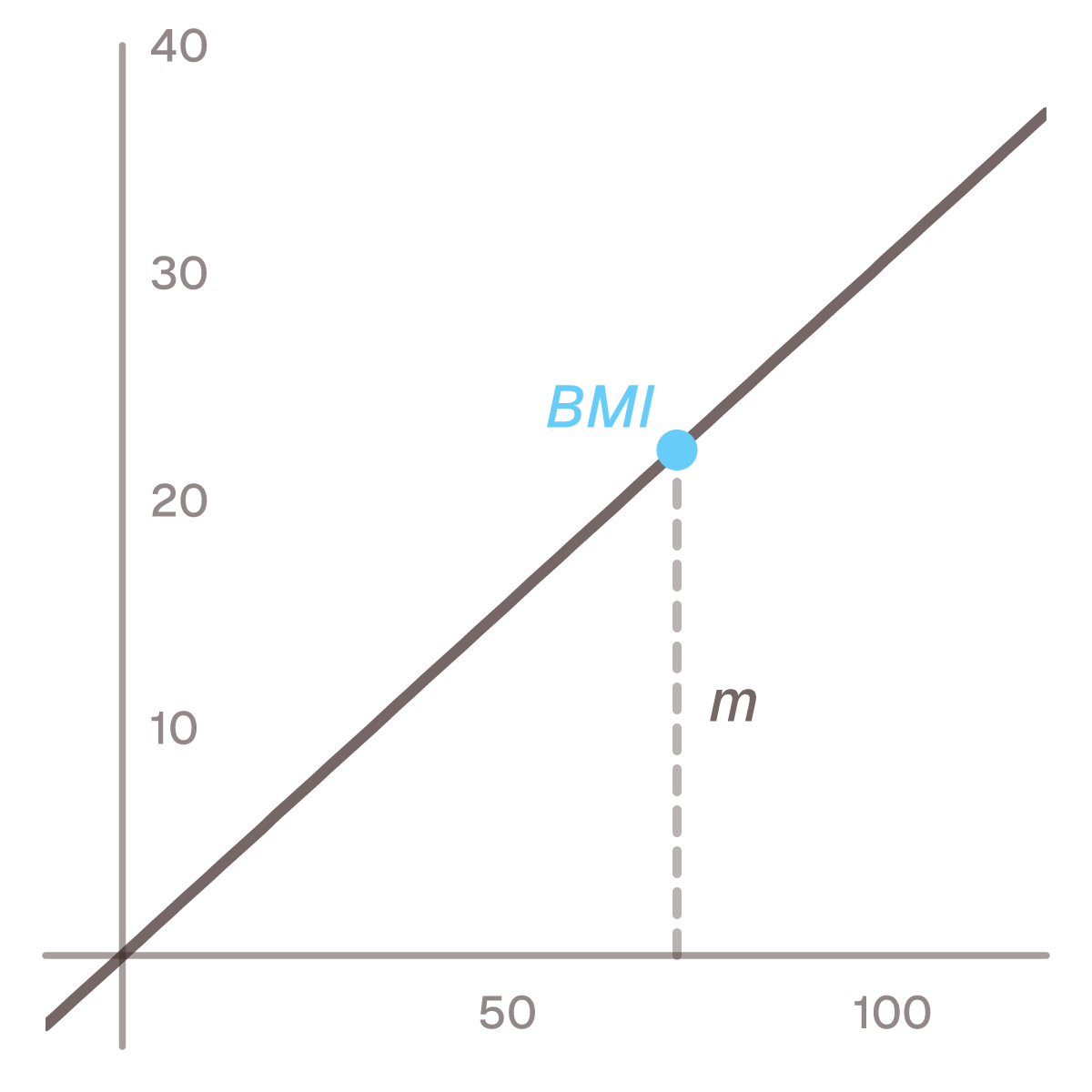
BMI is weight divided by height squared:
where m is weight in kilograms and h is height in metres. Someone who weighs 72 kg and is 1.80 m
tall has a BMI of 72 / 1.80² = 72 / 3.24 = 22.2.
It is a definition — it says what the abbreviation means, not anything about a body. Dividing by the
square is the point: weight grows roughly like a volume and height is a length, so anyone who
simply divides weight by height gets a number on which every tall person looks heavy.
Metres, not centimetres
This is the one mistake worth its own heading, because it gives an answer that is wrong by a factor of
ten thousand and still looks like a number:
- Right: 72 / 1.80² = 72 / 3.24 = 22.2
- Wrong: 72 / 180² = 72 / 32,400 = 0.0022
If your height is in centimetres, divide by 100 first. 180 cm is 1.80 m.
The three questions
The relation has three unknowns, and all three are questions somebody actually asks.
What is my BMI? Divide the weight by the height squared. 64 kg at 1.60 m gives 64 / 2.56 = 25.0.
What would I weigh at a given BMI? Multiply instead. Someone 1.80 m tall who wants to know what a BMI
of 25 comes to works out 25 · 1.80² = 25 · 3.24 = 81 kg. This is the backwards question asked most,
and the reason the formula is worth turning round.
Which height goes with a weight and an index? Take the square root of the quotient: h = √(m / BMI).
81 kg at a BMI of 25 gives √(81 / 25) = √3.24 = 1.80 m. Rarely a real question, but it belongs to the
relation.
The thresholds, and where they come from
The WHO fact sheet Obesity and overweight (updated 8 December 2025) gives, for adults:
| Value |
WHO’s term |
| BMI < 18.5 |
Underweight |
| BMI ≥ 25 |
Overweight |
| BMI ≥ 30 |
Obesity |
Sources: WHO, Obesity and overweight
(8 December 2025) for 25 and 30, and WHO Global Health Observatory, Body mass index
for the indicator Underweight among adults, BMI < 18.5. Both checked 22 September 2026.
Two things are worth noting about that table. It was written for populations — WHO uses the
thresholds to measure what share of a country sits where, which is a different question from what one
number means about one person. And it carries no age bounds of its own: children and adolescents are
compared against age-dependent curves instead, and for them the table above says nothing.
What BMI leaves out
The formula contains two numbers, a weight and a height. Everything it leaves out is also everything it
cannot account for:
| What BMI discards |
Why it matters |
| What the weight is made of |
Muscle weighs more than fat per litre. A well-trained person can sit above 25 with no excess at all |
| Where the weight sits |
A waist measurement catches abdominal fat, which is tied to higher risk. BMI sees no difference |
| Build |
A broad frame and a short torso give the same height and not the same weight |
| Age and sex |
Same number, same reading, whoever you are |
| Ethnicity |
Several health authorities use lower thresholds for people of Asian descent |
The number is a comparison, not a verdict. It was made to measure large groups cheaply: a scale and a
tape measure are enough, which is why it is used at all. For one person it is one number among several,
and the weakest of them.
Why the square
A fair objection is that weight ought to grow like h³ rather than h², since a body is
three-dimensional. If everyone were the same shape and only different sizes, that would be right.
But people do not get proportionally broader as they get taller — mostly they just get taller. Adolphe
Quetelet, who devised the ratio in the 1830s, chose the square because it empirically made the number
independent of height in the population he measured, not because it followed from a geometric
derivation. It also explains why the name Quetelet index lingered long after the abbreviation BMI took
over.
Common questions
Is BMI worked out differently for children?
The arithmetic is the same; the table is not. For children and adolescents the number is compared
against age- and sex-dependent curves, because a normal body composition changes throughout growing
up. The 18.5, 25 and 30 thresholds are for adults.
What is a good BMI?
Not a question a formula can answer. What the formula does is work out the number; what the number
means for a particular person is a question for someone who can also measure what BMI leaves out.
Why do I get a different number on another site?
Almost always rounding. 72 / 3.24 is 22.222…, so one site writes 22 and another writes 22.2. A bigger
difference than that is the height — check that it is in metres.
Is there a better measure?
A waist measurement, and waist-to-height ratio, catch where the weight sits, which BMI does not, and
need only a tape measure. They do not replace BMI but they say something else about the same body.