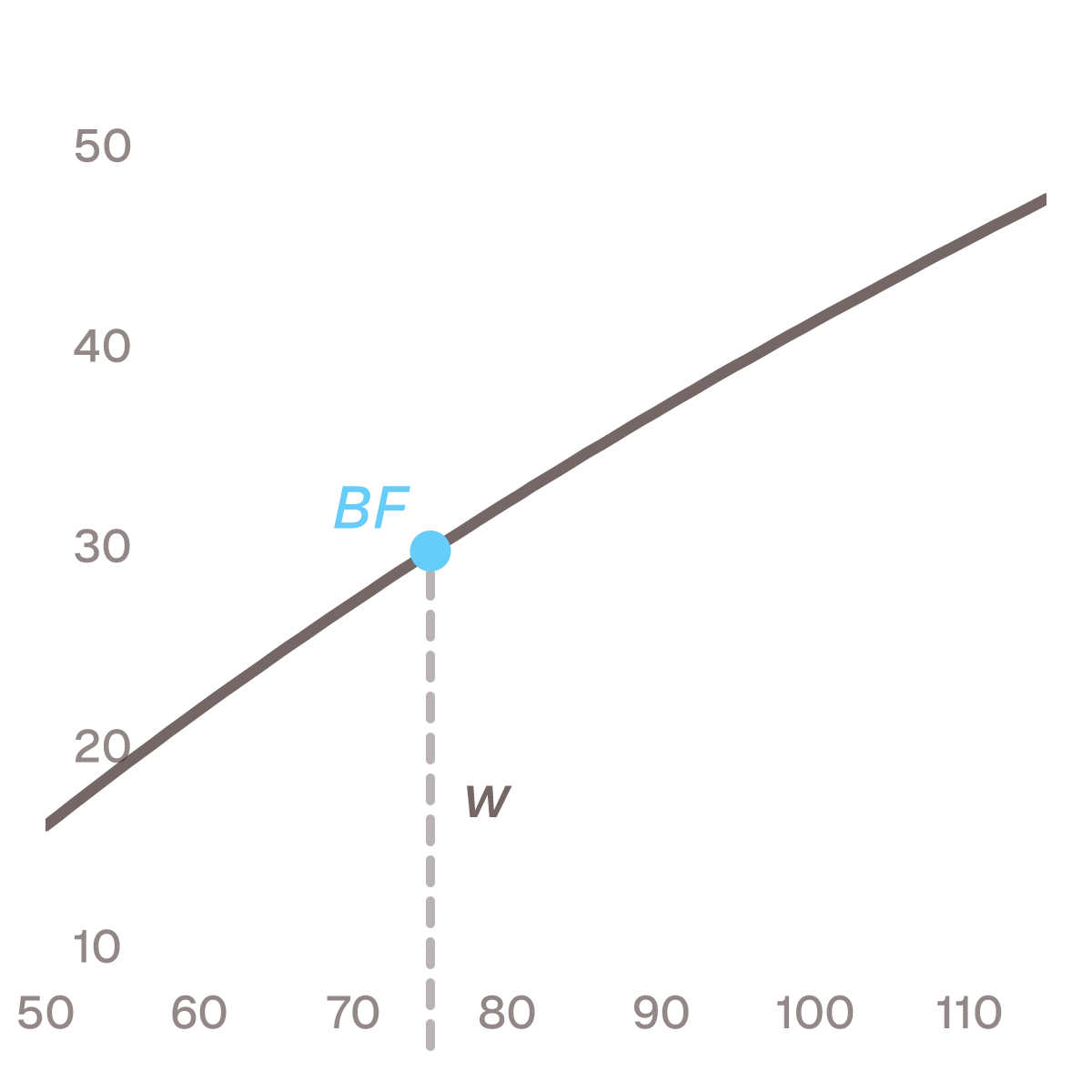
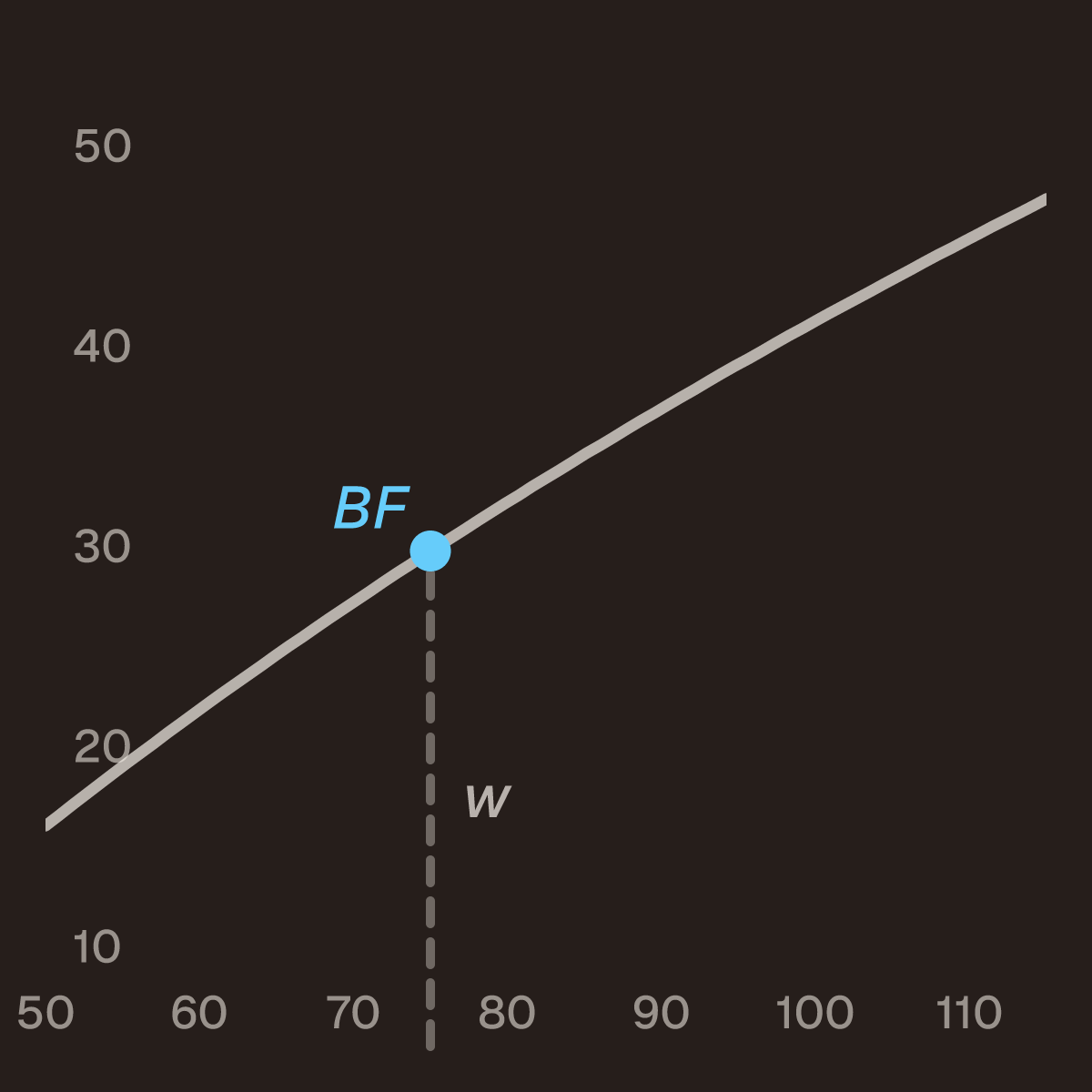
BF equals ((163.205 times the logarithm of (((75 plus 100) minus 33) divided by 2.54) to base 10) minus (97.684 times the logarithm of (165 divided by 2.54) to base 10)) minus 78.387, is approximately ((163.205 times the logarithm of ((175 minus 33) divided by 2.54) to base 10) minus (97.684 times the logarithm of (64.9606) to base 10)) minus 78.387, is approximately ((163.205 times the logarithm of (142 divided by 2.54) to base 10) minus (97.684 times 1.8127)) minus 78.387, is approximately ((163.205 times the logarithm of (55.9055) to base 10) minus 177.0669) minus 78.387, is approximately ((163.205 times 1.7475) minus 177.0669) minus 78.387, is approximately (285.1933 minus 177.0669) minus 78.387, is approximately 108.1264 minus 78.387, is approximately 29.7394
where w is the waist, p the hips, n the neck and h height, all in centimetres. log is the
base-10 logarithm, and dividing by 2.54 turns centimetres into inches, the unit the equation was fitted
in. The answer is body fat as a percentage.
The formula was developed by Hodgdon and Beckett at the US Naval Health Research Center in 1984, in a
separate study of women.
Worked example
A woman with a 75 cm waist, 100 cm hips, a 33 cm neck and a height of 165 cm:
Step
Working
Value
Waist plus hips minus neck, in inches
(75 + 100 − 33) / 2.54
55.91
First term
163.205 · log 55.91
285.19
Height in inches
165 / 2.54
64.96
Second term
97.684 · log 64.96
177.07
Sum
285.19 − 177.07 − 78.387
29.7%
Why a formula of its own
Women on average store more fat around the hips, which is why the hip measurement is included. All the
coefficients also differ from the formula for men.
They are two separate regressions, each fitted to its own group. So you cannot switch a constant for sex
to go from one to the other, as you can in the basal metabolic rate formula.
How sensitive it is to the tape
Two centimetres more around the waist, 77 instead of 75 cm, gives 30.7% instead of 29.7%. So measure the
same way every time: the waist at its narrowest, the hips at their widest, the neck just below the
larynx, with the tape snug but not pressing in.
What the formula leaves out
A follow-up study (Foulis and colleagues, 2023) found that the equations tend to underestimate body fat
in people with a lot of it and overestimate it in people with little. The formula is a way to estimate,
not to measure.
This is an estimate, not medical advice and not a measure of health.
Frequently asked questions
Why inches?
Because the equation was fitted to measurements in inches. The coefficients only hold if the
measurements are converted first. Changing the constants so centimetres can be used directly would be
possible, but then it would no longer be the formula in the source.
How is it different from BMI?
BMI only sees weight and height and cannot tell muscle from fat. This formula tries to estimate the fat
directly, from where on the body the circumference sits.
Looking for another letter? The formula solved for each one
Copy the code into your page where the formula card should appear. It loads from lovetocalc.com, so it stays current on its own — all we ask is that the credit line comes with it.