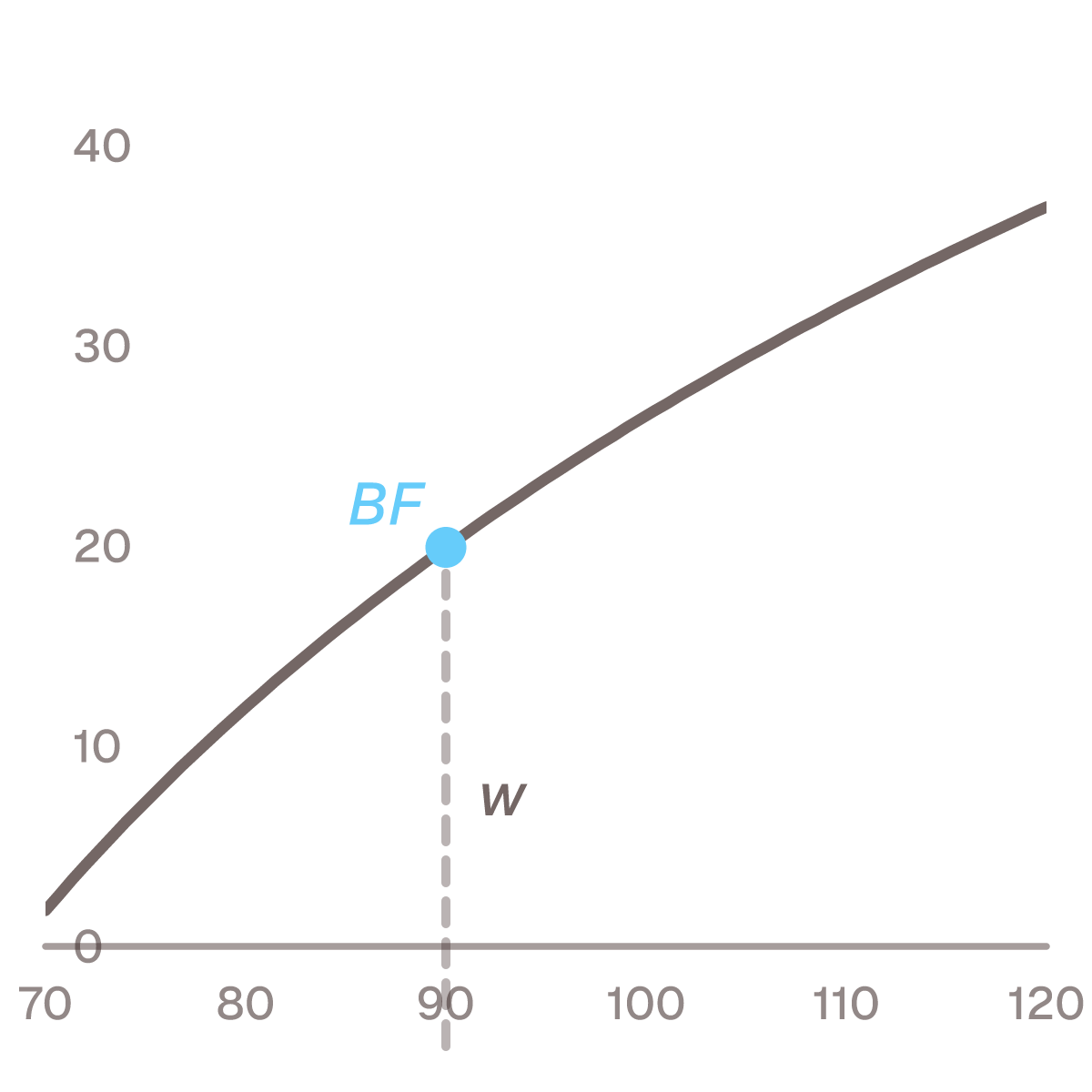
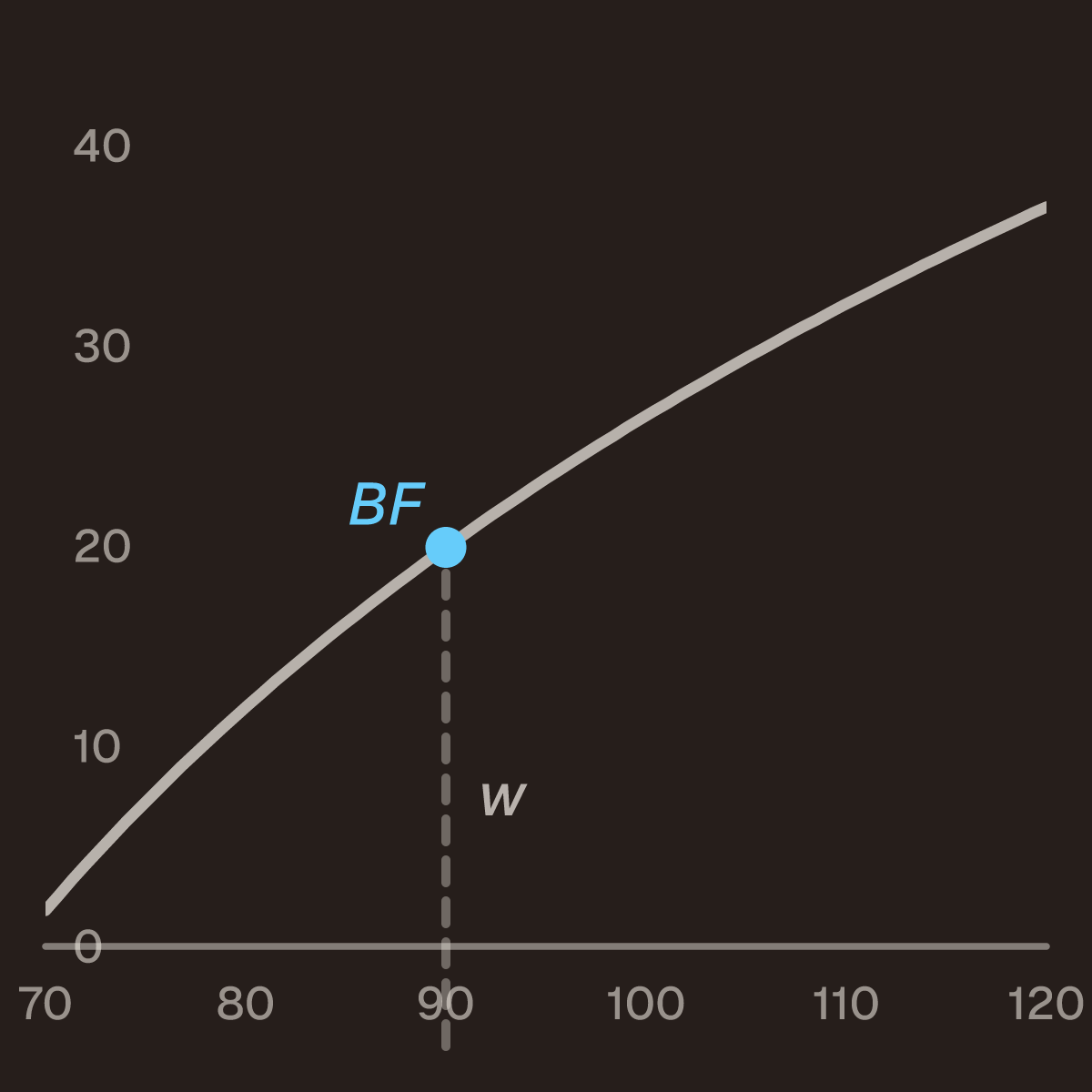
BF equals ((86.01 times the logarithm of ((90 minus 38) divided by 2.54) to base 10) minus (70.041 times the logarithm of (180 divided by 2.54) to base 10)) plus 36.76, is approximately ((86.01 times the logarithm of (52 divided by 2.54) to base 10) minus (70.041 times the logarithm of (70.8661) to base 10)) plus 36.76, is approximately ((86.01 times the logarithm of (20.4724) to base 10) minus (70.041 times 1.8504)) plus 36.76, is approximately ((86.01 times 1.3112) minus 129.6066) plus 36.76, is approximately (112.7737 minus 129.6066) plus 36.76, is approximately −16.8329 plus 36.76, is approximately 19.9271
where w is the waist measured over the abdomen, n the neck and h height, all in centimetres. log
is the base-10 logarithm. Dividing by 2.54 turns centimetres into inches, the unit the equation was
originally fitted in. The answer is body fat as a percentage.
The formula was developed by Hodgdon and Beckett at the US Naval Health Research Center in 1984, to
estimate body fat with nothing more than a tape measure.
Worked example
A man with a 90 cm waist, a 38 cm neck and a height of 180 cm:
Step
Working
Value
Waist minus neck, in inches
(90 − 38) / 2.54
20.47
First term
86.010 · log 20.47
112.77
Height in inches
180 / 2.54
70.87
Second term
70.041 · log 70.87
129.61
Sum
112.77 − 129.61 + 36.76
19.9%
Why those measurements
The difference between waist and neck captures fat around the abdomen. The neck stands for body size,
which changes little with fat. Height scales the result, so that a tall and a short person with the same
measurements do not get the same answer. The logarithm is there because the relationship between
circumference and fat is not a straight line.
How sensitive it is to the tape
Two centimetres more around the waist, 92 instead of 90 cm, gives 21.3% instead of 19.9%. That is more
than many people change in a month. So measure the same way every time: the waist at the level of the
navel, the neck just below the larynx, with the tape snug but not pressing in.
What the formula leaves out
A follow-up study (Foulis and colleagues, 2023) found that the equations tend to underestimate body fat
in people with a lot of it and overestimate it in people with little, and that changes over eight weeks
of training were not captured well. The formula is a way to estimate, not to measure.
This is an estimate, not medical advice and not a measure of health.
Frequently asked questions
Why is there a different formula for women?
The women’s equation has a hip measurement and different coefficients. They are two regressions, each
fitted to its own group, not one formula with a term for sex. See
the formula for women.
How is it different from BMI?
BMI only sees weight and height and cannot tell muscle from fat. This formula tries to estimate the fat
directly, from where on the body the circumference sits.
Looking for another letter? The formula solved for each one
Copy the code into your page where the formula card should appear. It loads from lovetocalc.com, so it stays current on its own — all we ask is that the credit line comes with it.