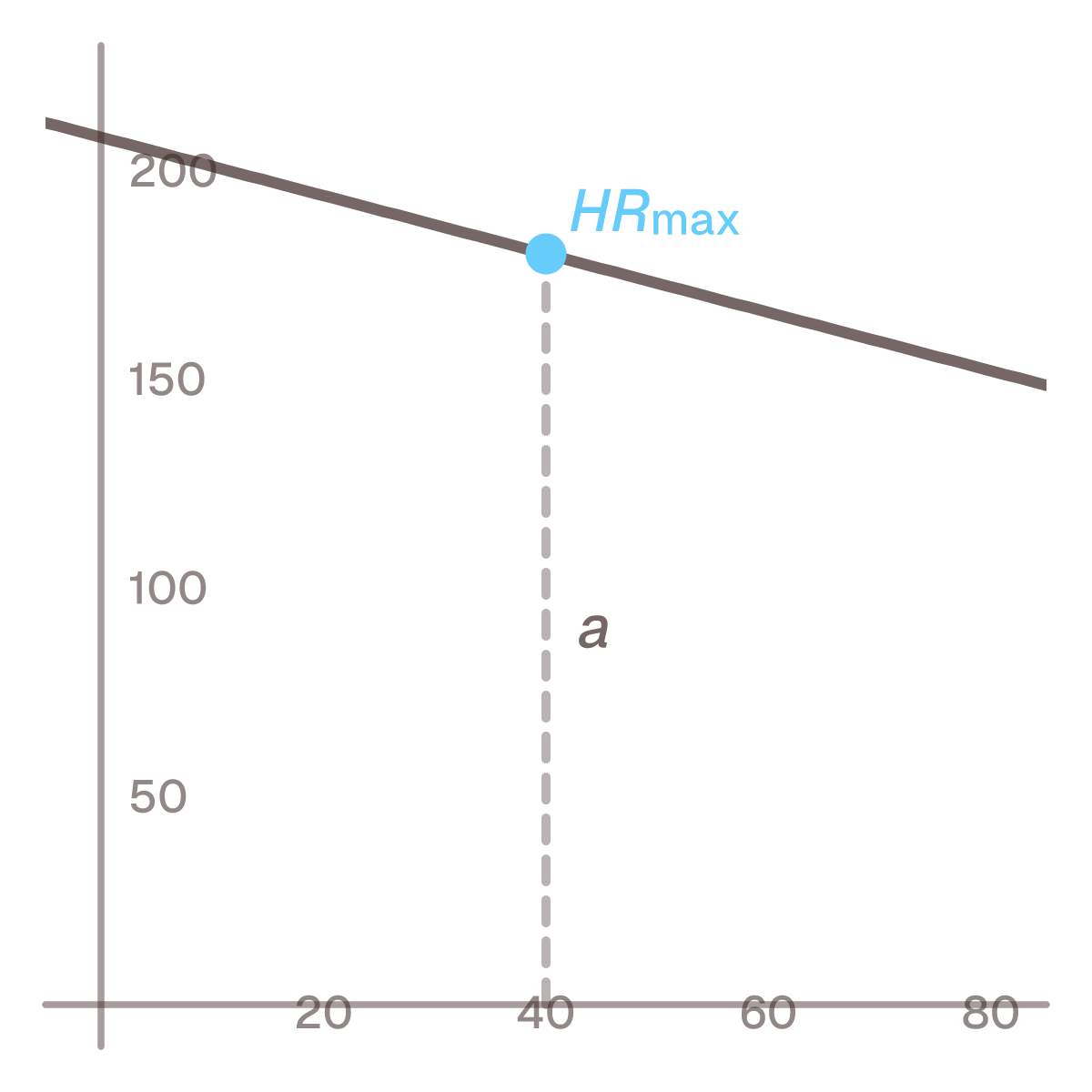
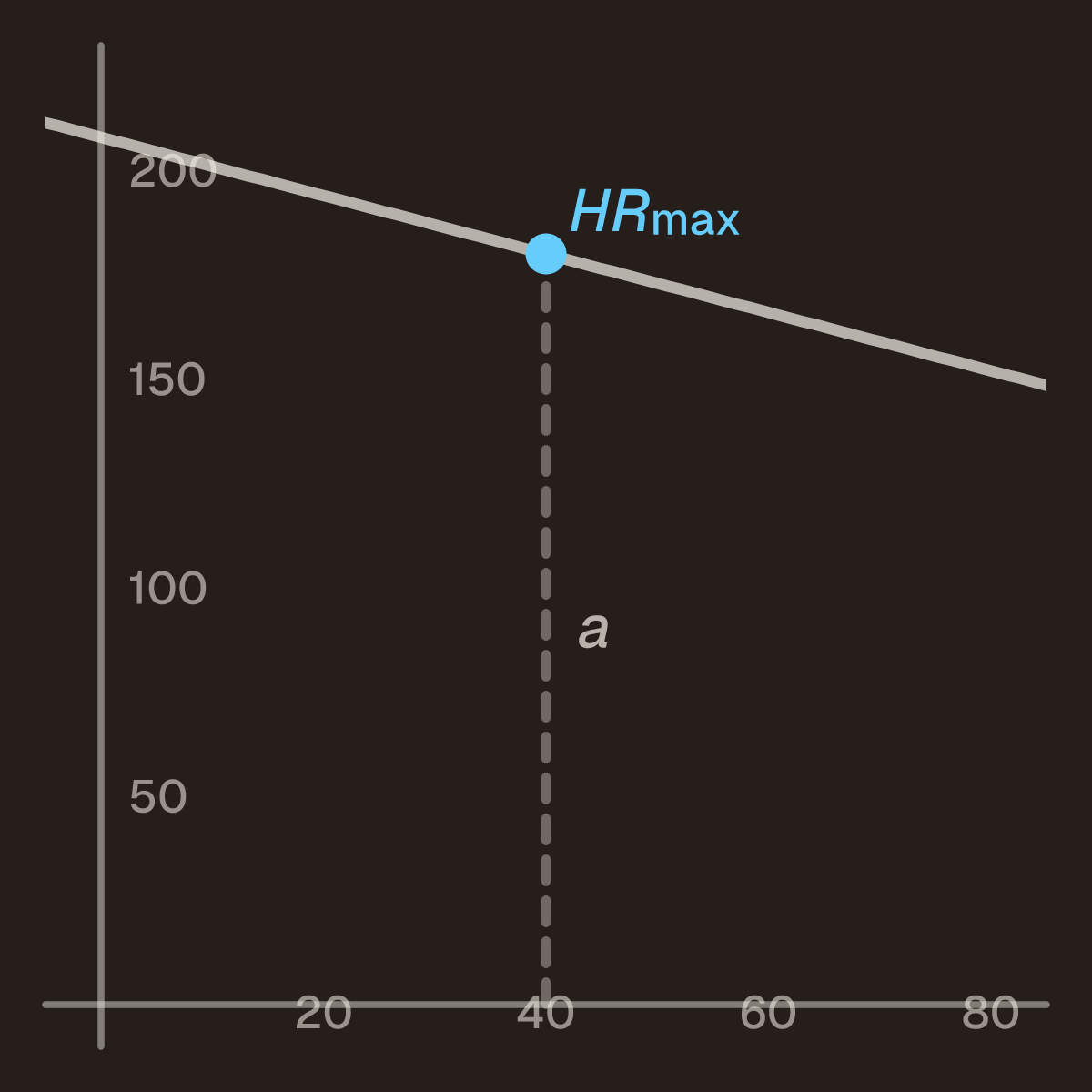
Tanaka’s formula estimates the highest heart rate the heart can reach, in beats per minute:
HRmax = 208 − 0.7a
where a is age in years. It comes from a review of 351 studies covering 18,712 people, and was then
tested in a laboratory on 514 healthy adults. There the line came out as 209 − 0.7 · age, in practice the
same. The line did not differ between men and women, and it did not depend on how fit people were.
Worked example
A 40-year-old: 208 − 0.7 · 40 = 208 − 28 = 180 beats per minute.
220 minus age
The older rule of thumb, 220 − age, is the one most people have heard. Tanaka and colleagues write that
it is commonly used but was never tested on enough older people, and that it underestimates maximum
heart rate in older adults. This is how the two compare:
Age
208 − 0.7 · age
220 − age
20
194
200
40
180
180
60
166
160
70
159
150
At 40 they give the same answer. Below that, Tanaka’s formula gives a lower value, above it a higher one,
and the gap grows the further from 40 you go.
What it is used for
Maximum heart rate is the starting point for training heart-rate zones: a zone is given as a share of
the maximum, such as 70–80%. For the 40-year-old above, 70% of 180 is 126 beats per minute.
What the formula leaves out
The individual. The formula gives an average. Two people of the same age can have maximum heart
rates ten beats or more apart, and no formula sees that.
Medication. Beta blockers, for example, lower the heart rate, and then no age formula applies.
Illness. The formula is based on healthy adults.
This is an estimate, not medical advice. Anyone with heart disease or symptoms should not train by a
formula but ask a clinician. A true maximum heart rate is measured in a test under controlled conditions.
Frequently asked questions
Why does my measured maximum differ from the formula?
Because the formula is an average over thousands of people. Your own maximum can be well above or below
it, and that says nothing about how fit you are. A measured maximum is better than the formula.
Does training lower maximum heart rate?
In Tanaka’s study, fitness did not change the relationship with age. What training changes is the
resting heart rate and how long you can stay near the maximum, not the maximum itself.
Does the formula apply to children?
No. It is based on adults and was not tested on children.
Looking for another letter? The formula solved for each one
Copy the code into your page where the formula card should appear. It loads from lovetocalc.com, so it stays current on its own — all we ask is that the credit line comes with it.