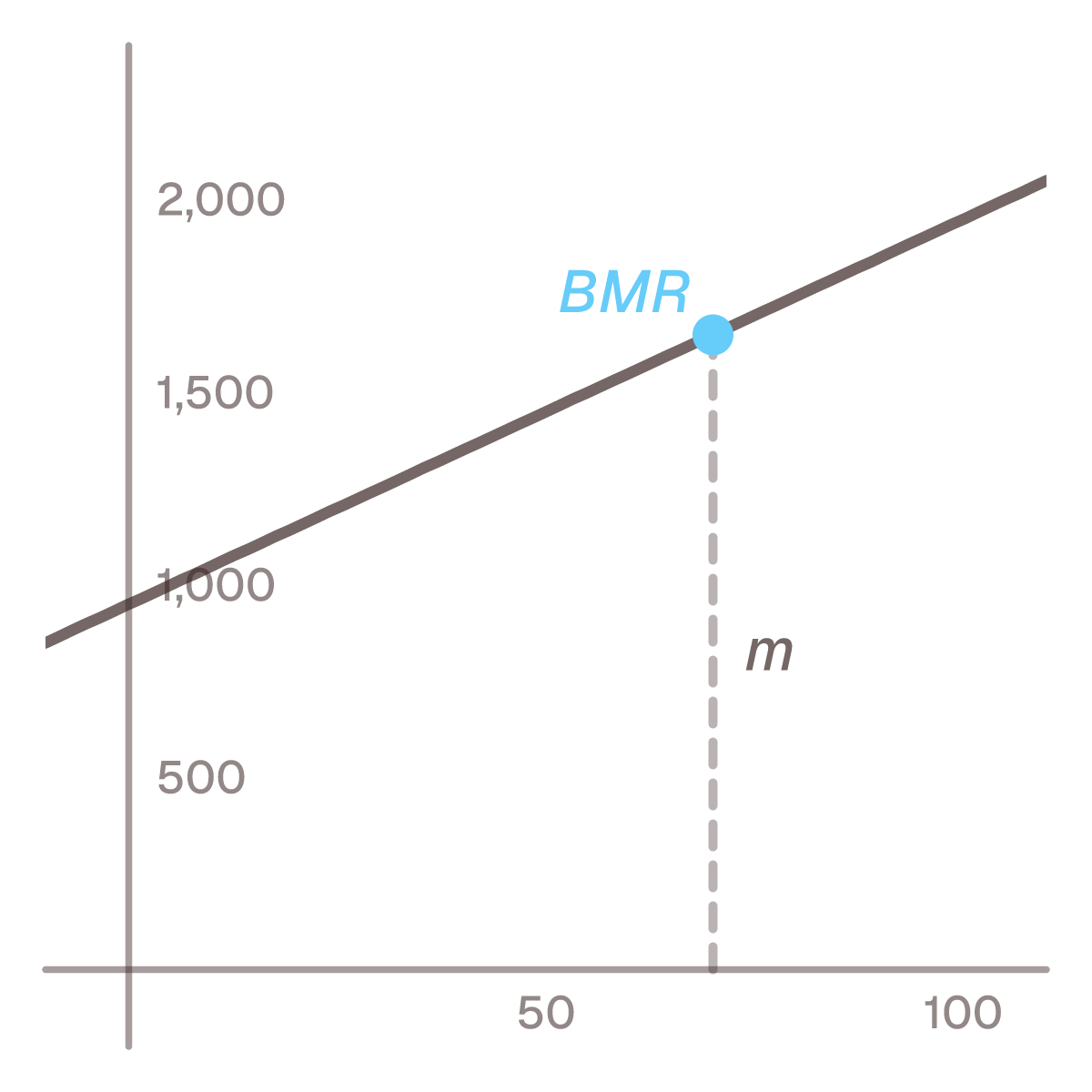
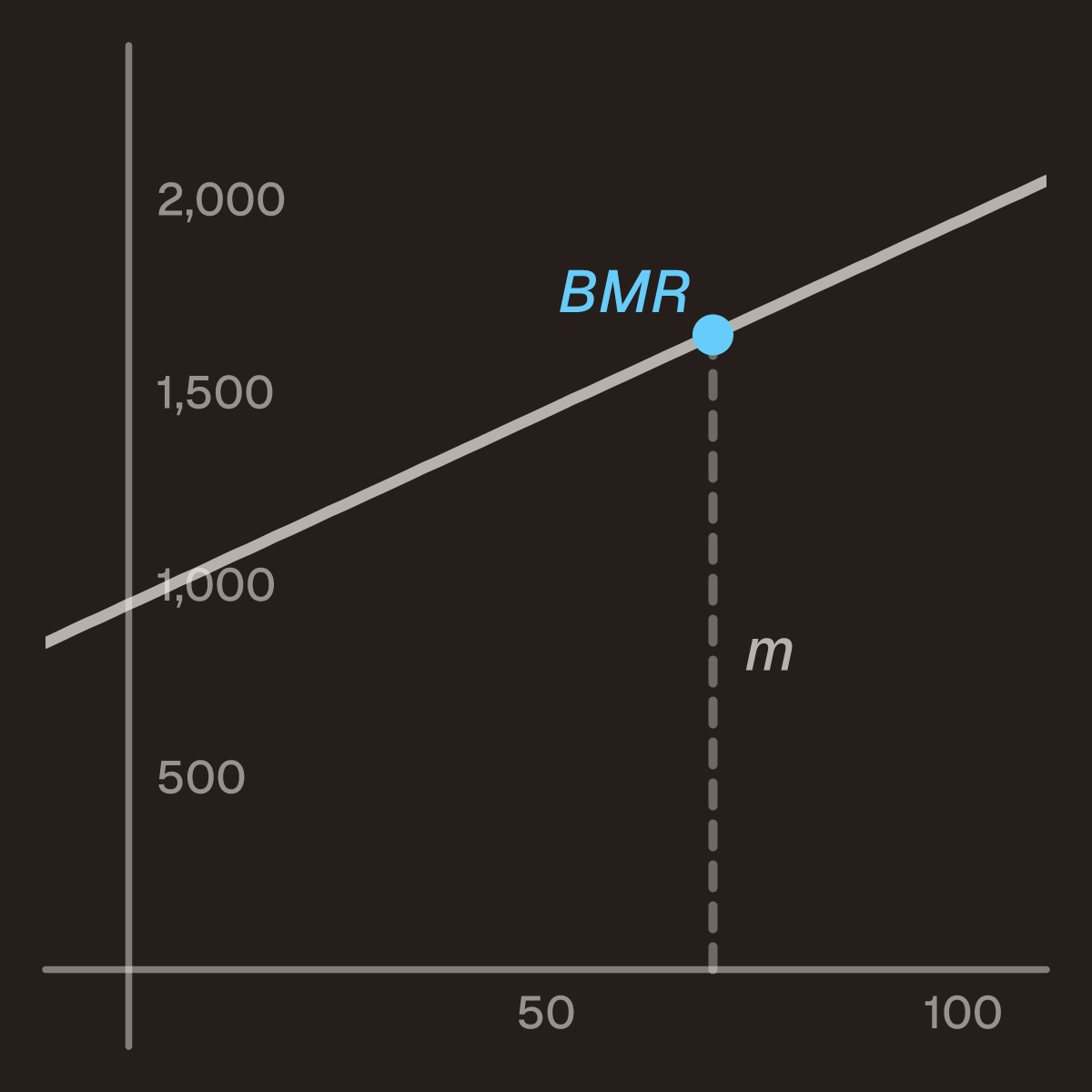
BMR equals (((10 times 70) plus (6.25 times 175)) minus (5 times 30)) plus 5, equals ((700 plus 1,093.75) minus 150) plus 5, equals (1,793.75 minus 150) plus 5, equals 1,643.75 plus 5, equals 1,648.75
The Mifflin–St Jeor equation estimates basal metabolic rate, the energy a body uses at rest over a day:
BMR = 10m + 6.25h − 5a + s
where m is weight in kilograms, h height in centimetres and a age in years. The constant s is
+5 for men and −161 for women. The answer is kilocalories per day.
The formula comes from a study in which 498 healthy adults, aged 19 to 78, had their energy use at rest
measured. The researchers then fitted an equation to the measurements. It is an average over many
people, not a measurement of one body.
Two worked examples
A man weighing 70 kg, 175 cm tall and 30 years old:
At the same weight, height and age the difference between the sexes is always 166 kcal, because
5 − (−161) = 166.
What each term means
The coefficients can be read straight off:
Each kilogram adds 10 kcal to the estimate.
Each centimetre adds 6.25 kcal.
Each year takes off 5 kcal.
Two people who differ only by ten years of age get answers 50 kcal apart.
What the formula leaves out
Body composition. Muscle uses more energy than fat. In the study, fat-free mass was the best single
predictor of energy use, but the formula only sees weight. Two people of the same weight and different
muscle mass get the same answer.
Activity. Basal metabolic rate is the energy at rest. What you need in a day is higher, depending
on how much you move.
The individual body. The formula explained about 70% of the variation in the study. The rest is
differences between people that no formula sees.
This is an estimate, not medical advice. With illness, an eating disorder, pregnancy or supervised weight
loss, the judgement of a clinician is what counts.
Frequently asked questions
Why is there a constant for sex?
Because the study found that men on average used more energy at rest than women of the same weight,
height and age. The full equation in the paper has a term 166 · sex. Split in two, that gives +5 and
−161.
How is it different from Harris–Benedict?
The Harris–Benedict equation dates from 1919 and was built on a different group of people. According to
Mifflin and colleagues it overestimated measured energy use by about 5%. That is why this page uses
Mifflin–St Jeor.
Are basal metabolic rate and resting energy expenditure the same?
Almost. The study measured resting energy expenditure (REE), and that is what the formula estimates.
Basal metabolic rate is measured under stricter
conditions, fasting and right after sleep. In everyday use the terms are used interchangeably.
Looking for another letter? The formula solved for each one
Copy the code into your page where the formula card should appear. It loads from lovetocalc.com, so it stays current on its own — all we ask is that the credit line comes with it.