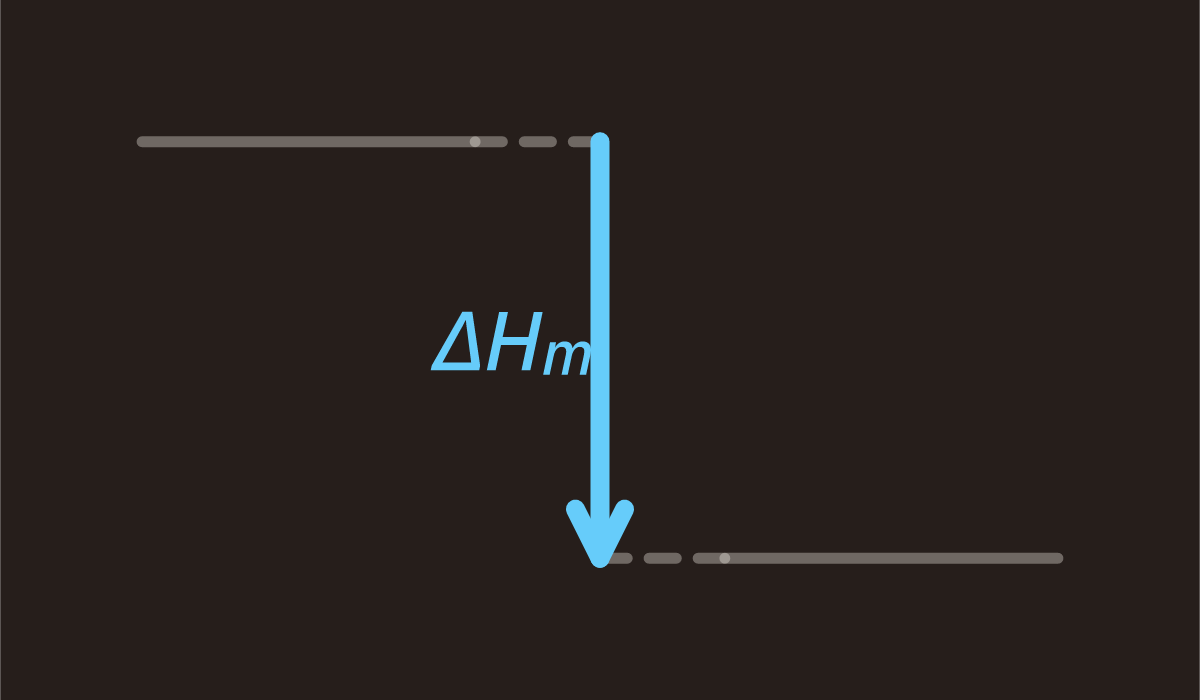
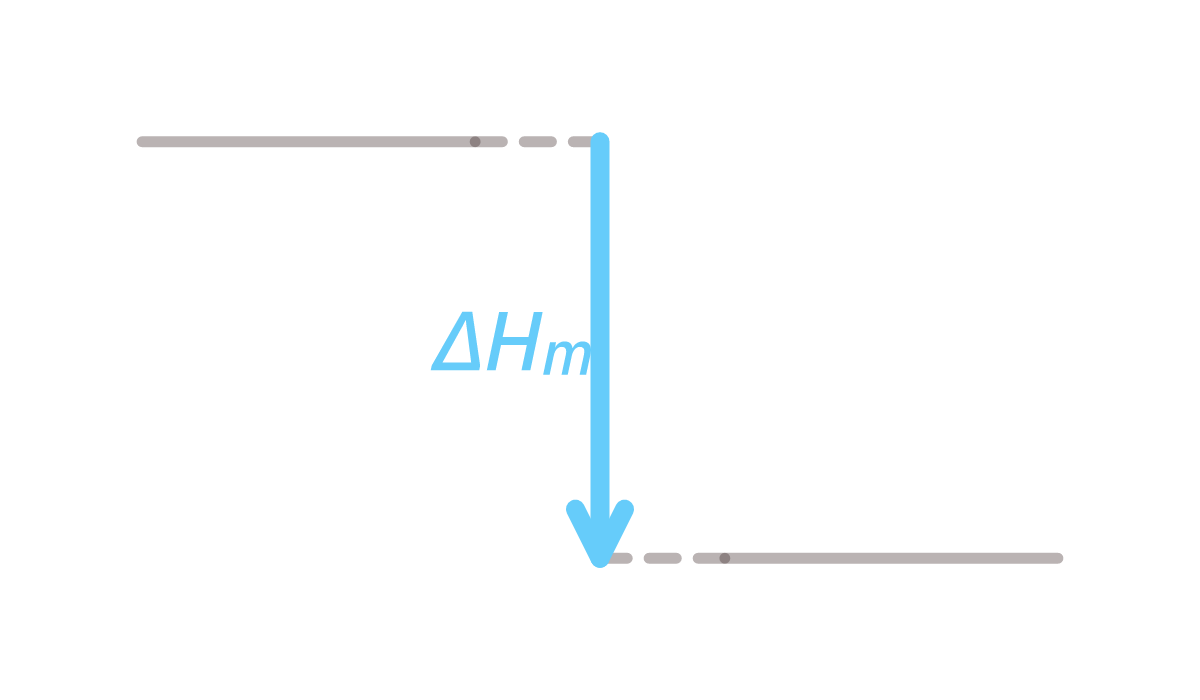
Molar reaction enthalpy
ΔHm
The heat a reaction gives off or takes up, divided by the number of moles that reacted. That gives the figure a table lists, whatever the amount in the flask.

ΔHm=−890
ΔH m equals −445 divided by 0.5, equals −890
Den här sidan finns på svenska. Byt till svenska
Definition — what does that mean?
The heat from a reaction depends on how much reacts. Per mole, it becomes a number you can look up.
In Swedish: Molär reaktionsentalpi
ΔHm
The heat a reaction gives off or takes up, divided by the number of moles that reacted. That gives the figure a table lists, whatever the amount in the flask.

ΔHm=−890
ΔH m equals −445 divided by 0.5, equals −890
You are given
ΔHm = q / n
ΔHm is the molar enthalpy in kJ/mol, q the heat the reaction gives off or takes up in kJ and n the
amount of substance that reacted, in moles.
Holds at constant pressure, where the heat the reaction exchanges equals the enthalpy change.
A reaction that gives off heat, exothermic, has a negative enthalpy: the system loses energy to its surroundings. One that takes up heat, endothermic, has a positive one. So q is negative when the surroundings warm up.
The defaults. 0.5 mol of methane burns and gives off 445 kJ: ΔHm = −445 / 0.5 = −890 kJ/mol, the value tables give for methane.
The other way. How much heat do 2 mol of methane give? q = n · ΔHm = 2 · (−890) = −1,780 kJ, that is 1,780 kJ given off.
How is the heat measured in a lab?
The reaction is left to warm a known amount of water, and the temperature rise is measured. The heat is
then the water’s mass times its specific heat capacity times the change in temperature.
| Solve for | Rearranged | With the numbers | Comes to |
|---|---|---|---|
| q | ΔHmn | −890·0.5 | −445 |
| n | qΔHm | −445−890 | 0.5 |
| ΔHm | qn | −4450.5 | −890 |
Table
| Substance | Formula | ΔHf° (kJ/mol) |
|---|---|---|
| Elements in their standard states | ||
| Hydrogen | H₂(g) | 0 |
| Oxygen | O₂(g) | 0 |
| Nitrogen | N₂(g) | 0 |
| Chlorine | Cl₂(g) | 0 |
| Carbon (graphite) | C(s) | 0 |
| Inorganic substances | ||
| Water, liquid | H₂O(l) | −285.830 |
| Water vapour | H₂O(g) | −241.826 |
| Carbon dioxide | CO₂(g) | −393.51 |
| Carbon monoxide | CO(g) | −110.53 |
| Ammonia | NH₃(g) | −45.94 |
| Hydrogen chloride | HCl(g) | −92.31 |
| Hydrogen fluoride | HF(g) | −273.30 |
| Hydrogen sulfide | H₂S(g) | −20.6 |
| Sulfur dioxide | SO₂(g) | −296.81 |
| Nitrogen dioxide | NO₂(g) | 33.10 |
| Sodium chloride | NaCl(s) | −411.12 |
| Calcium oxide (quicklime) | CaO(s) | −634.92 |
| Calcium carbonate (calcite) | CaCO₃(s) | −1,207.4 |
| Magnesium oxide | MgO(s) | −601.60 |
| Aluminium oxide | Al₂O₃(s) | −1,675.7 |
| Zinc oxide | ZnO(s) | −350.46 |
| Organic substances | ||
| Methane | CH₄(g) | −74.6 |
| Ethane | C₂H₆(g) | −84 |
| Ethene (ethylene) | C₂H₄(g) | 52.4 |
| Propane | C₃H₈(g) | −104.7 |
| Methanol | CH₃OH(l) | −239.5 |
| Ethanol | C₂H₅OH(l) | −276 |
| Benzene | C₆H₆(l) | 49 |
Last reviewed October 6, 2026 ·How pages are reviewed
Copy the code into your page where the formula card should appear. It loads from lovetocalc.com, so it stays current on its own — all we ask is that the credit line comes with it.