ΔH is the reaction’s molar enthalpy in J/mol, ΔS
its molar entropy in J/(mol·K), T the temperature in kelvin and ΔG the molar Gibbs free energy in J/mol.
The subscript m means per mole of reaction as written.
Holds at constant temperature and pressure.
What the sign says
A negative ΔG means the reaction runs on its own at that temperature. A positive ΔG means it does not: it
needs energy from outside, or it runs the other way. At ΔG = 0 the reaction is at equilibrium.
Two things push. Giving off heat (negative ΔH) favours the reaction, and so does increasing disorder
(positive ΔS). When both point the same way, the answer is the same at every temperature. When they pull
against each other, the temperature decides, and the switch happens at T = ΔH / ΔS.
Worked examples
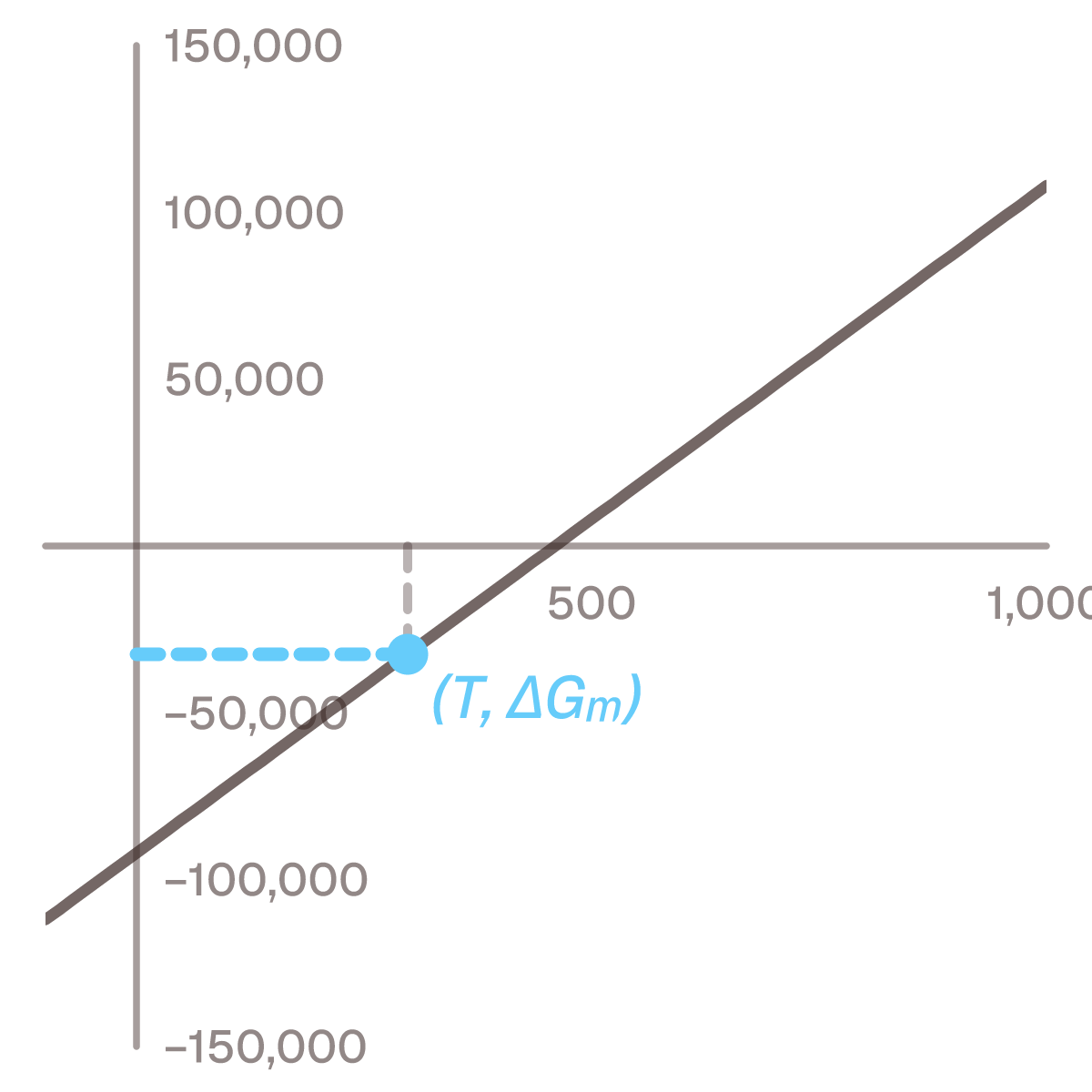
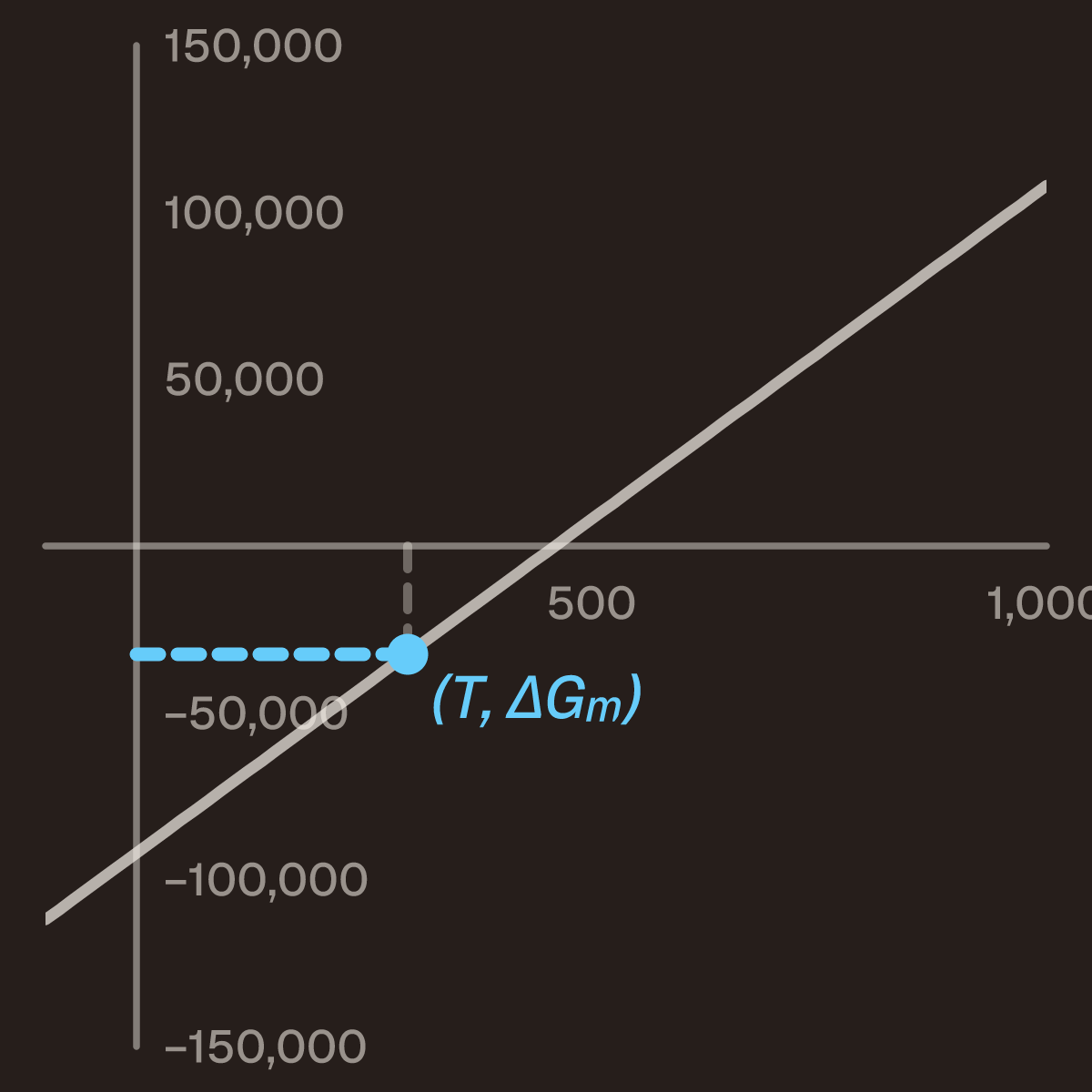
The defaults. An exothermic reaction that loses entropy: ΔH = −92,000 J/mol, ΔS = −200 J/(mol·K) and
T = 298 K. ΔG = −92,000 − 298 · (−200) = −92,000 + 59,600 = −32,400 J/mol, about −32 kJ/mol. It runs on
its own at room temperature.
Where it turns. The same reaction stops running at T = −92,000 / −200 = 460 K. Above that, the entropy
term wins and ΔG turns positive. That is why such a reaction gives a better yield at a low temperature.
An endothermic reaction that still goes. ΔH = +40,000 J/mol, ΔS = +150 J/(mol·K), T = 310 K:
ΔG = 40,000 − 310 · 150 = 40,000 − 46,500 = −6,500 J/mol. It absorbs heat and runs anyway, because the
gain in entropy pays for it. Below 40,000 / 150 ≈ 267 K it would not.
Common mistakes
- Mixing kJ and J. ΔH is usually given in kJ/mol and ΔS in J/(mol·K). Convert one of them before
multiplying, or the entropy term is a thousand times too large.
- Using degrees Celsius. T must be in kelvin: 25 °C is 298 K.
- Reading a negative ΔG as fast. ΔG says whether a reaction can run, not how quickly. Diamond turning into
graphite has a negative ΔG and takes longer than anyone will wait.
Frequently asked questions
How does ΔG connect to the equilibrium constant?
Under standard conditions, ΔG° = −RT ln K. A negative ΔG° gives K above 1, so the products dominate at
equilibrium. The Gibbs energy and equilibrium constant
page works it through.
How does it connect to a battery’s voltage?
For an electrochemical cell, ΔG = −zFE: a positive cell voltage means a negative ΔG, a reaction that
drives current on its own. The Nernst equation
gives E away from standard conditions.