Inverse proportion
The relation
y
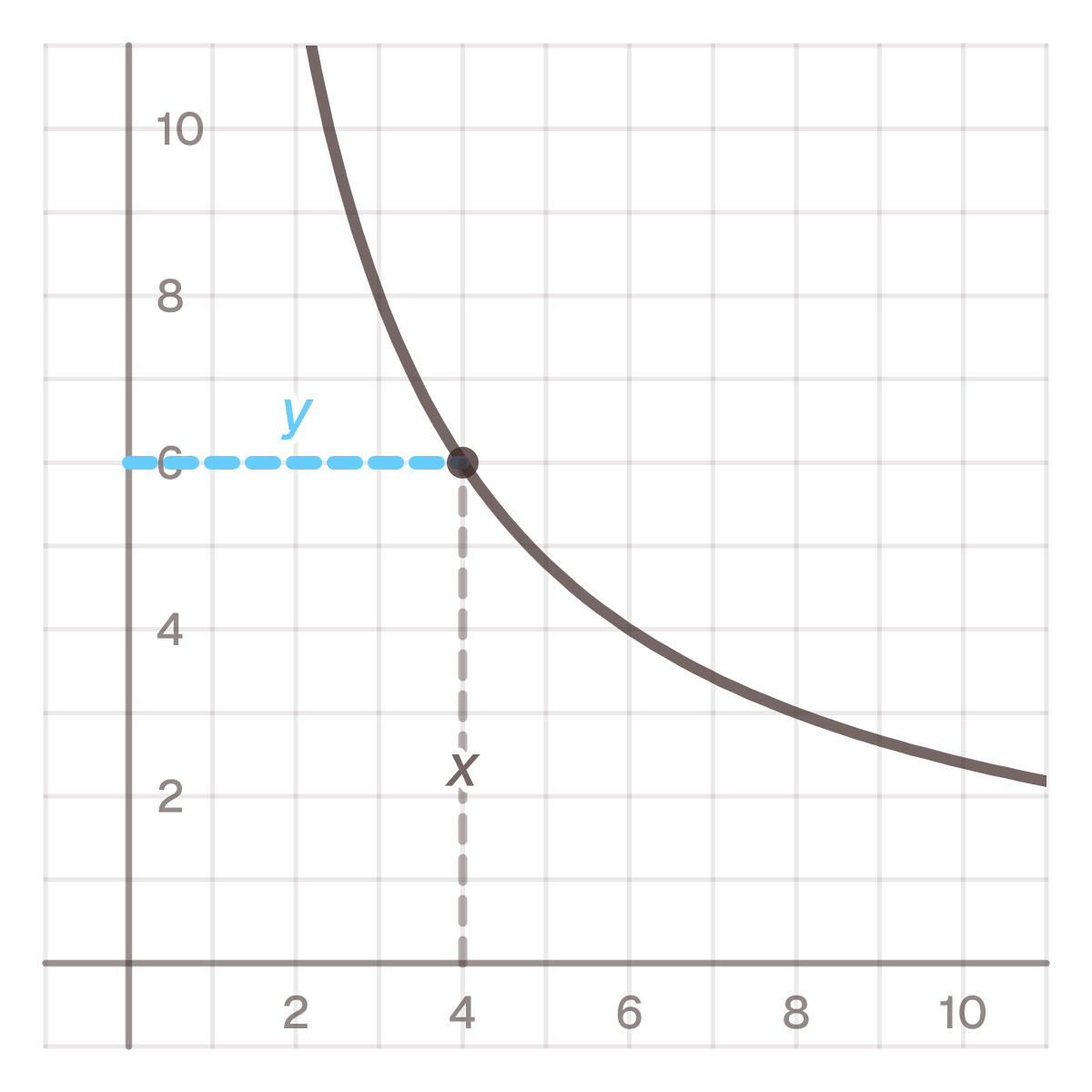
Double one and the other halves. The product of them is the same whatever pair you pick.
Solve for
y=6
y equals 24 divided by 4, equals 6
Den här sidan finns på svenska. Byt till svenska
Definition — what does that mean?
Twice as much of one gives half as much of the other. The product of them never changes.
In Swedish: Omvänd proportionalitet
y
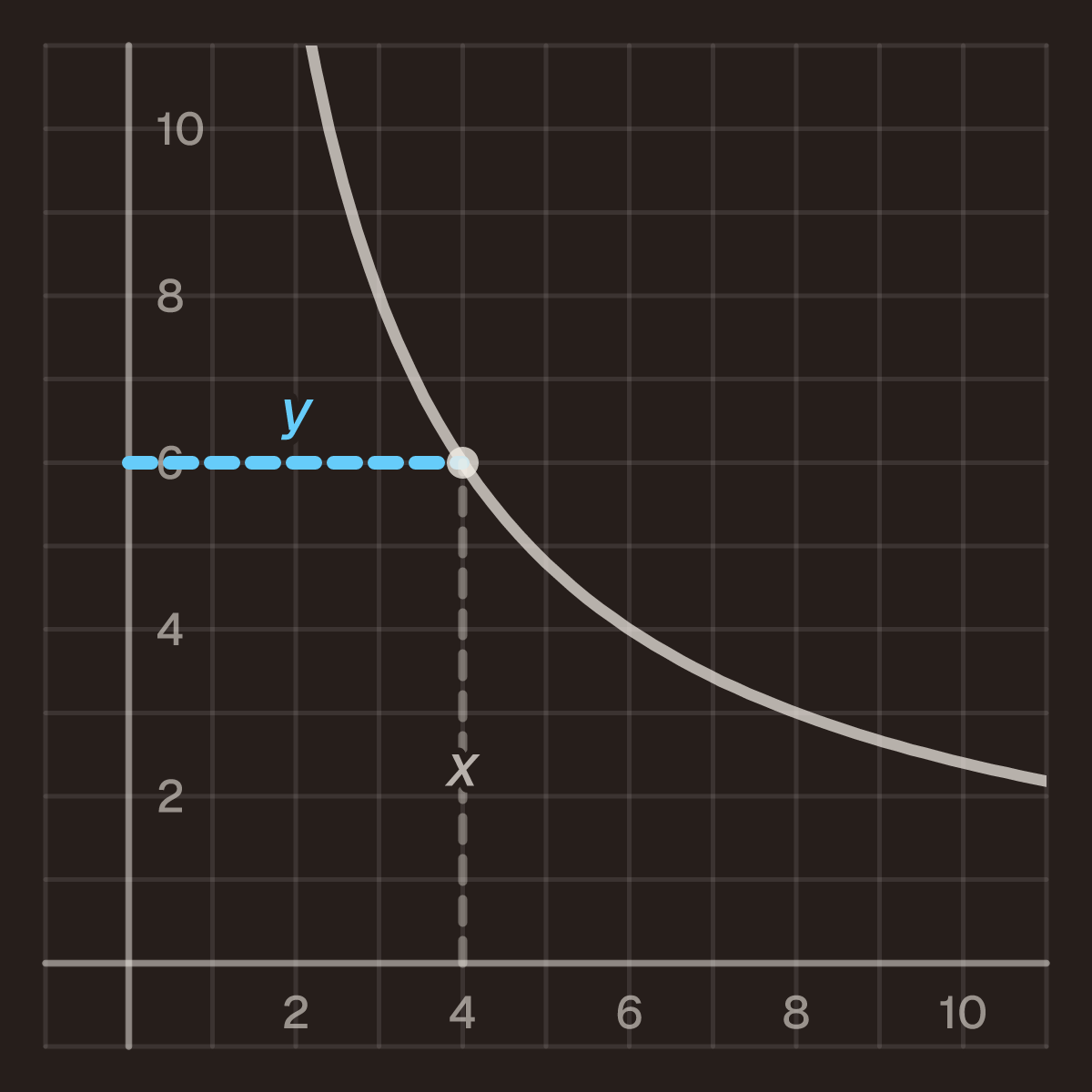
Double one and the other halves. The product of them is the same whatever pair you pick.
y=6
y equals 24 divided by 4, equals 6
You are given
Two quantities are inversely proportional when their product is constant. When one is multiplied by a factor, the other is divided by the same factor.
A common example is work: if four people paint a house in six days, twelve people take two. 4 · 6 = 24 and 12 · 2 = 24, and 24 is the constant — the number of person-days the job takes.
Other examples: speed and journey time over a fixed distance, the number of people and the size of each slice when a cake is shared, pressure and volume of a gas at the same temperature.
Multiply each x by its y. If the product is the same every time the relationship is inversely proportional.
| x | y | x · y |
|---|---|---|
| 2 | 12 | 24 |
| 4 | 6 | 24 |
| 8 | 3 | 24 |
Compare with direct proportion, where it is the quotient that stays constant. One test separates them: divide, then multiply. One of the two gives the same number every time — or neither does, and then the relationship is neither.
The curve never reaches either axis. As x grows, y creeps towards zero without arriving; as x shrinks, y grows without bound.
That is in the formula too: y = k/x is undefined at x = 0, and y can never be 0 however large x gets. Four people paint the house in six days, but no people never paint it.
Find the constant. 5 machines do the job in 18 hours. k = 5 · 18 = 90 machine-hours.
Use it. With 6 machines it takes 90 / 6 = 15 hours.
Backwards. To finish in 10 hours you need 90 / 10 = 9 machines.
Journey time. A distance takes 3 hours at 80 km/h. The constant is 240 km, so at 120 km/h it takes 240 / 120 = 2 hours.
What unit does k have?
The product of the two units: person-days, machine-hours, kilometres. Often it is the unit that reveals
what the constant actually is.
Can k be negative?
Yes, mathematically. The curve then sits in the second and fourth quadrants. In practical problems k is
almost always positive, since it measures an amount of work or a distance.
Is it the same as exponential decay?
No. Here the product is constant; in
exponential change it is the ratio
between successive values that is constant. Both curves fall, but at different rates and for different
reasons.
| Solve for | Rearranged | With the numbers | Comes to |
|---|---|---|---|
| x | ky | 246 | 4 |
| k | yx | 6·4 | 24 |
| y | kx | 244 | 6 |
Last reviewed October 6, 2026 ·How pages are reviewed
Copy the code into your page where the formula card should appear. It loads from lovetocalc.com, so it stays current on its own — all we ask is that the credit line comes with it.