Share of a ratio
The relation
S
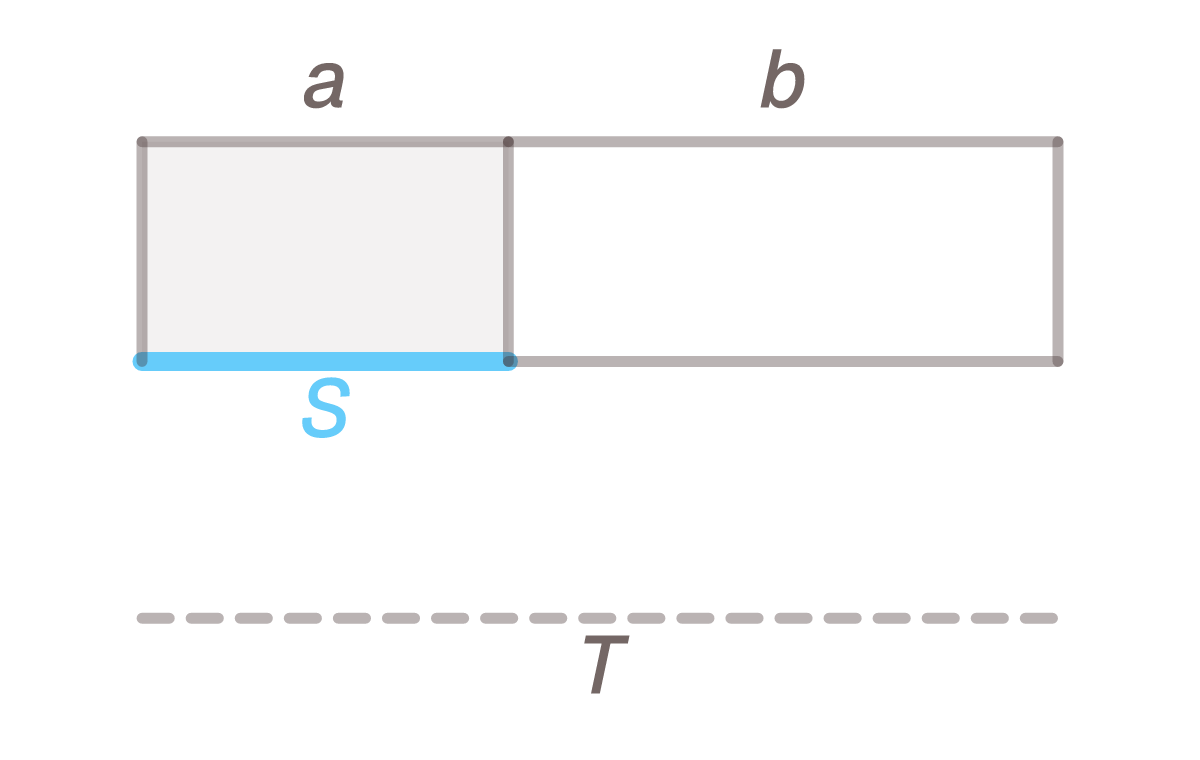
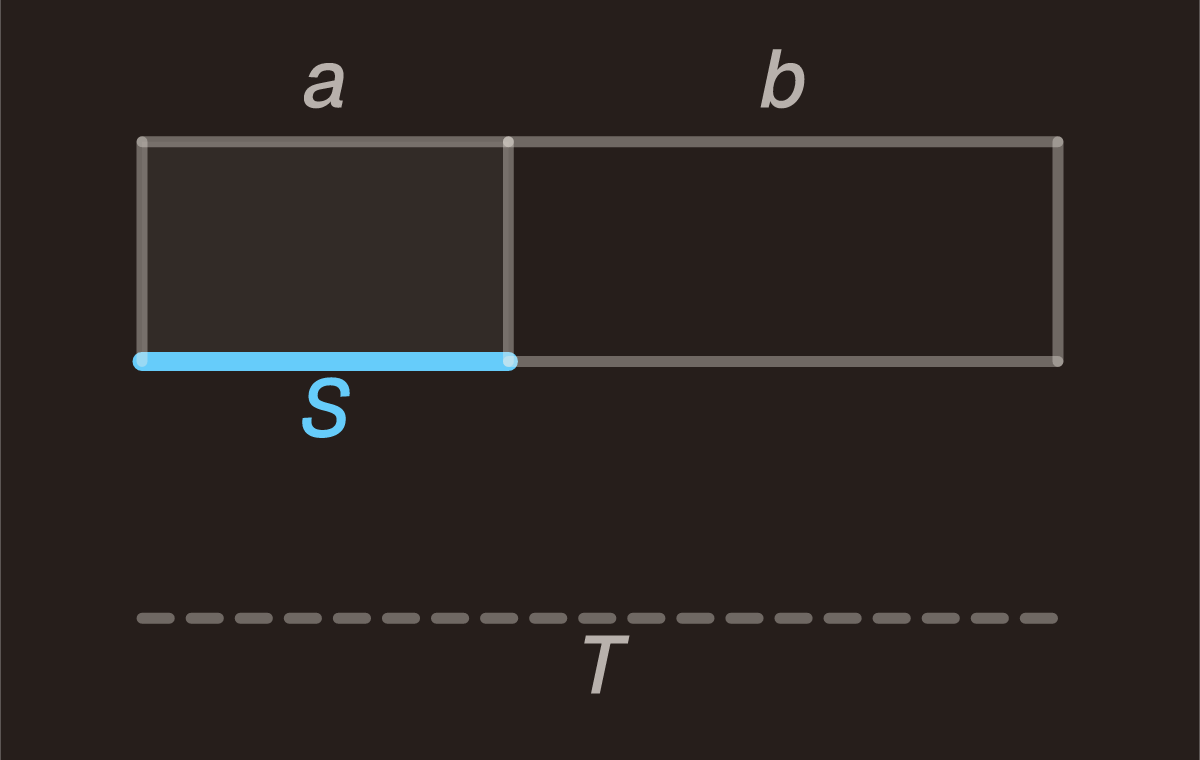
Splitting an amount in a given ratio: the total times one part over the sum of the parts.
Solve for
S=120
S equals (300 times 2) divided by (2 plus 3), equals 600 divided by 5, equals 120
Den här sidan finns på svenska. Byt till svenska
Theorem — what does that mean?
A ratio of 2:3 splits into five parts, not two. Count the parts first.
In Swedish: Andel i ett förhållande
S
Splitting an amount in a given ratio: the total times one part over the sum of the parts.
S=120
S equals (300 times 2) divided by (2 plus 3), equals 600 divided by 5, equals 120
You are given
An amount T is split in the ratio a:b. The sum a + b is the number of parts, T divided by that sum is what one part is worth, and one side gets a of those parts.
300 in the ratio 2:3. The parts number 2 + 3 = 5. One part is 300 / 5 = 60. The first side gets 2 · 60 = 120, the second 3 · 60 = 180.
The check is that the two shares must add back to the whole: 120 + 180 = 300. If they do not, something is wrong, and the first thing to check is the number of parts.
2:3 means two parts against three parts, that is 2/5 and 3/5 of the whole. It does not mean one side gets two thirds.
That misreading is common, and it shows up at once on a test: two thirds and three thirds add to more than the whole.
A ratio can be simplified just like a fraction. 6:9 is the same split as 2:3, since both numbers share a factor of 3. The split depends only on the proportion between the numbers, not on their size.
The formula is written for two sides because that is the common case, but the principle holds for any number: add all the parts, divide the amount by the sum, multiply by each side’s number.
1200 in the ratio 2:3:7. The parts number 12, one part is 100, and the shares are 200, 300 and 700. The total checks out: 1200.
Money. 1000 split 3:7 gives 300 and 700.
Ingredients. Squash is mixed 1:4 with water. One litre of the drink contains 1/5 litre of squash = 200 ml.
Backwards, the amount. One side got 150 on its number 5, and the other side’s number was 3. The whole amount is 150 · 8 / 5 = 240.
Backwards, the ratio. 300 was split and one side got 120. The other got 180, so the ratio was 120:180 = 2:3.
How is a ratio written?
With a colon: 2:3, read “two to three”. It is sometimes written as a fraction, but then it means the
quotient between the sides rather than either side’s share of the whole.
What if the split does not come out evenly?
Work exactly as far as you can and round last. 100 split 1:2 is 33.33 and 66.67 — in whole units it
becomes 33 and 67.
Can a ratio contain decimals?
Yes, but it is usually rewritten with whole numbers. 1.5:2 is the same as 3:4, and the second is easier
to work with.
| Solve for | Rearranged | With the numbers | Comes to |
|---|---|---|---|
| T | S(a | 120(2 | 300 |
| a | SbT | 120·3300 | 2 |
| b | a(T | 2(300 | 3 |
| S | Taa | 300·22 | 120 |
Last reviewed October 6, 2026 ·How pages are reviewed
Sheets that ask this formula, with their answer keys. Open one to see the questions or print it.
Six questions on direct proportion, six on sharing in a given ratio and four on equal fractions.
Copy the code into your page where the formula card should appear. It loads from lovetocalc.com, so it stays current on its own — all we ask is that the credit line comes with it.