Direct proportion
The relation
y
Double one and the other doubles. The quotient between them is the same whatever pair you pick.
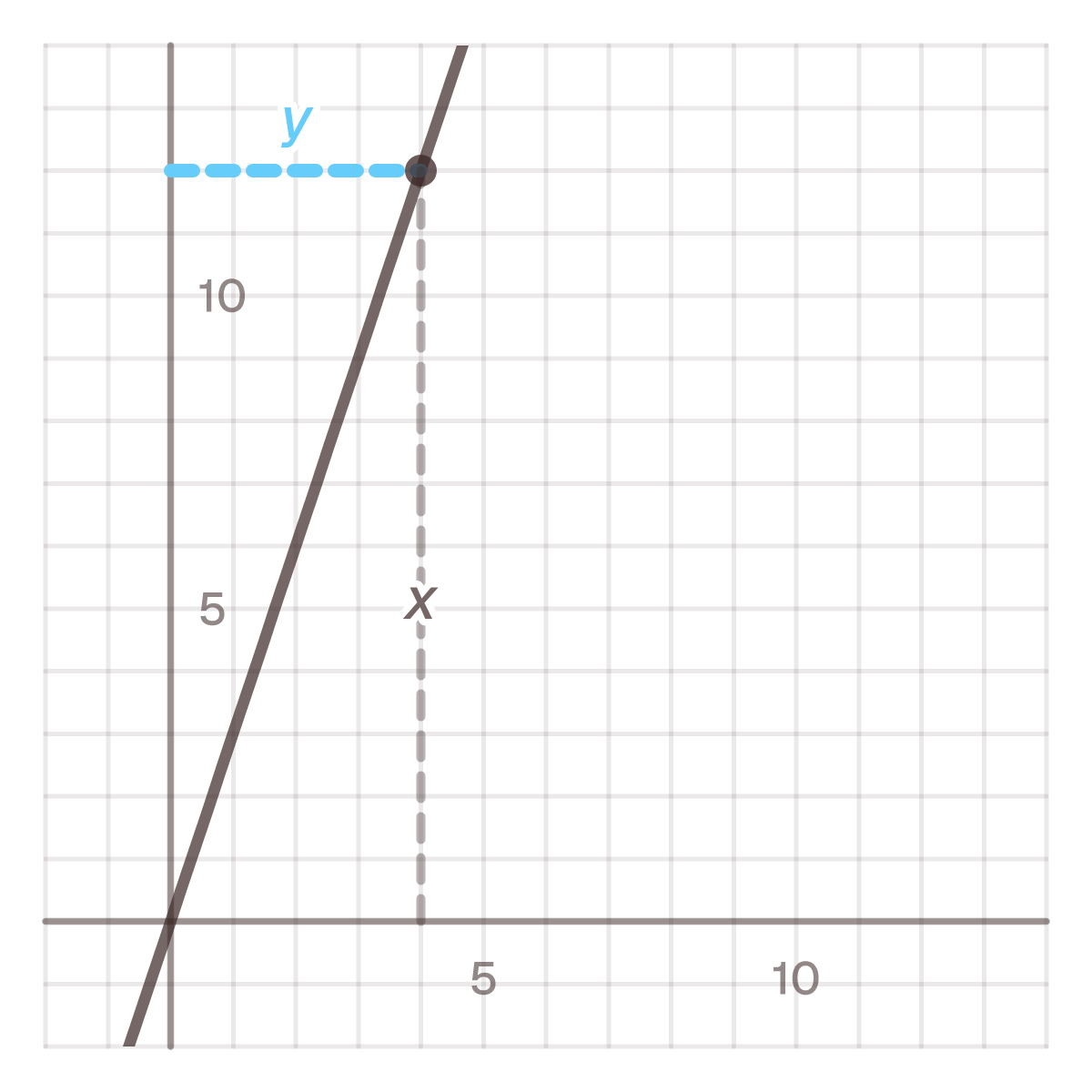
Solve for
y=12
y equals 3 times 4, equals 12
Den här sidan finns på svenska. Byt till svenska
Definition — what does that mean?
Twice as much of one gives twice as much of the other. The quotient between them never changes.
In Swedish: Direkt proportionalitet
y
Double one and the other doubles. The quotient between them is the same whatever pair you pick.
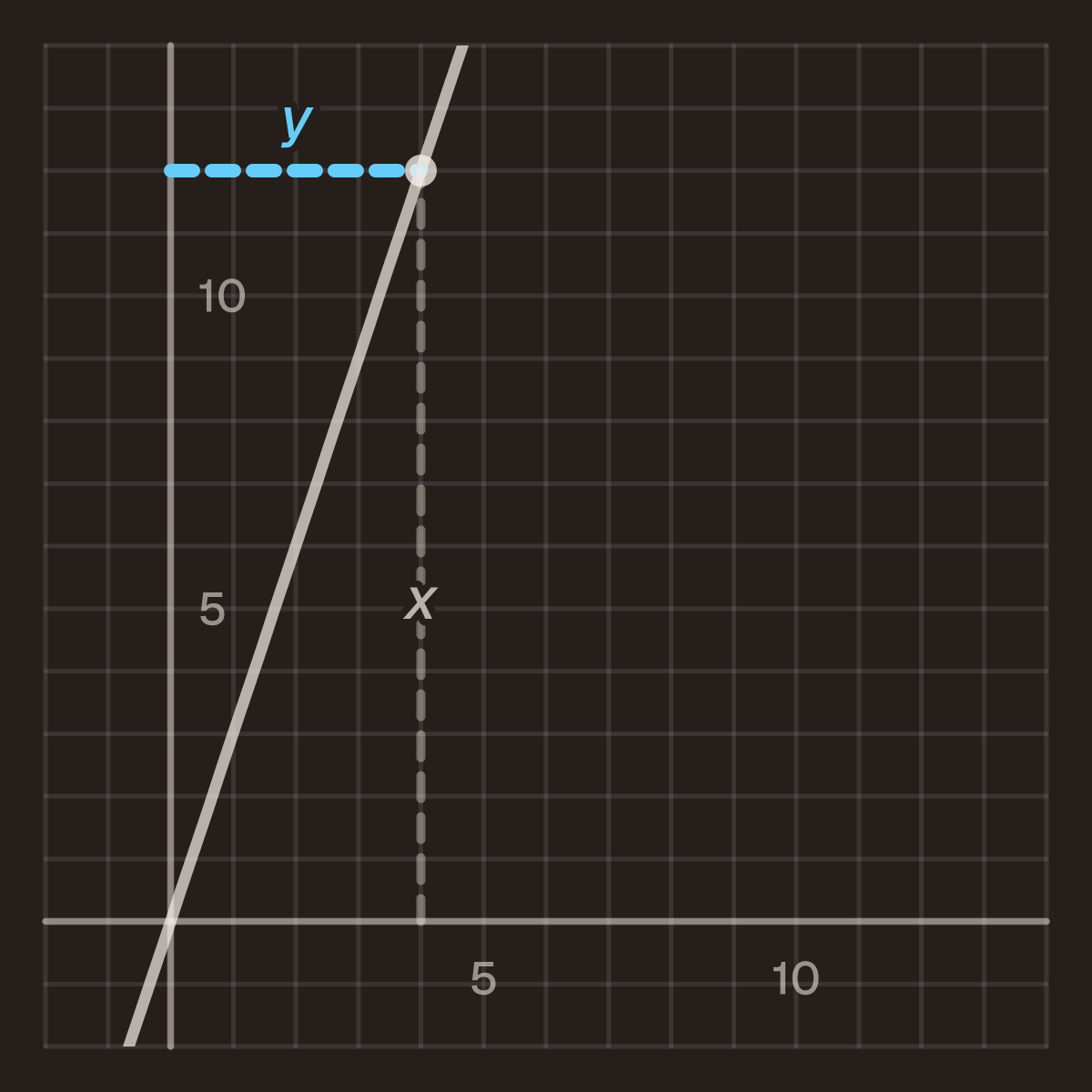
y=12
y equals 3 times 4, equals 12
You are given
Two quantities are directly proportional when one is always the same number times the other. That number k is called the constant of proportionality. The relationship is a linear function whose graph passes through the origin.
Three kilos of apples cost three times what one kilo costs. Five metres of fabric cost five times what one metre costs. In both cases k is the price per unit.
The same thing said as a quotient: y / x is the same number for every pair with x ≠ 0. That is the practical test, and the next section uses it.
Divide each y by its x. If you get the same number every time the relationship is proportional; if not, it is not.
| x | y | y / x |
|---|---|---|
| 2 | 6 | 3 |
| 5 | 15 | 3 |
| 8 | 24 | 3 |
The quotient is 3 throughout, so y = 3x.
A relationship that is not proportional gives itself away by a wandering quotient. A taxi fare with a pick-up charge is the classic case: 50 plus 20 per km gives 70 for one kilometre and 90 for two, and 70 is not half of 90. The relationship is linear but not proportional, because the line’s intercept is 50, not zero.
Graphically: a proportion is a straight line through the origin.
Find the constant. 7 kg costs 189. k = 189 / 7 = 27 per kg.
Use it. 12 kg costs 12 · 27 = 324.
Backwards. For 405 you get 405 / 27 = 15 kg.
What the unit means. k carries y’s unit over x’s: money per kilo, metres per second, money per hour.
Can k be negative?
Yes. Then one quantity falls as the other rises and the graph slopes downwards — still through the
origin.
How is this different from scale?
Not at all, mathematically. Scale is direct proportion
with a drawing in your hand, and the scale factor is k. Both pages exist because the questions are
asked differently.
Does x have to be positive?
No, the formula holds for any number. But to work out k you need an x that is not zero — at the origin
every constant fits.
| Solve for | Rearranged | With the numbers | Comes to |
|---|---|---|---|
| x | yk | 123 | 4 |
| k | yx | 124 | 3 |
| y | kx | 3·4 | 12 |
Last reviewed October 6, 2026 ·How pages are reviewed
Sheets that ask this formula, with their answer keys. Open one to see the questions or print it.
Six questions on direct proportion, six on sharing in a given ratio and four on equal fractions.
Copy the code into your page where the formula card should appear. It loads from lovetocalc.com, so it stays current on its own — all we ask is that the credit line comes with it.