Take the matrix with first row (a, b) and second row (c, d). Its determinant is
det = ad − bc
a and d sit on the main diagonal, from the top left to the bottom right. b and c sit on the other
diagonal. The determinant is the product of the first pair minus the product of the second.
It is written det A, or with straight bars around the matrix, |A|. The bars are the same ones used for
absolute value, and a determinant can be negative.
What the number tells you
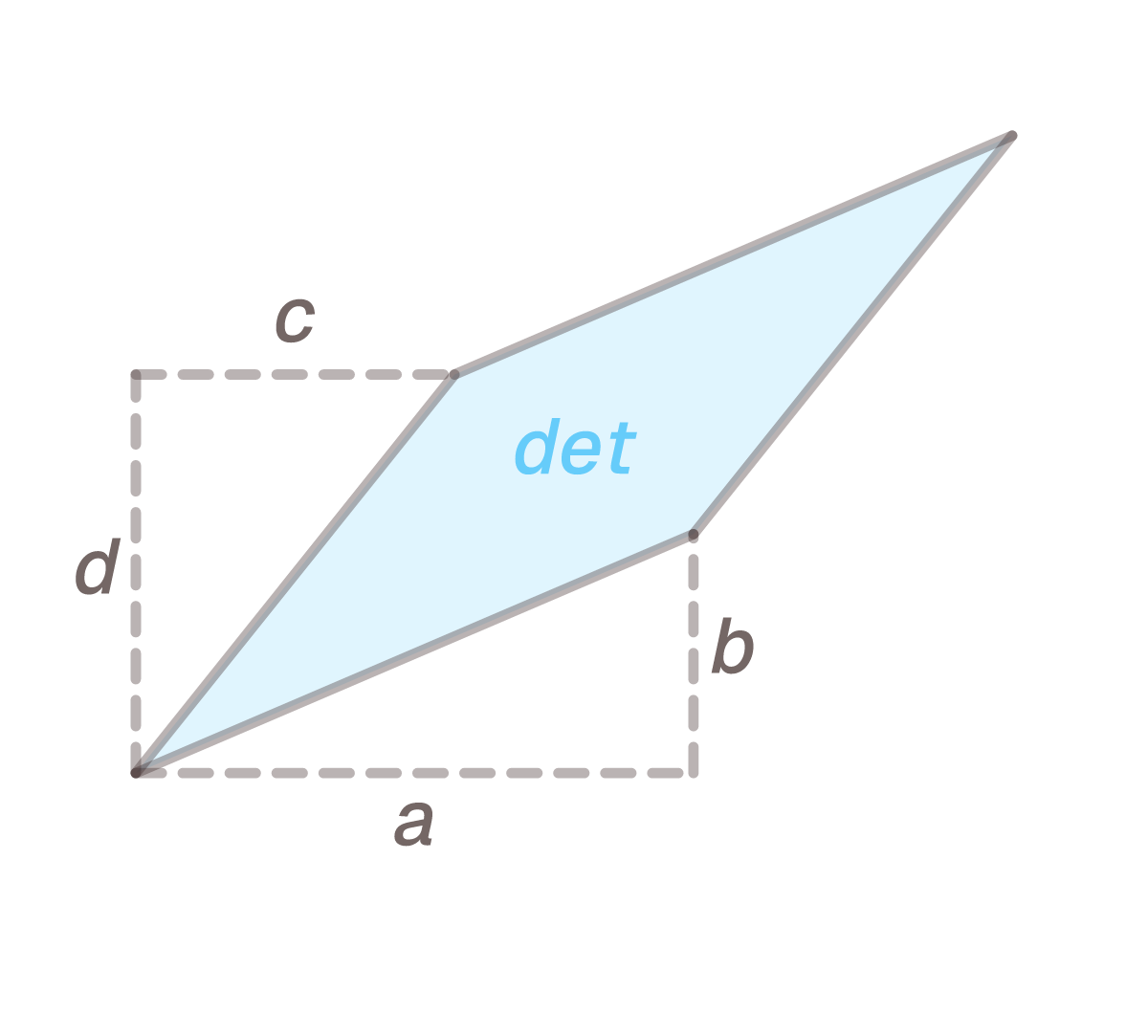
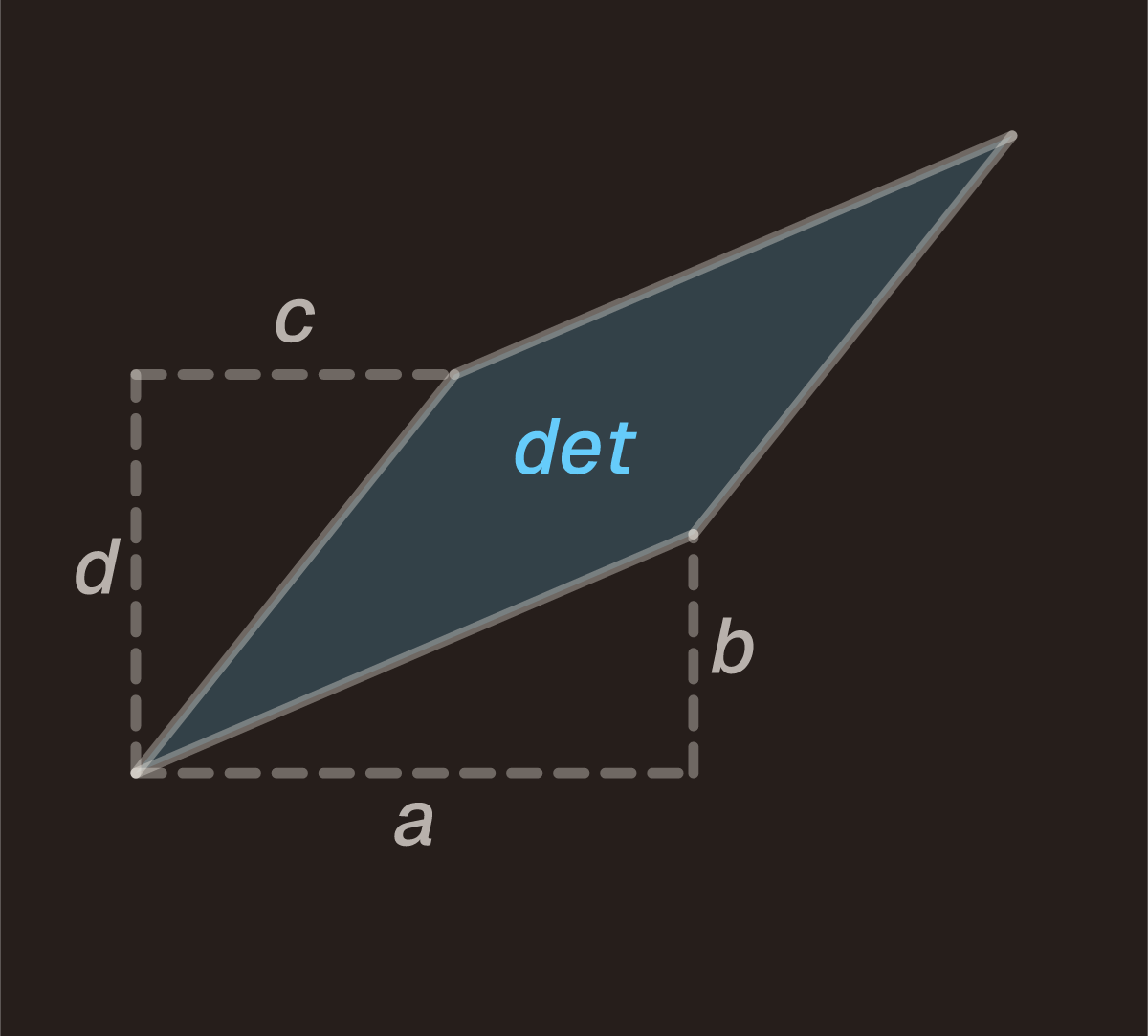
- The area. The rows (a, b) and (c, d) are two vectors from the origin. The parallelogram they span has
the area |ad − bc|, and the sign says whether the turn from the first row to the second is
counter-clockwise (positive) or clockwise (negative).
- Whether the matrix has an inverse. A 2×2 matrix has an inverse exactly when ad − bc ≠ 0. The inverse
is then the matrix with rows (d, −b) and (−c, a), divided by ad − bc.
- Whether a system has one solution. Two linear equations ax + by = e and cx + dy = f have exactly one
solution when ad − bc ≠ 0. Cramer’s rule uses the
determinant to write that solution down.
Worked examples
A positive determinant. The matrix with rows (7, 3) and (4, 5). The main diagonal gives 7 · 5 = 35 and
the other gives 3 · 4 = 12, so det = 35 − 12 = 23.
Negative entries. The matrix with rows (−2, 5) and (3, −4). The main diagonal gives
(−2) · (−4) = 8 and the other gives 5 · 3 = 15, so det = 8 − 15 = −7.
A determinant of zero. The matrix with rows (4, 6) and (2, 3). 4 · 3 = 12 and 6 · 2 = 12, so
det = 0. The second row is half of the first, which is what a zero determinant means for a 2×2 matrix:
one row is a multiple of the other, and the parallelogram they span is flat.
Finding a missing entry. For which d is the matrix with rows (6, 9) and (4, d) singular, that is, has
determinant 0? 6d − 9 · 4 = 0, so 6d = 36 and d = 6. The rows (6, 9) and (4, 6) are then proportional,
both in the ratio 3 : 2.
Reading the diagonals the right way
The mistake is to read the entries row by row. For the matrix with rows (7, 3) and (4, 5):
| What was computed |
Result |
Verdict |
| ad − bc, main diagonal first |
35 − 12 = 23 |
correct |
| ab − cd, the two rows |
21 − 20 = 1 |
wrong |
| ac − bd, the two columns |
28 − 15 = 13 |
wrong |
| ad + bc, plus instead of minus |
35 + 12 = 47 |
wrong |
All four are plausible numbers, which is why the diagonals have to be set out before multiplying. Swapping
the two diagonals gives bc − ad, which is the correct size with the wrong sign.
Common mistakes
- Multiplying along the rows or the columns. The products are along the diagonals.
- Adding the two products. The two diagonals are subtracted.
- Subtracting in the wrong order. The main diagonal comes first. bc − ad has the opposite sign.
- Losing a minus sign. In (−2) · (−4) the two minus signs make a plus. And when bc is negative,
subtracting it adds: 8 − (−6) = 14.
- Treating a determinant of 0 as an error. It is a legitimate answer. It means the matrix has no
inverse and a system built on it does not have exactly one solution.
Where to go next
Cramer’s rule solves two equations in two unknowns with
this determinant, and the
elimination method and the
substitution method solve the same
systems without it.
Common questions
Can a determinant be negative?
Yes. The sign is part of the answer: it records which diagonal product is larger. The area interpretation
uses the absolute value.
What does a determinant of 0 mean?
The rows are proportional, so the matrix has no inverse. For a system of two equations it means no
solution or infinitely many, depending on the right-hand sides.
Is there a determinant for a 3×3 matrix?
Yes, but it is a different formula with six products, not ad − bc. The 2×2 formula is the building block:
a 3×3 determinant is expanded along a row into three 2×2 determinants.
Does the formula work for any matrix?
Only for 2×2 matrices, and a determinant is defined only for square matrices. A matrix with two rows and
three columns has no determinant.