Skip to content
LoveToCalc

Definition — what does that mean?

Henderson-Hasselbalch equation

A buffer holds the pH still. This formula says which pH it holds.

In Swedish: Henderson-Hasselbalchs ekvation

Henderson-Hasselbalch equation

The relation

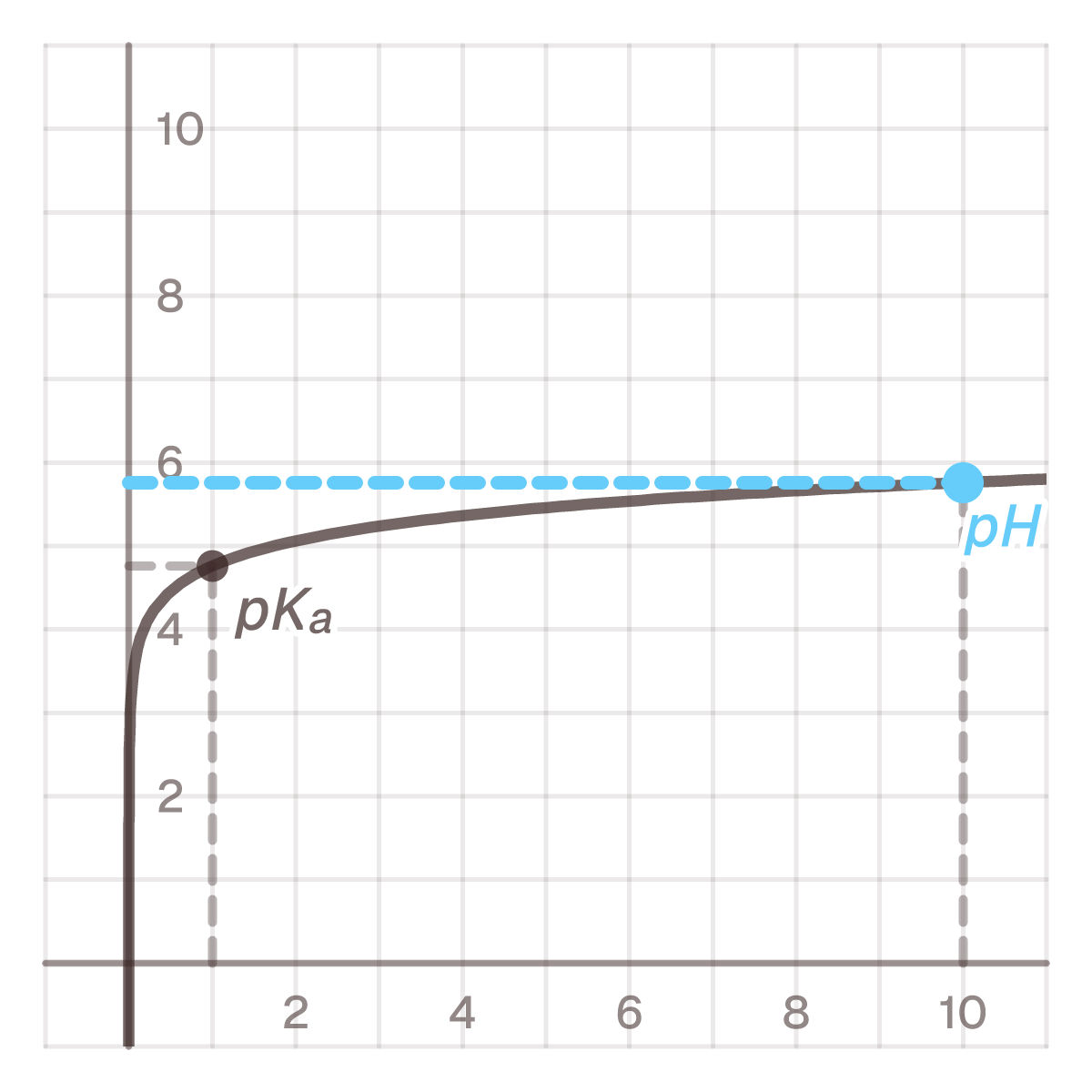
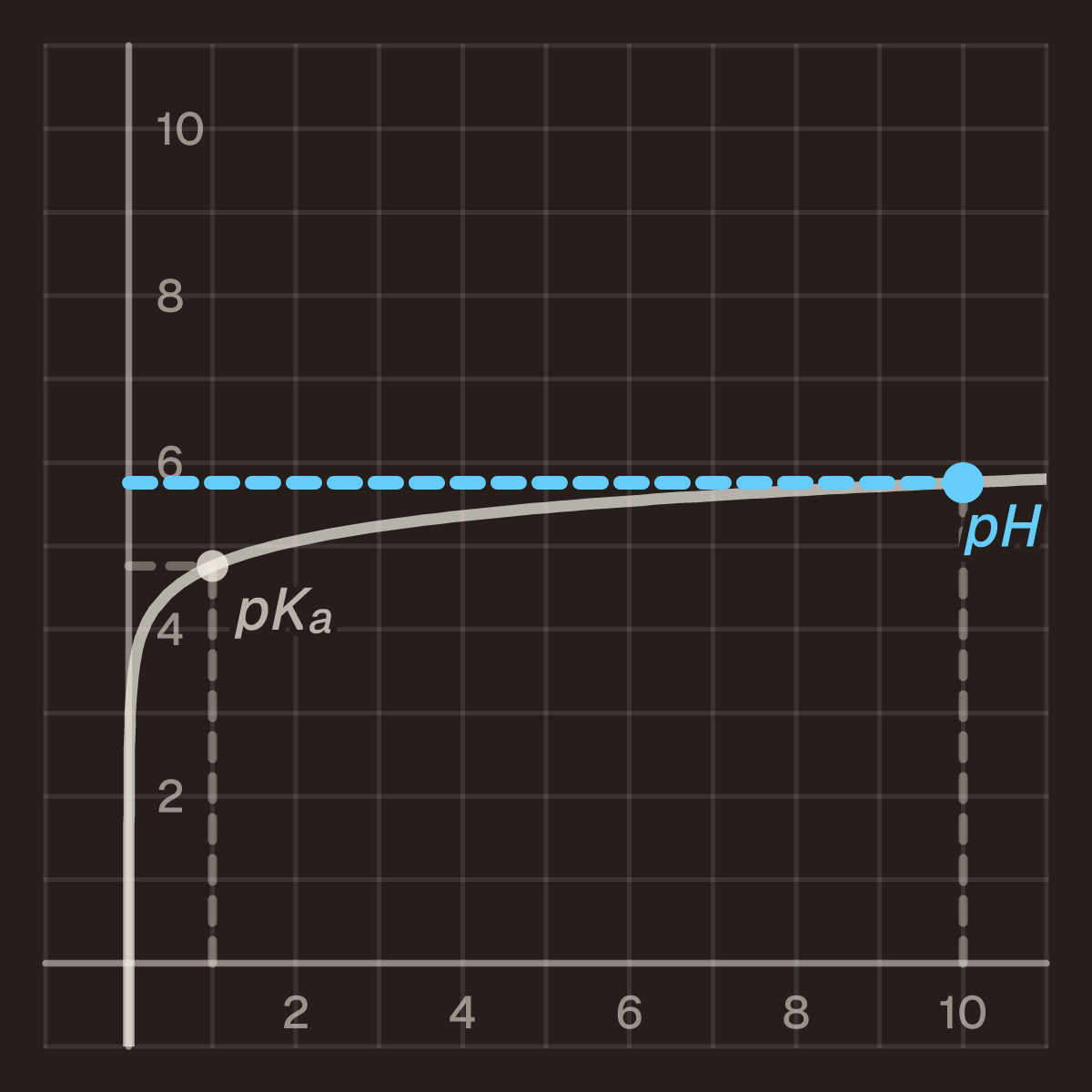
pH=pKa+log([A⁻][HA])

The pH of a buffer is the acid's pKa plus the logarithm of the base-to-acid ratio. Equal amounts of both give a pH equal to the pKa.

Solve for

pH=5.76

pH equals 4.76 plus the logarithm of (1 divided by 0.1) to base 10, equals 4.76 plus the logarithm of (10) to base 10, equals 4.76 plus 1, equals 5.76

Working4 steps

Practice questions

You are given

  • pH=4.75
  • pKa=3.75
  • [HA]=1

The formula

pH = pKa + log([A⁻] / [HA])

pKa belongs to the buffer’s acid, [A⁻] is the concentration of its conjugate base and [HA] that of the acid, both in mol/dm³.

Holds for a buffer of a weak acid and its conjugate base, when the ratio [A⁻] / [HA] lies between about 0.1 and 10 and the concentrations are not too small.

What it says

A buffer is a weak acid mixed with its conjugate base, for example acetic acid and acetate. Add a little acid and the base takes care of it, and the other way round, so the pH barely moves. The formula is the acid dissociation constant rewritten with logarithms. With equal amounts of base and acid, log 1 = 0, and the pH equals the pKa.

Worked examples

The defaults. pKa 4.76, [A⁻] = 1 and [HA] = 0.1: pH = 4.76 + log 10 = 5.76.

Equal parts. 0.1 mol/dm³ of each: pH = 4.76 + log 1 = 4.76. The buffer then takes as much acid as base.

Common mistakes

Frequently asked questions

Where are buffers found in real life? In blood, which is held at pH 7.4 by a buffer of carbonic acid and hydrogen carbonate. A shift of just a few tenths makes a person seriously ill.

Looking for another letter? The formula solved for each one
Solved for each letter
Solve forRearrangedWith the numbersComes to
pKapH−log([A⁻][HA])5.76−log(10.1)4.76
[A⁻][HA]·10pH−pKa0.1·105.76−4.761
[HA][A⁻]10pH−pKa1105.76−4.760.1
pHpKa+log([A⁻][HA])4.76+log(10.1)5.76

Acid dissociation constants

Table

Acid dissociation constants
AcidFormulaTemperature (°C)pKaKa
Strong acids — fully dissociated in water
Perchloric acidHClO₄20−1.640
Hydrochloric acidHCl———
Nitric acidHNO₃———
Sulfuric acid, first stepH₂SO₄———
Weak acids
Oxalic acid, first stepH₂C₂O₄251.250.056
Hydrogen sulfate ion (sulfuric acid, second step)HSO₄⁻251.990.01
Phosphoric acid, first stepH₃PO₄252.160.0069
Hydrofluoric acidHF253.200.00063
Nitrous acidHNO₂253.250.00056
Formic acid (methanoic acid)HCOOH253.750.00018
Hydrogen oxalate ion (oxalic acid, second step)HC₂O₄⁻253.810.00015
Benzoic acidC₆H₅COOH254.2040.000063
Acetic acid (ethanoic acid)CH₃COOH254.7560.000018
Carbonic acid, first stepH₂CO₃256.354.5 × 10⁻⁷
Hydrogen sulfide, first stepH₂S257.058.9 × 10⁻⁸
Dihydrogen phosphate ion (phosphoric acid, second step)H₂PO₄⁻257.216.2 × 10⁻⁸
Hypochlorous acidHClO257.404 × 10⁻⁸
Hydrogen cyanideHCN259.216.2 × 10⁻¹⁰
Ammonium ion (conjugate acid of ammonia)NH₄⁺259.255.6 × 10⁻¹⁰
Hydrogen carbonate ion (carbonic acid, second step)HCO₃⁻2510.334.7 × 10⁻¹¹
Methylammonium ion (conjugate acid of methylamine)CH₃NH₃⁺2510.662.2 × 10⁻¹¹
Hydrogen phosphate ion (phosphoric acid, third step)HPO₄²⁻2512.324.8 × 10⁻¹³

Sources

(2)

Last reviewed October 6, 2026 ·How pages are reviewed

Ready-made worksheets with this formula

Sheets that ask this formula, with their answer keys. Open one to see the questions or print it.

High school

  • pH value

    Six questions on the relation between pH and pOH, six on the pH of a weak acid and four on buffers. Calculator allowed.

  • pKa, pKb and buffers

    Four questions on the relation between pKa and pKb, six on the pH of a weak acid and six on buffers. The first one is worked. Calculator allowed.

Acids and basesAll formulas

Put this formula on your site

Copy the code into your page where the formula card should appear. It loads from lovetocalc.com, so it stays current on its own — all we ask is that the credit line comes with it.